Descrizione
The Benedictine Abbey immerses us in a thousand-year history of saints and ancient civilisations
Seamlessly integrated into the townscape yet towering in all its majesty, the Benedictine Abbey of San Lorenzo in Campo is one of the finest examples of Romanesque-Gothic architecture in the Marche region.
With its interior comprising three naves, the first thing to strike the eye are the enormous columns, as mighty as tree trunks, which rise up and join to form round arches.
One cannot help but be awestruck by the combination of balance and solemnity they convey. The stone, like an enormous book, bears the engraved marks of the Abbey’s history.
Much of the material originally used in its construction came from the Roman town of Suasa. This is evidenced by the capitals decorated with plant motifs, figures of animals or mythological creatures.
The attentive observer will spot the ancient Roman frieze set above a column, depicting an eagle and a shell, whilst even the most inattentive will notice the four columns that differ from the others in colour and material: their origins date back as far as the Egyptian kingdom.
There are also numerous valuable paintings, notably the large altarpiece by Rondolino, which depicts the village of San Lorenzo in the background.
And it is precisely the raised altar that hints at the Basilica’s secret.
Beneath the chancel lies the ancient crypt, where the relics of Saint Demetrius, a Roman martyr from Thessalonica (now Thessaloniki), are kept; his remains were discovered here during restoration work in 1520.
This was a discovery of exceptional historical importance, which led, amongst other things, to the local painter Pietro Paolo Agabiti being commissioned to paint the panel depicting the Madonna Enthroned with the Child, Saint Lawrence and Saint Demetrius.
One detail catches our eye: the pointed arch in the background, which is said to symbolise the two different Churches – the Orthodox and the Catholic – united by the gesture of Jesus.
This bond has become a substantial one, as demonstrated by St Lawrence’s excellent relationship with the Orthodox community, to whom part of the relics of St Demetrius have been returned.
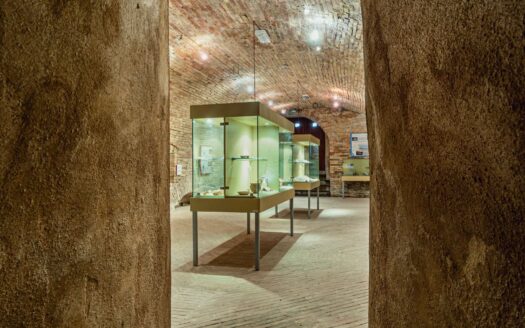
The painting is housed in the antiquarium adjoining the church, which is home to numerous valuable artefacts, amongst which a magnificently inlaid chalice stands out – a gift from Giuliano Della Rovere, the future Pope Julius II.