

6 reasons to visit
Colli al Metauro
A microcosm of excellence nestled between the coast and the peaks of the Furlo Gorge. A landscape of fortresses, monasteries and stately homes, where clay-rich hills and wild woods meet cultivated countryside, yielding unique culinary and wine specialities.
Colli al Metauro was formed in 2017 through the merger of Saltara, Serrungarina and Montemaggiore al Metauro. A new identity that preserves the history of three distinct communities, now united in a shared project of promotion and beauty.
The area is characterised by the waters of the Metauro, the longest river in the Marche region. Described by Torquato Tasso as the ‘glorious son of the Apennines’, the river is the central thread that runs through the valley, bestowing upon it life and centuries-old prestige.
A strategic transit point since ancient times, the town lies where the river meets the ancient Via Flaminia. Commissioned in 220 BC, this Roman road served for centuries as the vital link between the capital and northern Italy.
The presence of these major transport routes has endowed Colli al Metauro with a history rich in pivotal events. These momentous occurrences have blended harmoniously with rural life, without ever severing the deep bond with local traditions.
The locals protect and cherish their land, tilling the fields and honouring the monuments with a quiet determination. It is the strength of those with deep roots, capable of looking to the future with the confidence that comes from a solid and authentic identity.

Discover the beauty of
Colli al Metauro
The Beauty Trail comes to life
Exploring the beating heart of the Marche region has never been easier with Criluma Viaggi!
Romantic weekends, days spent immersed in nature or cultural tours: we’ve put together itineraries to suit all tastes and time constraints.
The Stairway to Heaven
The beauty of ancient fortified villages

Each village in Colli al Metauro retains its own identity and distinctive features, yet together they form a cohesive cluster of historic hamlets, built in accordance with an architectural principle that placed political, religious and economic power in close proximity.
Steep flights of steps serve as the gateway to the centre of each village, a prelude and showcase to what lies ahead.
The staircases in Saltara are particularly famous: long and criss-crossing, they climb the sloping walls from Piazza Garibaldi to lead into the covered market, a unique structure in Italy, bathed in light streaming through its large windows.
In summer, these staircases also serve as a prime spot from which to enjoy the music of the bands performing for Saltarua, an event that attracts artists of great renown. From the market, one looks out over a roof garden, a green balcony guarded by the red dragon, the town’s symbol.

The route continues through the narrow streets surrounding the square, which on Good Friday are traversed by the traditional Procession of the Dead Christ, featuring a procession of locals dressed as ancient Roman soldiers, apostles and craftsmen in an evocative re-enactment that blends religion and folklore.
Finally, you reach the ‘bow’ of the village, which is laid out in the shape of a ship, from where you can see Montemaggiore, which owes its name to Mons Major because of the hill on which it stands.
Here too, you reach the village square via a wide flight of steps.

From this square, dominated by the bell tower, there is a sweeping and magnificent view across the entire Metauro valley as far as the coast. Looking eastwards, towards the opposite bank of the river, you can see Serrungarina, a village whose houses rise in concentric rows up to the main square, home to the old town hall, which is reached by climbing the steps that cut right through the village, branching off into narrow alleyways that offer glimpses of everyday life.
It was here that Renata Cortiglioni, amongst others, was born – the legendary director who founded and led the Rai children’s choir.

The hundred or so churches
The wonders of religious buildings

The ancient villages, the historic heart of Colli al Metauro, are characterised by a thriving religious tradition, which has given rise over the centuries to a large number of churches, rich in history and unexpected works of art.
Suffice it to say that Saltara alone boasted the title of ‘town of a hundred churches’, but the other villages were no less impressive.

It is in Saltara itself that one of the most fascinating buildings stands: the Church of the Gonfalone, the town’s pride and joy, reopened in 2014 following meticulous restoration work that brought to light the fresco of the Last Judgement, situated above the entrance, which depicts, with great evocative power, the weighing of souls that, at the end of time, will determine salvation or damnation.
Also on display are a beautiful painting from the school of Perugino, the ‘Deposition from the Cross’, and a coffered ceiling with hand-painted plasterwork.
The MOS ‘Hall of Mosaics’ in Saltara has been set up within the Church of the Gonfalone; it houses three Roman-era mosaic panels from a domus discovered in the countryside around Colli al Metauro.
Among the other churches in Saltara, the imposing orange façade of the Church of Celestino—which catches the eye as soon as you reach the village—and the Bellinzoni fresco in the Church of the Fonte are particularly striking; gazing at the latter, one feels as though one is stepping into a Renaissance courtyard.

In nearby Serrungarina, meanwhile, the parish church of St Anthony the Abbot is well worth a visit; it houses fine works by two local artists: a painting by Presutti from Fano and one by Guerrieri from Foresmprone, depicting, respectively, ‘The Immaculate Conception’ and ‘The Visitation’ respectively. But churches can also be found outside the town walls, such as the 16th-century church of St Apollonia in the centre of the charming little hamlet of Bargni.

On the other hand, when you reach the top of Montemaggiore al Metauro, the imposing church of Santa Maria del Soccorso, dating from the 15th century, stands in the main square and houses an interesting Baroque-style ‘Last Supper’.

The Paths of Silence
The peace and tranquillity of Colli al Metauro

As we wander through the streets of Colli al Metauro, losing ourselves in the narrow lanes that criss-cross densely to form an ancient labyrinth, or as we stroll along the gravelly paths of the hills, dazzled by the landscapes that unfold before us, we may not realise it.
You need to pause for a moment and close your eyes; only then will you discover it: the silence.
Unaccustomed to it, in Colli al Metauro the air is crystallised in this absence of vibration, which makes you take deep breaths and breathe out your worries.
It is these villages of silence that allow this enchantment, a magical glass bell jar that shuts out all the hustle and bustle.
Even the sounds that break this stillness seem to come from another reality, one that shares in the same magic.
The tolling of the bells sends the little birds fluttering away as they chirp merrily; now and then a cat meows placidly in search of a stroke, or a local greets you courteously, smiling at your look of wonder.
Sometimes you might find yourself spending an hour or two in unbroken tranquillity, leaning against the parapet of the walls and gazing out at the surrounding hills, until your gaze reaches the sea, where you can vividly imagine the sound of the surf.
The people of the Metauro region seem to possess this innate gift of living their lives with composure and respect for their surroundings, aware of how fortunate they are to live in places blessed by nature and history.
A visitor cannot help but adapt with joy, whether climbing the steps leading to the heart of Saltara, Serrungarina and Montemaggiore al Metauro, listening to the sound of their own breathing, or passing through the hamlets of Bargni and Pozzuolo, tiny gems perched atop the hills that have held time in their embrace, where in summer children bathe in open-air wooden tubs, and if you look up, you can see a girl leafing through the pages of a novel amongst the branches of a cherry tree.
Your eyes are filled with wonder and your ears relax.

The river, the scene of great battles
The history of the Metauro and the museum dedicated to Winston Churchill

Soldiers have forded the waters of the Metauro; its banks have been home to military encampments, traces of which can still be seen today in the remains of horse-changing stations and rest stops dotted across the hills.
The river, which has always been regarded as strategically important, was the scene of one of the bloodiest battles in ancient history, between the Roman army and the troops of Hasdrubal, brother of the legendary Hannibal, who lost his life here, crushed by the legionaries’ tortoise formations.

More recently, in 1944, the Metauro Valley was visited by Prime Minister Winston Churchill, who, together with General Alexander, looked out from the square in Montemaggiore al Metauro to take in the view of the valley below.
It was from here, on the night of 25 August, that the breakthrough of the Gothic Line – the last bastion of Nazi resistance – began; this line was finally crushed on 5 January 1945.
The memory of those days, as well as being commemorated in the ‘Era ieri’ historical re-enactment held in August, has been painstakingly and passionately preserved within the Winston Churchill Metauro River Historical Museum, which houses, within a deconsecrated church, bullets and military uniforms from the period, original flags and historical photographs depicting the wary Churchill conferring on military tactics with Alexander, and newspaper clippings from those days recounting the events that took place.
This momentous event, decisive for the fate of the nation, still fills the inhabitants of the Colli with pride to this day; amongst them, perhaps, there may still be a great-grandchild of Comrade Nello, a heroic partisan who intercepted a German soldier poised to ambush Churchill, thereby changing – perhaps without realising it – the course of all future history.
The hospitality with which the people of Metaura welcomed Churchill can be savoured in the traditional recipe for tagliatelle dedicated to him, cooked with a simple meat sauce that echoes the one Mrs Marietta served to the Allied soldiers who burst into her kitchen, overcoming her surprise and fear by putting the rules of good hospitality first.

Balì Science Museum
Do not touch!

Just north of Saltara stands the Villa del Balì, a beautiful 18th-century building reached via a long avenue shaded by cypress trees, in whose shade it is said that the ancient philosophers debated the great questions of the universe.
Built around a chapel dedicated to Saint Martin dating back to the year 1000 – the setting for tales of ghosts – inside the villa, superstition gives way to scientific rigour, revealing the Balì Museum, a modern interactive Science Centre and a shining example of Italian excellence. This is a museum whose philosophy is ‘you must NOT touch’, as interactivity is its strong point: a tour of the nine galleries consists of hands-on experimentation at more than 40 stations showcasing scientific phenomena and experiments of various kinds.
An original and entertaining way to engage with science, perfectly suited to light, child-friendly education but also highly interesting for adults, who… THE TYPICAL FLAVOURS OF THE HILLS: From heavenly pears to ancient liqueurs. When you fancy a refreshment after long walks, in Colli al Metauro you can sit down in one of the many traditional little restaurants and leisurely savour an assortment of characteristic local produce, the result of carefully monitored cultivation, rooted in the values of respect for the consumer and product quality.
It is no easy task to list all the outstanding products the area has to offer, such as the prized olive oil and the fresh Bianchello del Metauro wine, which come from the splendid olive groves and vineyards that dominate the landscape; in November, the landscape is further enriched by the colourful expanse of flowering chrysanthemums, a crop typical of the area.

There are also strong-flavoured cheeses, traditional pasta such as cappelletti and passatelli, and warm baked goods such as maritozzi and pan nociato. But the Serrungarina Angelica pear certainly deserves a special mention, as it is recognised as a traditional product of the Marche region.
It is a fruit that fully lives up to its name. As the chrysanthemums bloom, the people of Montemaggiore al Metauro rediscover their curiosity about the great phenomena of physics and compete with the little ones over the many installations.
The museum is enhanced by an 8-metre-diameter planetarium: on its dome, visitors can admire the spectacle of the night sky, travel as if in a spaceship through distant galaxies and land on planets at astronomical distances from our Earth, all without leaving their comfortable seats.
But the Balì Museum does not merely reproduce the stars virtually. In the villa’s grounds, visitors can go in search of the moon and the sun from the vantage point of the mighty astronomical observatory.
The main telescope, a 40-cm-diameter Ritchey–Chrétien, bridges the gap between us and the universe, allowing us to see celestial bodies as if they were truly within reach.

The traditional flavours of the hills
From heavenly pears to vintage liqueurs
When you want to recharge your batteries after a long walk, in Colli al Metauro you can sit down in one of the many traditional little restaurants and leisurely savour a selection of characteristic local produce, the result of carefully monitored cultivation practices rooted in a commitment to consumer respect and product quality.
It is no easy task to list all the exceptional produce the area has to offer, such as the fine olive oil and the fresh Bianchello del Metauro wine, which come from the splendid olive trees and vines that dominate the landscape; in November, this landscape is further enriched by the colourful expanse of flowering chrysanthemums, a crop typical of the area.
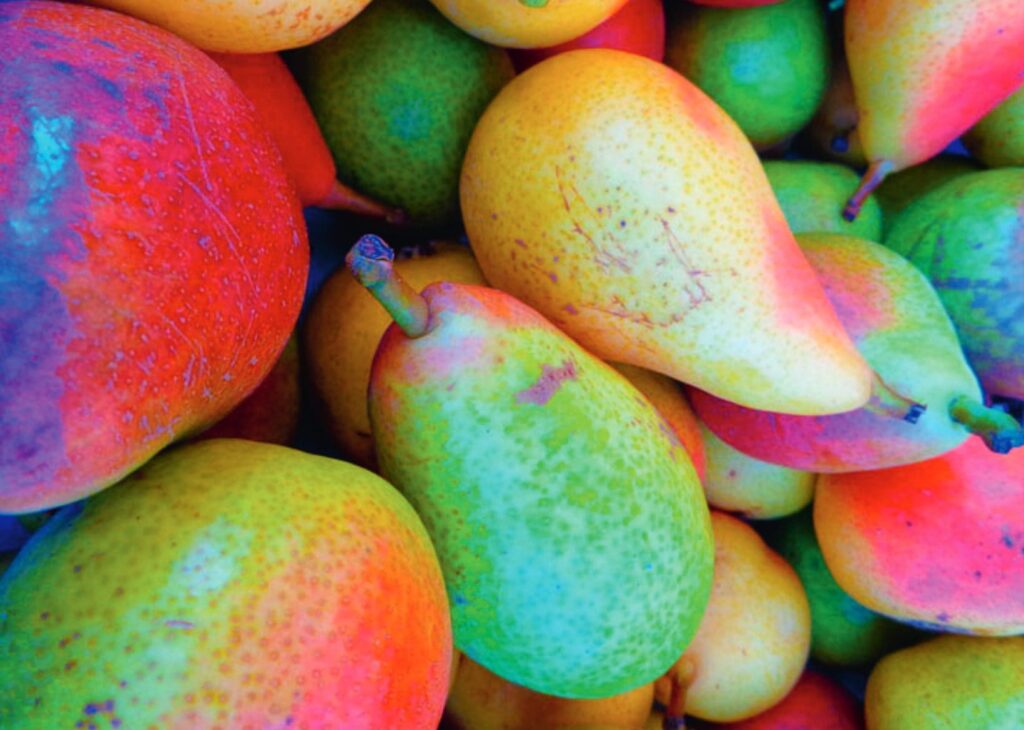
There are also cheeses with a strong flavour, traditional pasta such as cappelletti and passatelli, and warm baked goods such as maritozzi and pan nociato. But the Serrungarina Angelica pear certainly deserves a special mention, having been recognised as a traditional product of the Marche region. It is a fruit that fully lives up to its name.
Indeed, the sweet, flavourful juice that flows from the delicate white flesh – hidden beneath a skin reminiscent of the colours of the sky at sunset, with gold fading into the brightest red – seems almost otherworldly.
The farmers of Metaura have always tended these unique orchards with unwavering care, preserving them with the hard work and love characteristic only of those who have always dedicated themselves to the land. During the festival of the same name in Serrungarina in early September, you can sample the Angelica in its various forms and uses, from grappa to ravioli, jams and desserts.
Equally heavenly is the Liquor d’Ulivi from Giuliano Berloni’s organic farm, which has always been distinguished by the high quality of its products, underlined by its firm commitment to organic farming. It is Dante who mentions this liqueur during his journey through Paradise in his *Divine Comedy*, through the words of Saint Peter Damian, who lived not far from the Berloni estate. It is a liqueur made by infusing olive leaves and bark in alcohol, with the addition of sugar and only natural flavourings, using a traditional production process that lasts several months and results in a liqueur with a sweet, balsamic flavour that can be enjoyed neat, chilled or warmed.


Discover the beauty of Colli al Metauro
The Beauty Trail comes to life
Exploring the beating heart of the Marche region has never been easier. Criluma Viaggi is proud to bring to life the ‘Itinerario della Bellezza’ project by Confcommercio Marche Nord, transforming a guide to excellence into real-life itineraries, ready for you to experience.
Romantic weekends, days spent immersed in nature or cultural tours: we’ve created itineraries to suit all tastes and time constraints. The Criluma experience is the added value that guarantees you first-class treatment, comprising continuous support, personalised attention and immediate responses.