
6 reasons to visit
Corinaldo
Nestled between the blue waters of the Adriatic and the green peaks of the Apennines, Corinaldo proves to be a destination of the highest calibre. A village that surprises visitors with its uniqueness, where the splendour of its historical heritage blends with a hilly landscape of rare harmony.
The imposing, perfectly preserved Renaissance walls form a veritable open-air museum. Every step along the fortified perimeter tells a story of defence and resilience, inviting visitors to immerse themselves in a past that is in constant dialogue with the present.
Known as the ‘Town of Art and Faith’, Corinaldo has a deep connection with Saint Maria Goretti. The shrine dedicated to her and the former Augustinian convent offer an emotional journey through devotion and spirituality, making the town a key destination for religious tourism.
Historical celebrations bring the village to life with institutional rigour and popular enthusiasm. The famous “Contesa del Pozzo della Polenta” brings the medieval past to life through historical processions and competitions between neighbourhoods, transforming the streets of the town centre into a stage for identity and remembrance.
Corinaldo celebrates its uniqueness with the ‘Festa dei Folli’, honouring its historic title of ‘City of Fools’ through art and humour. In October, the town takes on a new look for Halloween, enveloped in a magical and enchanting atmosphere that attracts visitors from all over Europe.
The experience is rounded off at the table with the authentic flavours of local tradition. The delicious ‘pecorelle’, sweet treats that symbolise the region’s authenticity, embody the character of a land that invites you to be captivated by endless views and timeless culinary delights.

Discover the charms of Corinaldo
The Beauty Trail comes to life
Exploring the beating heart of the Marche region has never been easier with Criluma Viaggi!
Romantic weekends, days spent immersed in nature or cultural tours: we’ve put together itineraries to suit all tastes and time commitments.
Town Hall
From the Picture Gallery to the Hall of Costumes and Folk Traditions
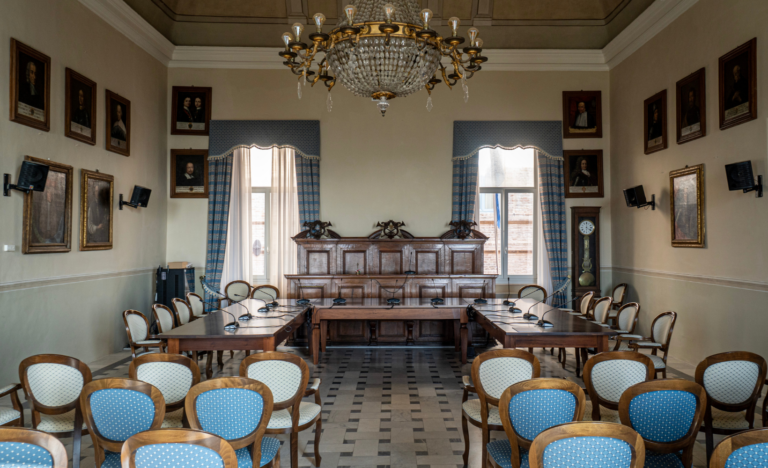
As you walk through the corridors and state rooms of the Palace, you can admire the works in the prestigious municipal picture gallery, a collection of portraits spanning three centuries of art, from the sixteenth to the eighteenth century. These works, donated by the noble families of Corinaldo, bear witness to the town’s rich artistic heritage. Among the masterpieces on display, the portrait of Monsignor Pietro Agostino Boscarini stands out; it has recently been attributed to the famous painter Carlo Magini from Fano.
Another notable work is the portrait of Blessed Pope Pius IX, painted by the Corinaldo-born artist Domenico Berardi. These artistic treasures further enhance the palace’s charm, making it an unmissable destination for anyone wishing to discover the historical and cultural soul of Corinaldo.In the cellars, another surprise awaits visitors: the Hall of Costumes and Folk Traditions. This space houses the ducal costumes used during the historical re-enactment of the ‘Contesa del Pozzo della Polenta’, a tradition deeply rooted in the town’s collective memory.
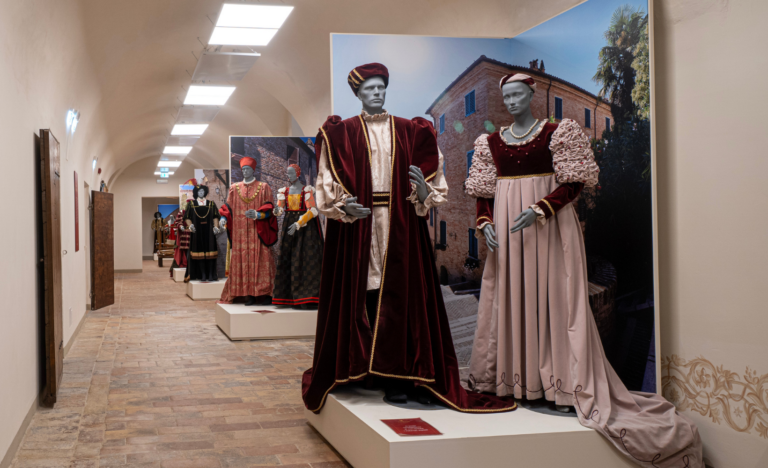
The costumes, crafted each year by the district that wins the Palio, represent just a fraction of a vast sartorial heritage comprising over 500 costumes, including those of nobles, heralds, armigeri and commoners. Here you will also find painted ‘palii’, tools for working with fabrics and a replica of the legendary ‘Cannone di Fico’, a reference to a historic Corinaldo legend.
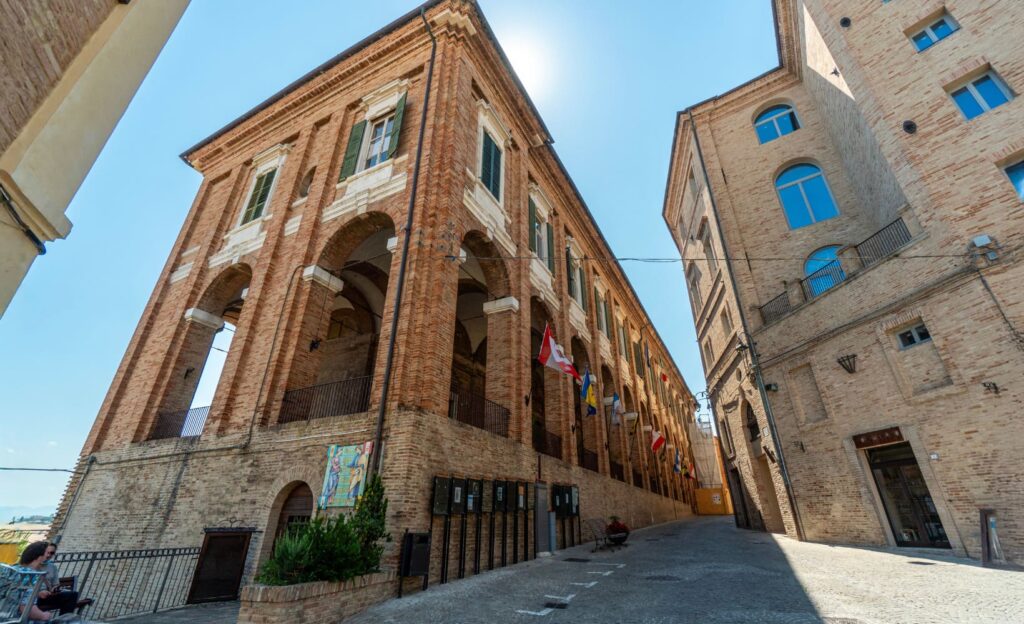
As you stroll along the historic Via del Corso in Corinaldo, the majestic Town Hall immediately catches the eye with its grandeur and charm. This building, a symbol of the town in the Marche region, is not merely an administrative centre, but a true guardian of local history and culture. Its current structure, built between 1784 and 1791 by the Fano-born architect Francesco Maria Ciaraffoni, with subsequent alterations by Giuseppe Brunelli, stands on the foundations of an ancient Renaissance palace.
Its neoclassical forms reflect the transition from Baroque opulence to 18th-century simplicity, with elegant arches and windows set on pedestals that create evocative plays of light and shadow. From the eastern loggia, the view stretches as far as the Apennines, offering a breathtaking panorama of the Marche countryside. Upon entering the palace, one steps into a veritable treasure trove of historical and artistic treasures.
The Art Gallery
Masterpieces of painting, relics and the secrets of the Picene civilisation
The Art Gallery, housed in the ancient church of San Nicola, is a treasure trove. At its heart lies the Claudio Ridolfi Municipal Art Collection, dedicated to the Venetian painter who made Corinaldo his source of inspiration.
His works, characterised by a style that combines the spirituality of the Counter-Reformation with the precursors of the Baroque, are complemented by works by other masters such as Ercole Ramazzani, Gaspare Gasparini and Domenico Peruzzini, whose masterpieces dating from the 16th to the 18th centuries enrich the exhibition. The collection also includes sacred and devotional objects from local churches.
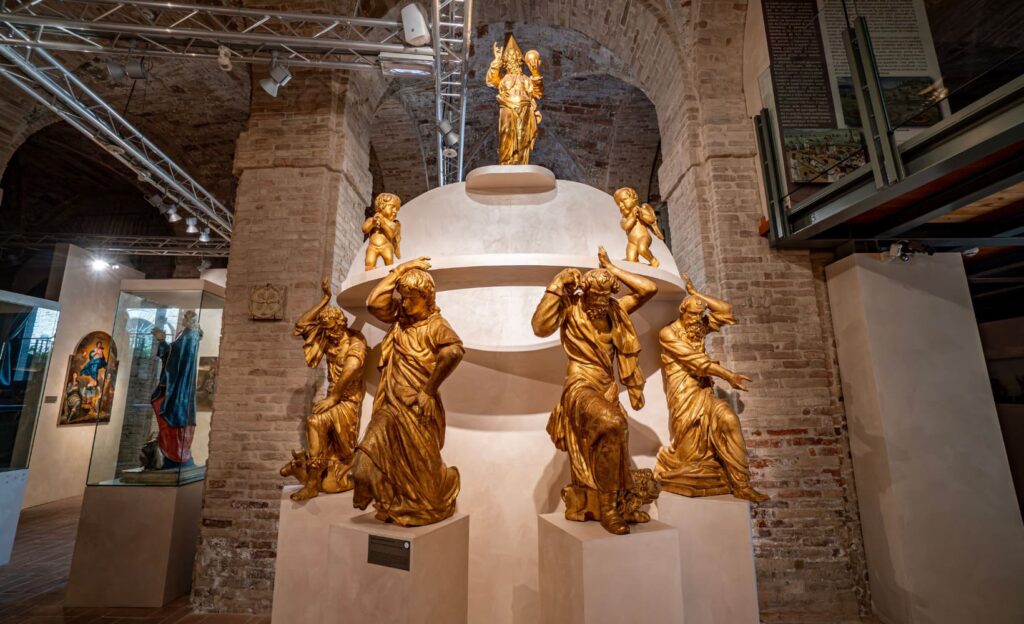
Among the most remarkable works are a number of exquisite 17th-century reliquary busts, probably crafted by a Sicilian woodcarver. Brought to Corinaldo by Fra Bartolomeo Orlandi, together with a parchment attesting to their authenticity, these busts bear witness to the deep bond between faith and art.
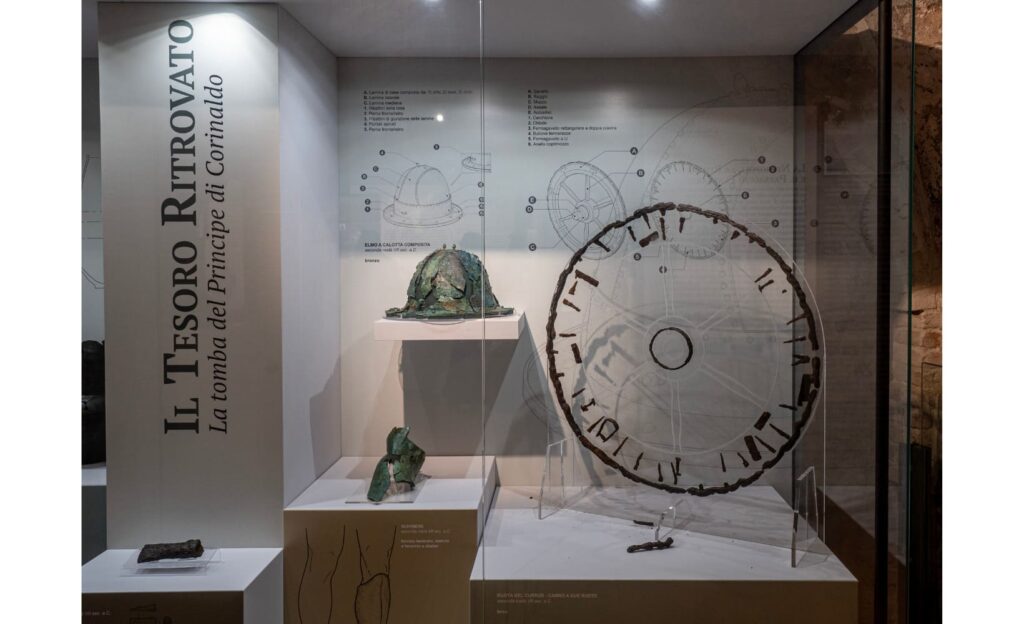
Another treasure housed in the Art Gallery is the Tomb of the Picene Prince, an archaeological discovery from 2018 that sheds light on the Picene civilisation of the 7th century BC, which also settled in this part of the region.
A selection of twelve artefacts is on display, including a finely restored helmet, a greave and a chariot – symbols of military, political and economic power. The utensils for the funeral banquet, such as containers for food and drink, skewers and brazier stands, evoke the sacred ceremonies associated with the burial and the life of the deceased.
Each artefact speaks to the greatness of this historical figure and the rich symbolism of his era, offering a unique insight into life and death in antiquity
The heart and soul of the Augustinian convent
The library and its commitment to women
The Augustinian Convent, built between 1767 and 1789 by the architect Giuseppe Carbonari Giminiani, is one of the city’s most iconic landmarks. This historic complex, with its elegant internal courtyard in the style of Borromini, embodies centuries of history, culture and change.
Originally conceived as a religious centre, the convent served as a spiritual, educational and social hub for the Corinaldo community.
The convent housed spaces dedicated to prayer, as well as areas for education and assistance to the needy, reflecting the Augustinians’ mission to combine faith with social commitment. During the 19th century, with the suppression of religious orders and the redistribution of church property, the complex underwent profound changes. Some parts were adapted for new secular uses, whilst others were integrated into community life, confirming the symbolic and practical value of the site. Today, the former convent is one of Corinaldo’s most important cultural centres.
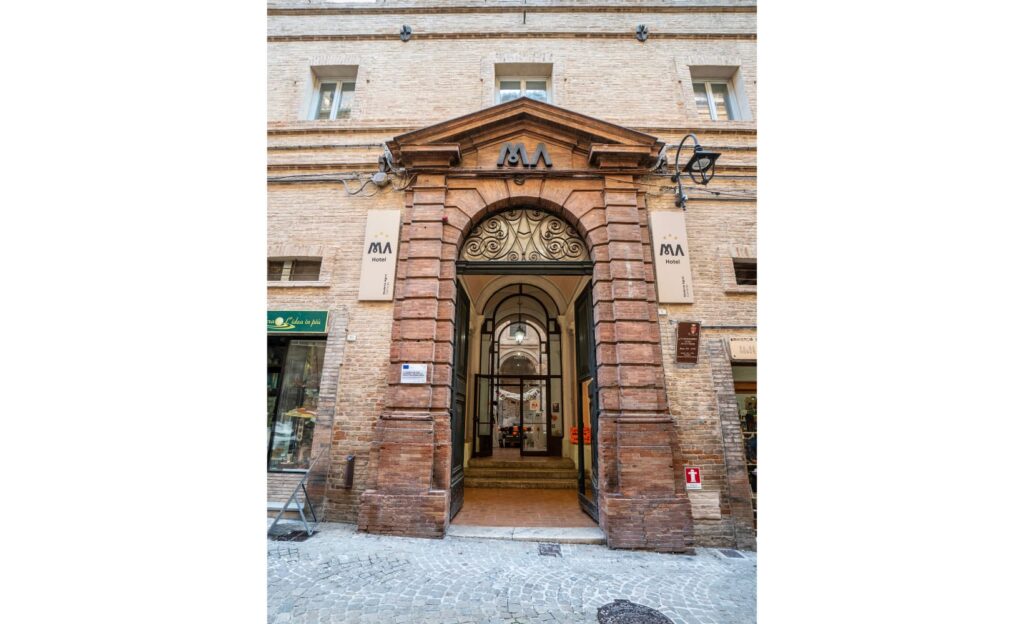
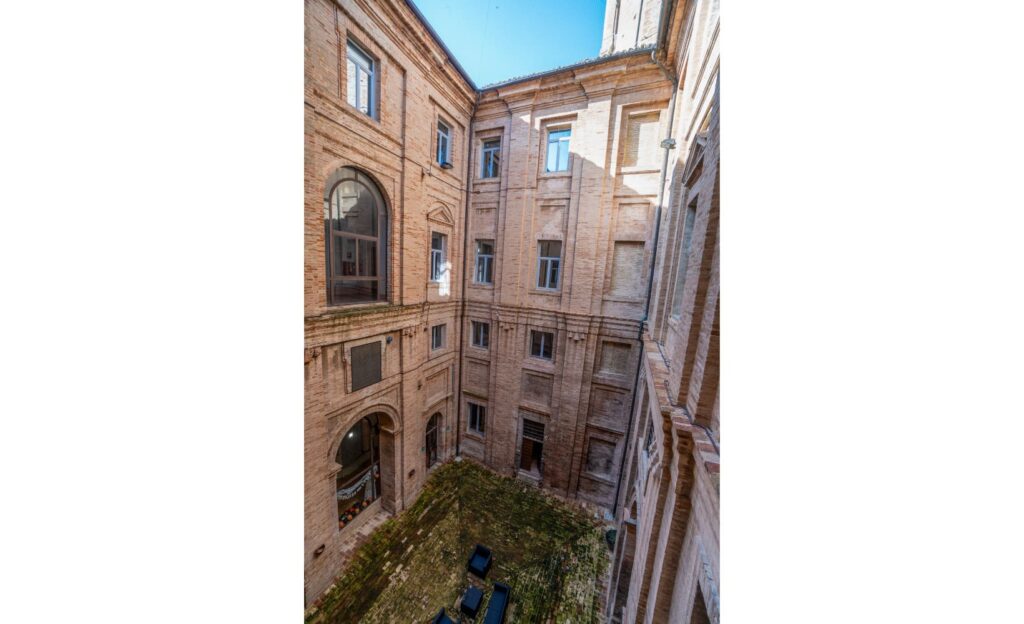
In 2021, the convent became home to the MA – Moderna Agorà project, the City of Corinaldo’s Palace of Culture, an innovative vision that reimagines the complex as a contemporary public square for the city. This multi-purpose space houses venues for events and exhibitions, as well as the Santa Maria Goretti International Study Centre, dedicated to women and inspired by the figure of Saint Maria Goretti. The Centre was established with the aim of promoting the role of women in society, raising awareness of gender-based violence and stimulating cultural reflection through research, education and awareness-raising activities.
Also housed within the MA is the Municipal Library, a dynamic space that blends history and modernity. As well as collaborating with schools and providing study spaces for pupils, the library serves as a hub for knowledge dissemination and reflection for local communities. Events, exhibitions and pop art installations bring the spaces to life: among these is an interactive exhibition dedicated to women who have shaped the history of science, enhanced by QR codes that recount their stories, transforming the entrance staircase into a unique educational experience.
An open-air museum
Amidst walls, towers and staircases
Strolling through Corinaldo is like stepping into an open-air museum, where every corner tells stories of defence, power and traditions. The village, encircled by its imposing Renaissance walls, is one of the best-preserved in Italy and stands as a rare example of a fortified town, with a perimeter of 912 metres and a maximum height of 18 metres. Built in the 14th century and extended between 1480 and 1490, the walls showcase a veritable catalogue of military architecture, featuring machicolations, arrow slits, loopholes, parapet walkways, towers and monumental gates.
The undisputed symbol of the walls is the Torre dello Sperone, a mighty pentagonal structure probably designed by the Sienese architect Francesco di Giorgio Martini. Standing approximately 18 metres tall, the tower offers a spectacular view over the Marche countryside and now houses a memorial dedicated to the victims of all wars. Alongside it, other towers such as the Torre dello Scorticatore, the Torre del Mangano and the Torre del Calcinaro tell stories of sieges and everyday life.
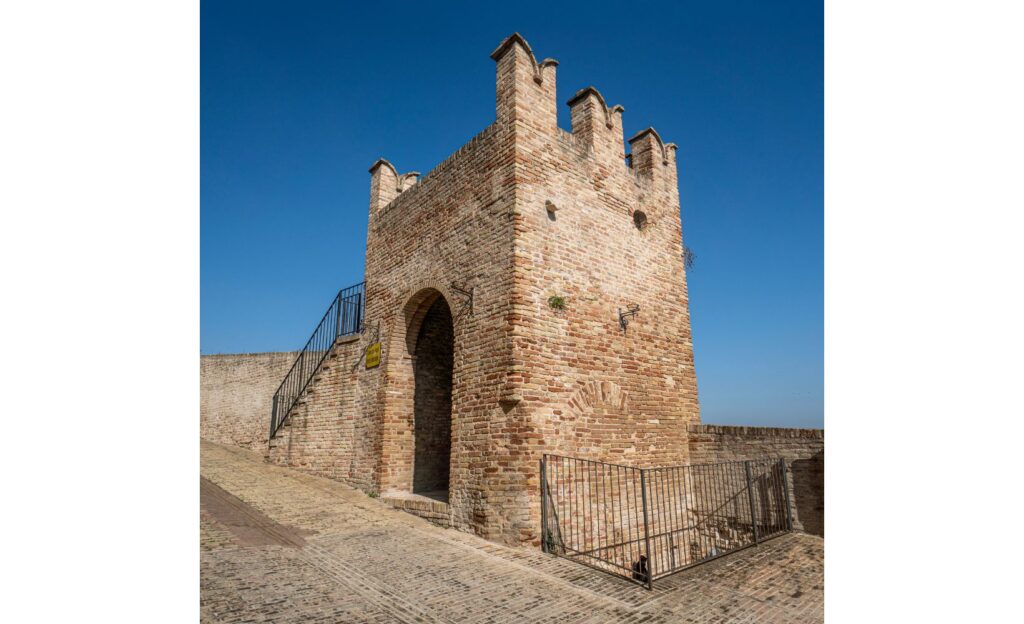
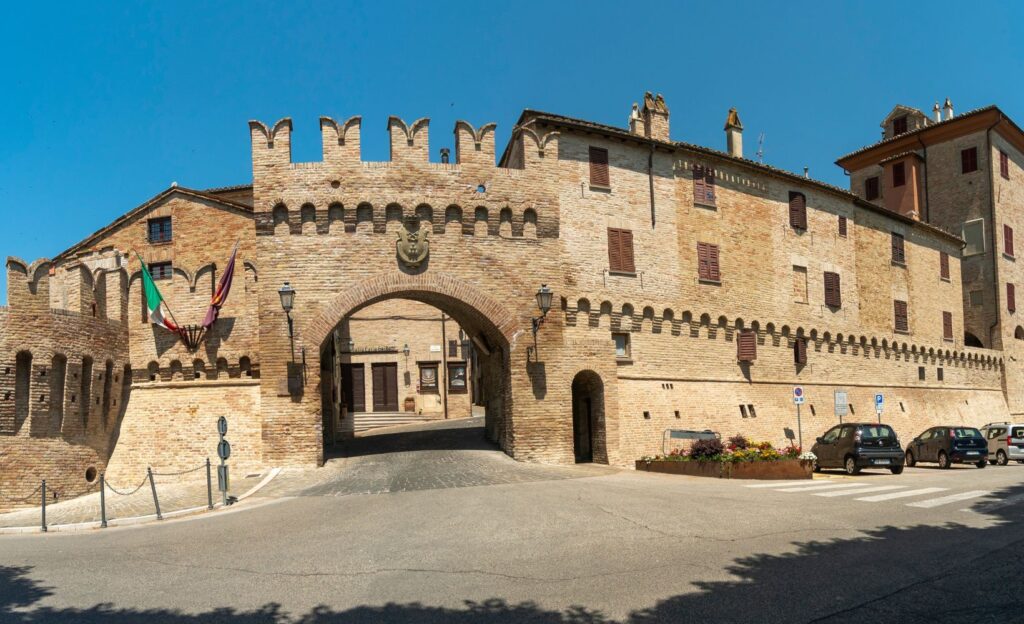
The village’s three main gates – Porta San Giovanni, Porta Santa Maria del Mercato and Porta Nova – are true architectural gems. Porta San Giovanni still retains defensive features such as the ‘bianchetta’, a small gate for night-time access, and traces of a drawbridge. Porta Santa Maria del Mercato, a majestic defensive complex, combines 14th-century arches with 15th-century polygonal structures. Porta Nova, built during the Renaissance expansion, was modified in the early 20th century to allow vehicles to pass through.
Amidst the characteristic towers and gates lie the ‘landroni’, a colonnaded corridor created by raising the height of the 17th-century stately buildings. The undisputed symbol of the village is the Piagga staircase. Here stands the famous Pozzo della Polenta, linked to a charming legend: a man, whilst climbing the steps with a sack of flour, dropped it into the well, giving rise to the tale of polenta in the well and fuelling the gossip that has made the people of Corinaldo famous as ‘polentari’. Today, the well and the staircase are icons of local tradition. Rounding off the picture, Viale Dietro le Monache, lined with lime trees, offers a panoramic view of the walls, weaving nature and architecture together into a unique experience.
The Shrine of Saint Maria Goretti
Faith, history and spirituality
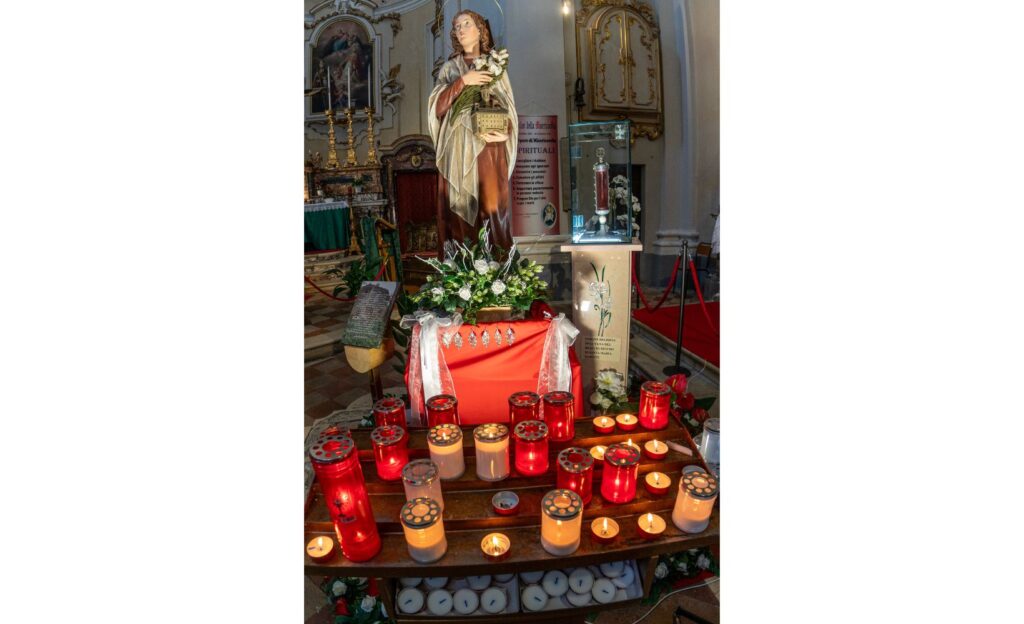
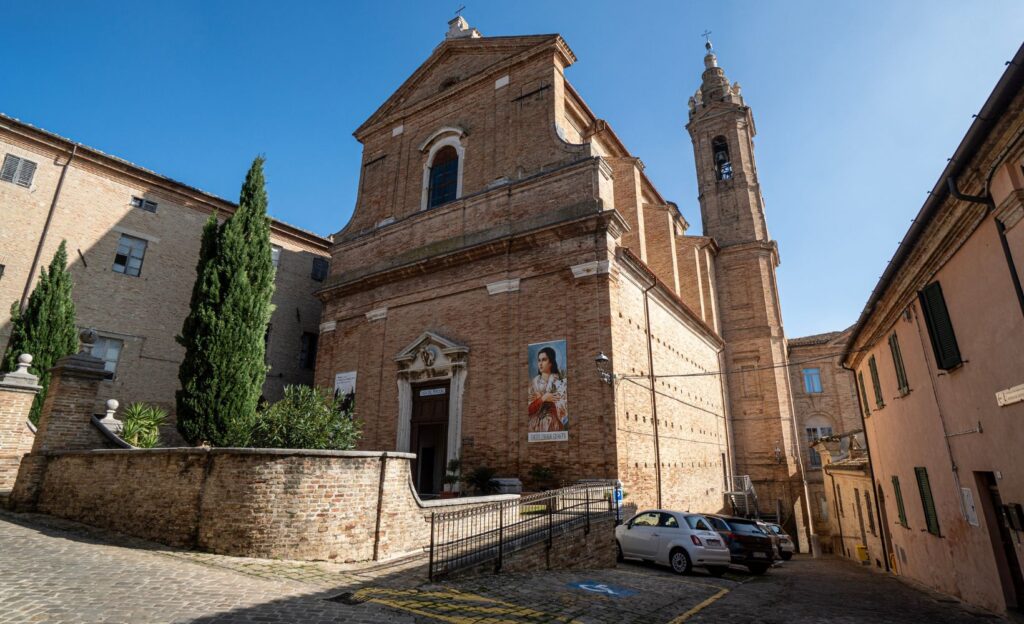
Its connection with Saint Maria Goretti makes Corinaldo a world-renowned religious centre. Born here in 1890, Maria led a simple and devout childhood, before moving with her family to the Pontine Marshes. It was there, in 1902, that the young girl was tragically murdered whilst defending her purity. Her canonisation, which took place in 1950 at the hands of Pope Pius XII, established her as a symbol of forgiveness and deep faith. The Diocesan Shrine of Saint Maria Goretti, formerly known as the Church of Saint Augustine, is the spiritual heart of the village.
Built between 1740 and 1756, it features an elegant brick façade embellished with pilasters and limestone details. The interior, with a single nave and a Latin cross plan, is a refined example of Baroque architecture, with the play of light enhancing the dome and the lantern.
Among the works of art housed here, the highlights include a 17th-century copy of the Annunciation by Federico Barocci, a Martyrdom of Saint Bartholomew by Cesare Maggeri and a Madonna and Child with Saints by Carlo Maratta. Above the entrance door, a wooden choir loft houses a fine organ dating from 1767, the work of the renowned Gaetano Antonio Callido.
The high altar, carved from white Carrara marble, features a wooden statue of Saint Maria Goretti and a silver urn containing the bone from the arm with which the young girl attempted to defend herself against her attacker. Also laid to rest here are Mamma Assunta, the saint’s mother, and Alessandro Serenelli, her repentant murderer, whose story of redemption is an integral part of the message of forgiveness that Maria left as her legacy.
The journey to discover the saint continues with a visit to her birthplace, in Contrada Pregiagna. This rural cottage, nestled in the countryside, still preserves some of the Goretti family’s original furnishings. A short walk away, the Sanctuary of the Madonna dell’Incancellata, where Maria used to go to pray as a child, brings this intimate and moving journey to a close.
A shining example of a vibrant community
Events, Theatre and the delightful ‘little sheep’
A vibrant social fabric where traditions and a sense of community intertwine. As you stroll through the streets and past the monuments, you can sense the strong bond between past and present, nourished by events that celebrate the town’s identity and heritage. The Contesa del Pozzo della Polenta is one of Corinaldo’s most iconic events. Inspired by the siege of 1517, it celebrates the arrival of the Duke of Urbino and the town’s resilience in the face of Francesco Maria Della Rovere. The districts compete in traditional games, accompanied by a historical procession featuring 16th-century costumes created by local tailors – true masterpieces of craftsmanship.
The ‘palii’ (banners), painted by local and internationally renowned artists, reflect the community’s commitment to preserving its cultural heritage. The Festa dei Folli, an ironic and playful festival, celebrates the town’s nickname as the ‘City of Fools’ with a colourful race in which participants are showered with vibrant coloured powder. The famous ‘madman’s passport’ and stories such as that of the Cannone di Fico, which humorously recounts the rivalry with the neighbouring town of Ostra Vetere, or that of Scuretto, the cobbler who built only the façade of a house to deceive his son who had emigrated, add a unique touch to the local folklore.
Also not to be missed is the famous Halloween Festival, which transforms Corinaldo into one of Italy’s Halloween capitals. The village comes alive with spooky decorations, theatre performances, costume parades and markets. The evocative atmosphere of the medieval walls illuminated by pumpkins offers a unique experience, celebrating the community’s ability to innovate without losing touch with its roots.
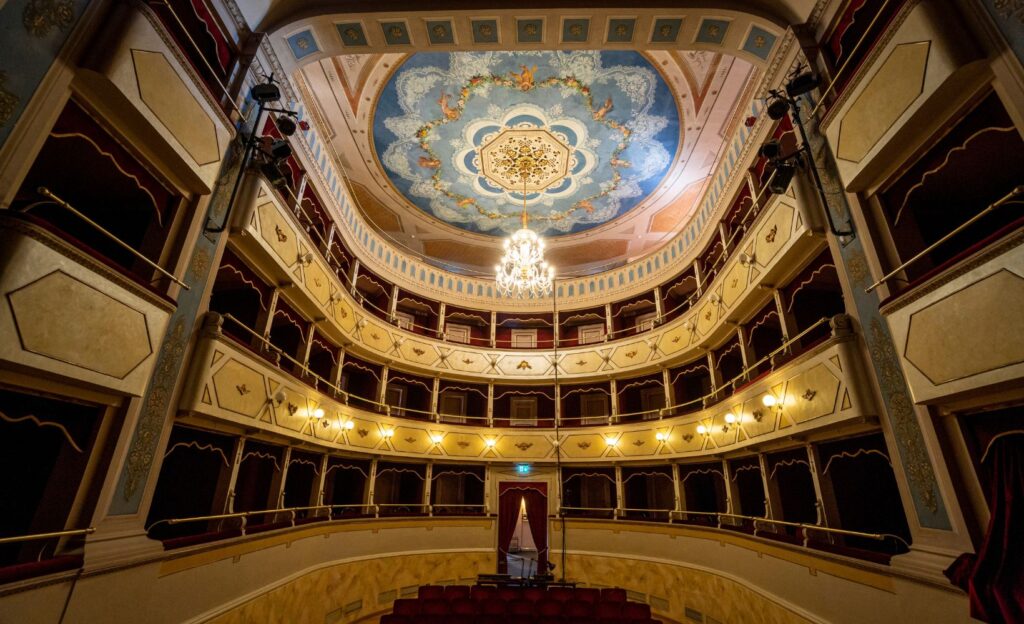
Rounding off the town’s cultural landscape, the Carlo Goldoni Theatre stands as a symbol of Corinaldo’s artistic vibrancy. Built between 1861 and 1869, this nineteenth-century gem, with its stalls, three tiers of boxes and a gallery, serves as a hub for socialising and cultural innovation. Carefully restored, the theatre hosts a rich programme of performances, events and exhibitions, blending tradition and modernity. You cannot leave Corinaldo without sampling one of its specialities: the delicious ‘pecorelle’. This traditional Christmas sweet can be found in the village bakeries almost all year round – a symbol of flavour and tradition that perfectly embodies the warmth of the Corinaldo community.

Discover the charms of Corinaldo
The Beauty Trail comes to life
Exploring the beating heart of the Marche region has never been easier. Criluma Viaggi is proud to bring to life Confcommercio Marche Nord’s ‘Itinerario della Bellezza’ project, transforming a guide to excellence into real-life itineraries, ready for you to experience.
Romantic weekends, days spent immersed in nature or cultural tours: we’ve created itineraries to suit all tastes and time constraints. The Criluma experience is the added value that guarantees you first-class treatment, comprising continuous support, personalised attention and immediate responses.