
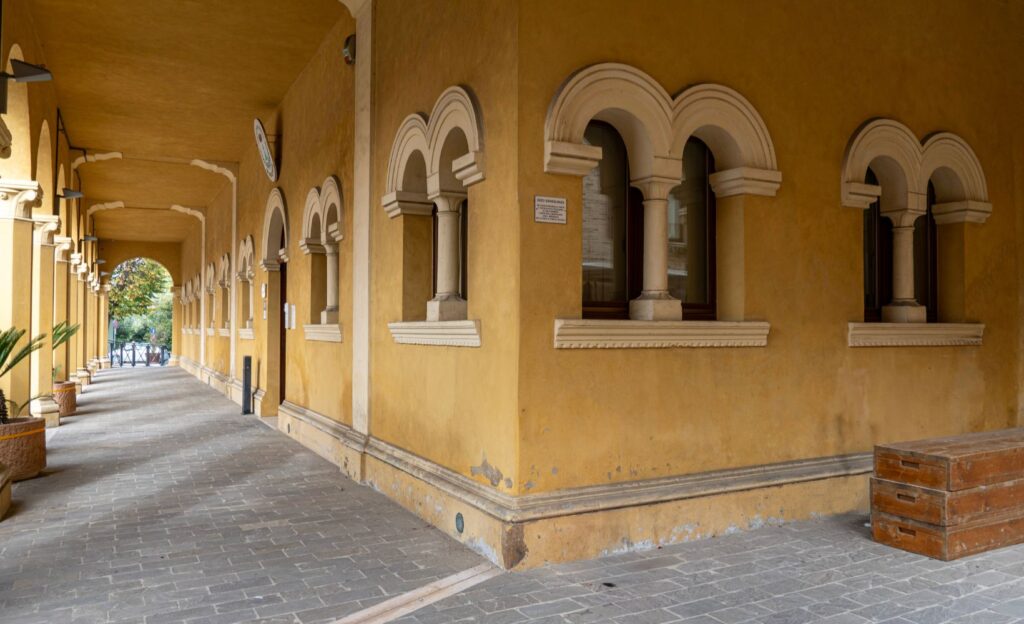
6 reasons to visit
San Costanzo
San Costanzo stands like a natural balcony between the Metauro Valley and the Cesano Valley. From its walls, the view stretches from the contours of the Apennines to the azure line of the Adriatic, offering a perfect synthesis of the beauty of the Marche region: a village where the sea breeze meets the tranquillity of the hills.
The village has ancient roots, dating back to the Iron Age, as evidenced by the valuable artefacts from the Picene necropolis. Over time, the settlement evolved into an imposing medieval castle, traces of which can still be seen in the steep alleyways, the arches and the walls that encircle the heart of the historic centre.
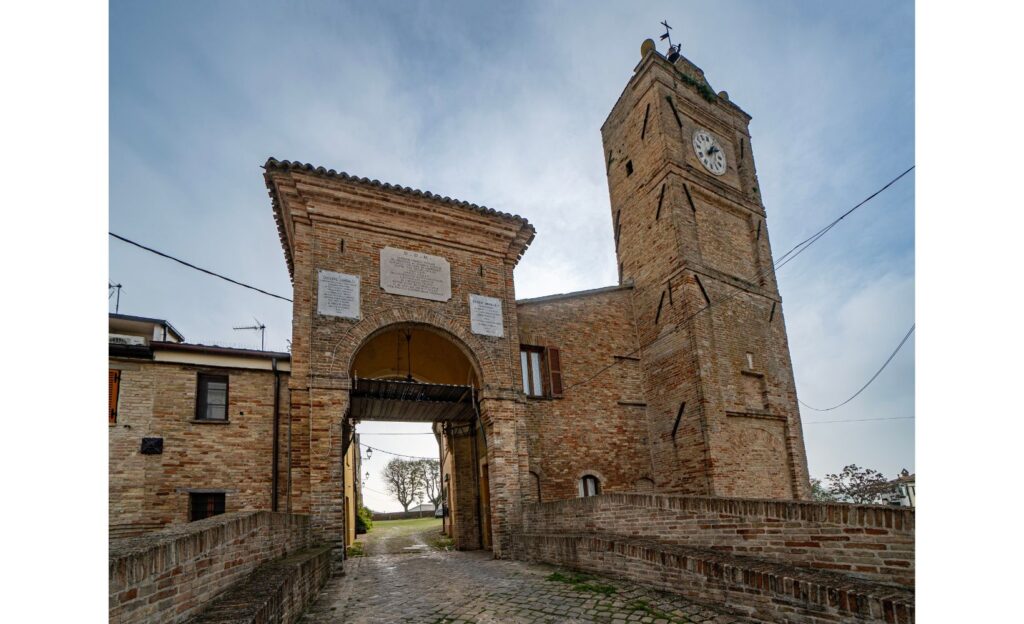
The heart of town life is Piazza Perticari, a harmonious space where history takes the form of architecture. Dominating the square are the Bell Tower, an ancient defensive bastion, and the Collegiate Church, home to treasures of sacred art and centuries-old relics that bear witness to the devotion of a community proud of its origins.
A true gem of the village is Palazzo Cassi, a historic noble residence and literary salon that once hosted distinguished intellectuals such as Giulio Perticari. Today, the palace, with its Picture Gallery and Archaeological Hall, serves as a guardian of history and a cultural hub, welcoming visitors into rooms of extraordinary elegance.
Nestled within the tower of the Roveresco Palace, the Teatro della Concordia is a unique symbol of local history. A small and exquisite acoustic gem, it boasts a rare feature: the chance to catch a glimpse of the sea directly from the stage, seamlessly blending the art of theatrical fiction with the beauty of the real landscape.
San Costanzo celebrates its identity through the Sagra Polentara, the oldest festival of its kind in the Marche region, having been held over two hundred times. From traditional flavours, such as the famous dishes prepared by the master polenta-makers, to the atmosphere of the Valle dei Tufi, the village offers an authentic sensory experience steeped in history and hospitality.

Discover the charms of San Costanzo
The Beauty Trail comes to life
Exploring the beating heart of the Marche region has never been easier with Criluma Viaggi!
Romantic weekends, days spent immersed in nature or cultural tours: we’ve created itineraries to suit every taste and every time commitment.
The History of San Costanzo
From the Picene Necropolis to the splendour of the Renaissance
San Costanzo, a charming village in the Marche region, boasts a history stretching back a thousand years, with its roots in the Iron Age. Between the 8th and 6th centuries BC, these lands were inhabited by the Piceni, a people devoted to agriculture, hunting and sheep farming, who left behind one of the most significant necropolises in the Marche region, which was partially excavated in the 1920s.
During the Roman period, San Costanzo occupied a strategic position, as evidenced by the numerous archaeological finds unearthed there. It is thought that the Roman garrisons, during the famous Battle of the Metauro against Hasdrubal, passed through these lands coming from Senagallica, now known as Senigallia. In the 15th century, the castle of San Costanzo became an important stronghold under the Malatesta family, who erected the village’s defensive walls, which were reinforced in 1429 by the people of Fano to prevent a Visconti invasion.
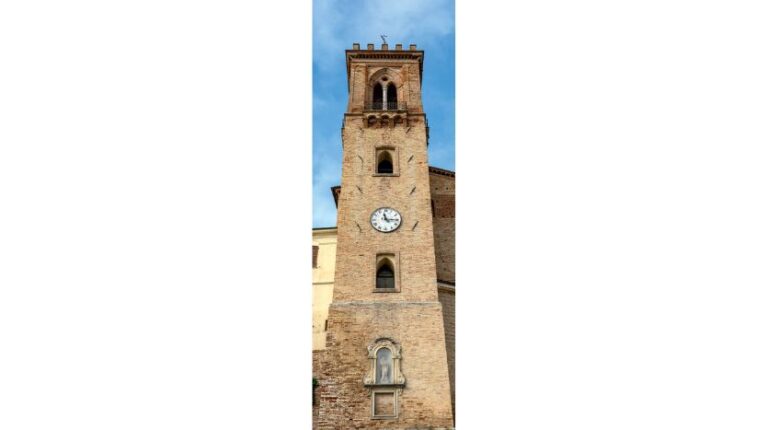
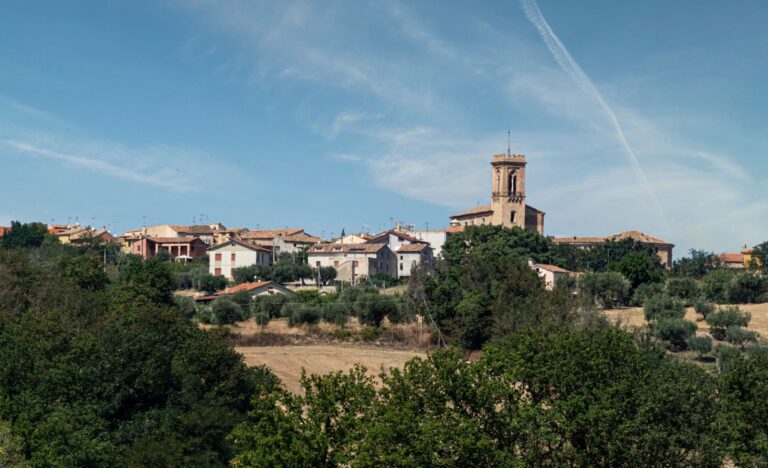
Between the 14th and 15th centuries, the village came under a succession of rulers, but the urban consolidation and the upgrading of the fortifications are attributed to Giovanni della Rovere, as indicated by the gunports engraved with ‘IO DUX’. The walls, characterised by cylindrical towers and an internal spiral staircase known as ‘la lumaca’, display a coherent urban layout and functional consistency. After a series of ups and downs, in 1520 San Costanzo came under the rule of the Papal States, taking on the Renaissance layout still visible in some of its elegant stately buildings.
The entrance to the village is adorned by the fountain in the square, built in 1904 to celebrate the first joint-venture aqueduct. Built from local limestone, the fountain – initially criticised for failing to meet the water needs of the countryside – is now a symbol of the town, having been restored and fitted with a recirculation system. In Piazza Perticari, visitors can admire the bell tower – once part of the town’s defences – the collegiate church and the Malatesta walls, which bear witness to the historical and cultural importance of this village.
Palazzo Cassi
“University of Italic Wisdom”
Palazzo Cassi, situated in the heart of San Costanzo, is an elegant historic residence of extraordinary cultural and architectural significance, a symbol of the village’s noble and intellectual tradition. Built in the 18th century by the Cassi family of Pesaro as a summer residence, the palace is the result of the harmonious union of three residential units: Palazzo Mei, purchased by Count Francesco Cassi in 1814, and two palaces previously belonging to the Diotallevi family. Francesco Cassi, an enlightened patron of the arts, transformed this residence into a veritable cultural centre, dubbing it the ‘Ateneo d’Italica sapienza’ (Academy of Italic Wisdom) due to its frequent visits by artists and intellectuals.
Among its illustrious guests was Giulio Perticari, a celebrated man of letters, who spent the final days of his life in one of the palace’s rooms, where he passed away in 1822, leaving an indelible mark on the cultural history of San Costanzo, along with his wife Costanza Monti, daughter of the renowned poet Vincenzo Monti. Until a few years ago, the building housed the San Costanzo Town Hall, but following a thorough restoration, completed in 2013, it has been returned to the community as a vibrant cultural and social centre. On the ground floor are the ‘A. Betti’ municipal library, a media centre and rooms dedicated to conferences and exhibitions.
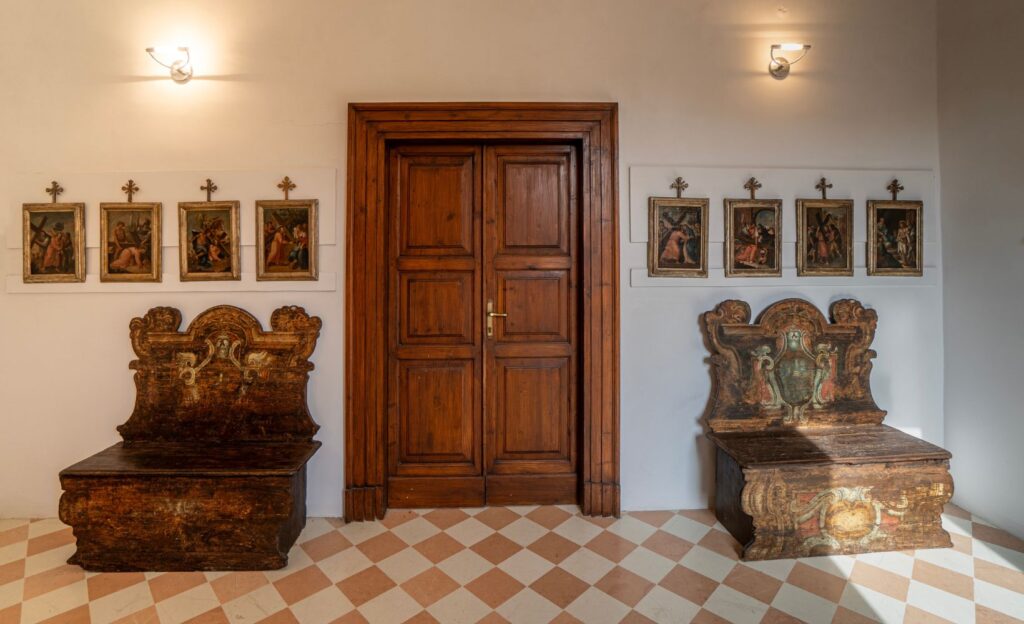
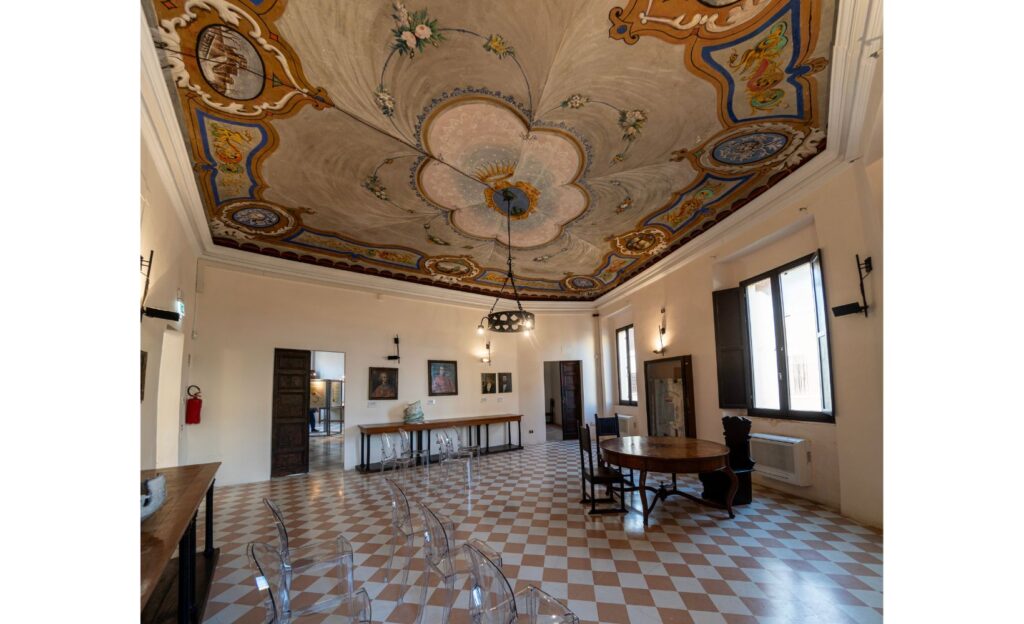
The first floor, known as the ‘piano nobile’, houses an art gallery featuring works from the 16th to the 18th centuries, including paintings of ecclesiastical origin such as *The Baptism of Emperor Constantine* by Terenzio Terenzi, known as ‘il Rondolino’, and a fresco depicting the Madonna and Child, which is currently undergoing conservation work.
The latter, originating from the Cemetery Church, displays stylistic features reminiscent of ‘Pierfrancescan’ influences. Among the historical curiosities, a papal bull issued by Fra Raphael Riphoz – one of the inquisitors in the trial of Galileo Galilei – stands out, as does the Napoleonic Room, which houses lithographs relating to the transfer of Napoleon Bonaparte’s remains.
This floor also houses a section dedicated to protohistoric settlements and the Picene necropolis, with artefacts dating back to the 7th and 8th centuries BC. On the second floor are the “Maschere del Castello” (Castle Masks), unique creations by the designer Anna Lorenzetti inspired by tarot cards and the medieval Three Kings, as well as a collection of works by Roberto Natale Patrizi, known by his artistic name Agrà, depicting landscapes of the hinterland.
Rounding off the cultural programme is a photographic exhibition curated by Paolo Alfieri, documenting rural life and local traditions. The charming, renovated inner courtyard hosts concerts and cultural events, reinforcing Palazzo Cassi’s role as a guardian of historical memory and the hub of cultural life in San Costanzo.
The spiritual soul
The Legacy of the Augustinians
San Costanzo, once a hub of vibrant religious life, boasted a spiritual heritage centred around numerous churches, including the Church of Sant’Agostino, an emblematic example of faith, art and history. The Augustinians’ presence in San Costanzo dates back to before 1445, with a convent initially situated on Monte Campanaro.
Subsequently, to foster closer ties with the local population, the old convent was demolished and rebuilt alongside a new church in 1610, thanks to the generosity of Count Pietro Barbetta and the local community. The church, dedicated to Mary, Queen of Heaven, and St Peter, is known as the Church of St Augustine.
Completed in 1617, its façade features a sandstone plaque commemorating the benefactors. Inside, there are five altars adorned with fine stucco work and paintings inspired by Augustinian spirituality, including depictions of the Crucifix, the Virgin Mary, Saint Augustine and Saint Nicholas.
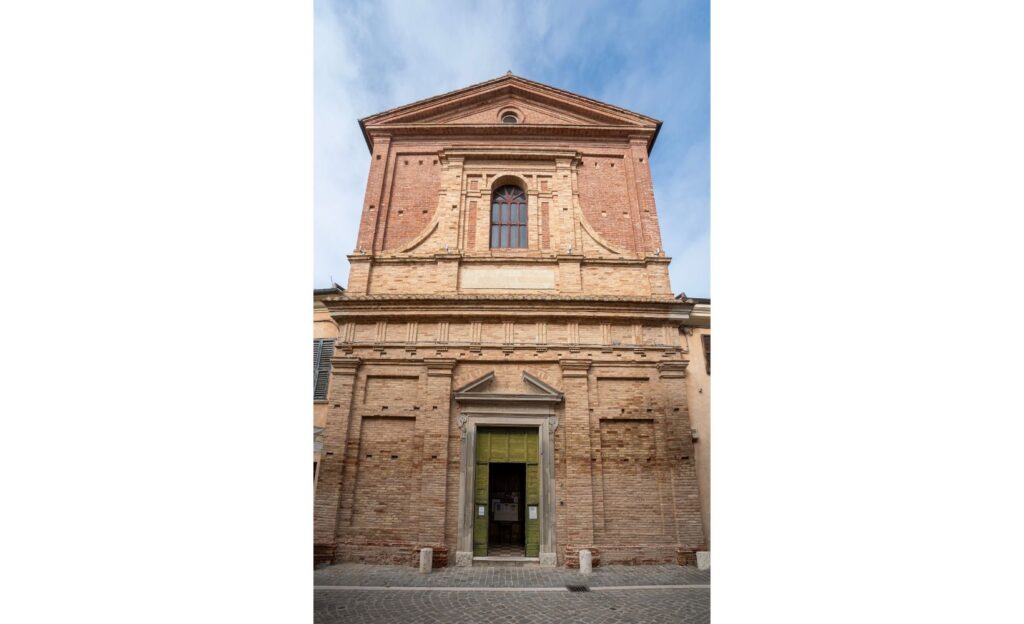
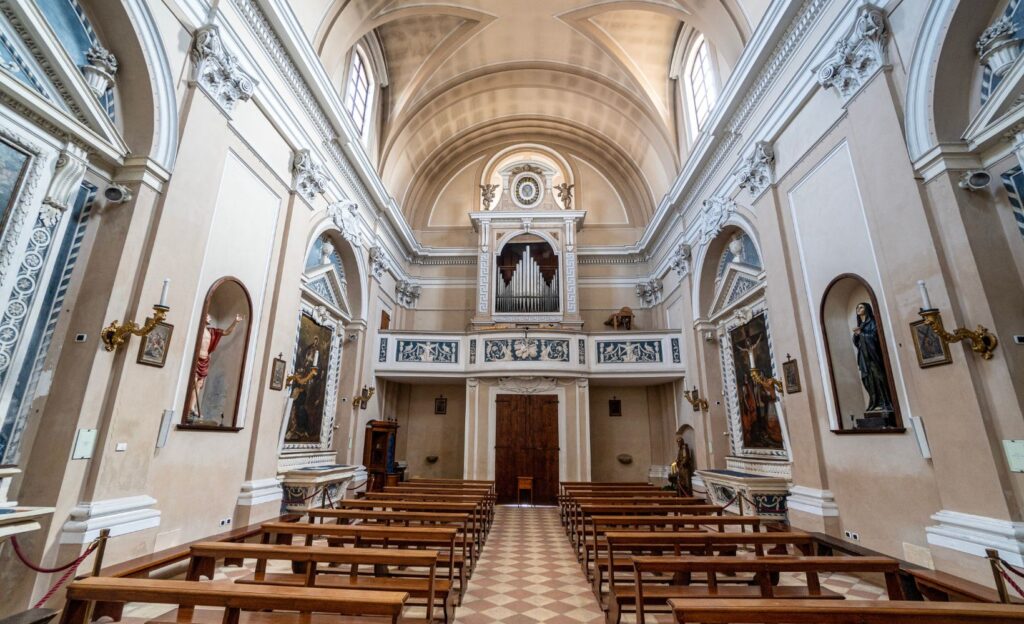
The marble high altar is surmounted by a painting depicting the Handing Over of the Keys to Saint Peter, whilst in the chancel there are two large canvases by Giuseppe Ceccarini: a ‘Miracle of Saint Nicholas of Tolentino’ and the ‘Tomb of Saint Augustine’. Of particular note is the ‘Crucifixion’ painted by Ceccarini in 1785, situated on the first altar on the left, beneath which stands a wooden ‘Dead Christ’ from 1826 by Filippo Reali, a pupil of Canova. Among the church’s highlights is also an organ by Gaetano Callido, dated 1785, which dominates the choir loft. As well as its artistic beauty, the church is at the heart of religious celebrations, such as the evocative Good Friday procession, during which the statues of the Dead Christ and Our Lady of Sorrows are carried through the streets of the village.
During Holy Week, the ‘Machina del Monte Calvario’ is set up, a representation of the Passion of Christ featuring papier-mâché statues painted in oil. The church also preserves the traditions of the Confraternities of Our Lady of the Belt and of the Good Death, which have contributed over the centuries to the care and enhancement of the site. Despite the suppression of the convent in 1811 during the Kingdom of Italy, the church remained open for worship and continues to be a bastion of spirituality and culture in San Costanzo.
The Concordia Theatre
Theatre with a sea view
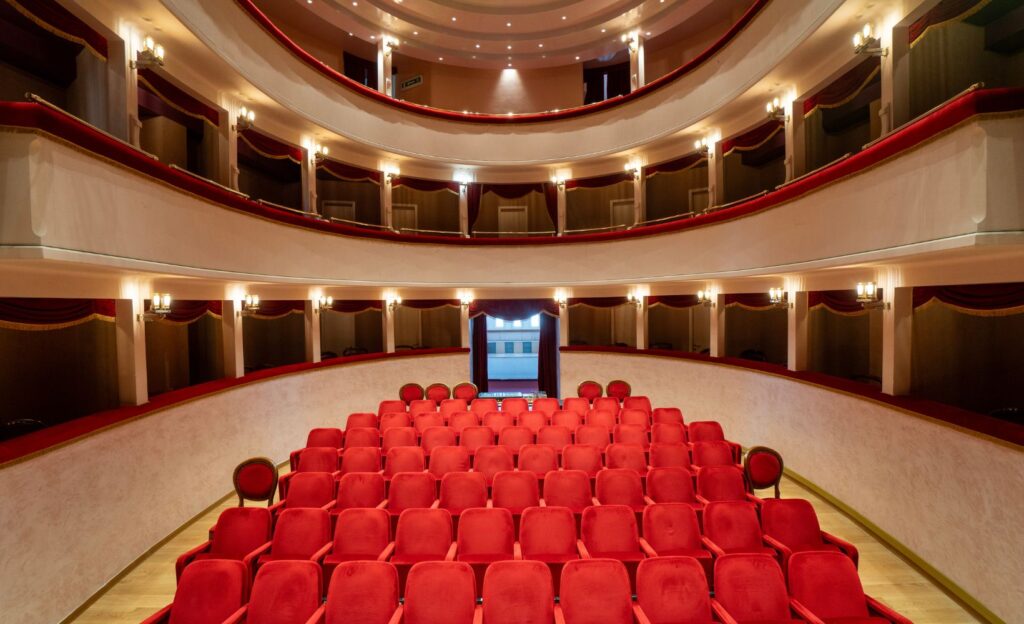
The Teatro della Concordia in San Costanzo, nestled within the ancient tower of the Roveresco palace, is a symbol of local culture and history.
Created in 1721 within a hall in the south-eastern residential wing of the castle – originally intended for community celebrations – it boasts a long tradition, with documents attesting to theatrical activity there as early as that period. Its horseshoe-shaped layout, with two tiers of boxes and a gallery, reflects the changes it has undergone over time, including major restorations, the last of which was completed in 1987 and proved decisive for its reopening and revitalisation as a venue for cultural events.
In 1778, the theatre hosted the musical comedy *I Viaggiatori* by Pasquale Melilotti, set to music by Nicolò Piccini, whilst Filippo Nicolini, Kapellmeister of Mondavio, played the lead role of Giancostanzo. Among the leading performers was Giambattista Cenerini from Sancostanza, first violinist ‘de’ Balli’.
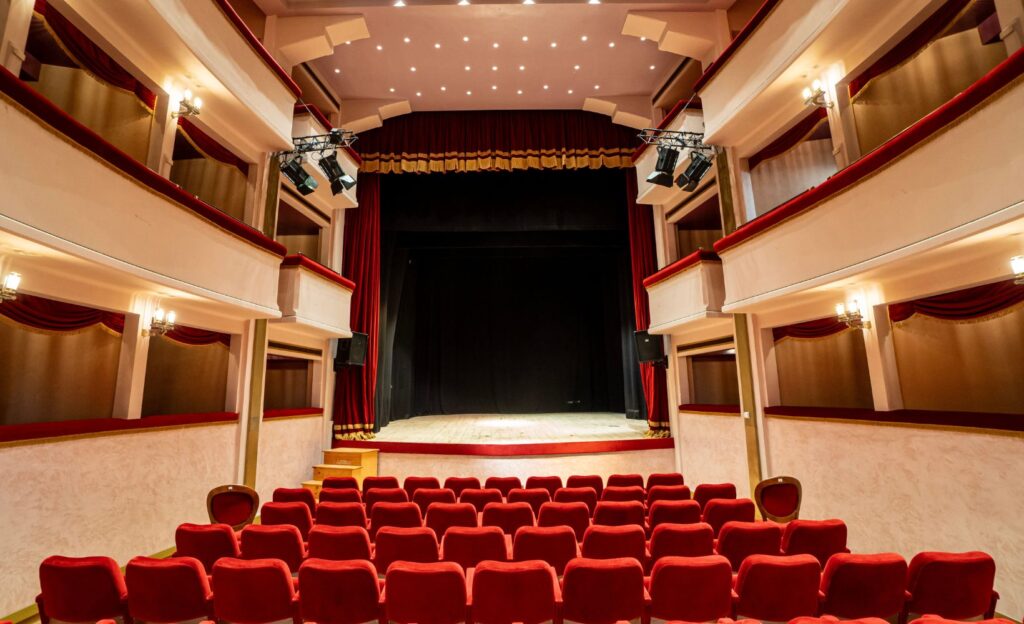
The opera, dedicated to Monsignor Carlo Livizzani, President of the Legation of Urbino, confirmed the theatre’s role as a centre of artistic production. The libretto of the play, preserved in the Biblioteca Federiciana in Fano, bears witness to the cultural vibrancy of the theatre in the 18th century.
The cosy and intimate auditorium offers a unique experience thanks to its extraordinary location, which allows the audience to admire the Adriatic Sea from the stage. This panorama, stretching as far as the eye can see, adds a breathtaking natural element to the scenic charm, which is particularly striking by day. This distinctive feature makes the theatre not only a place of culture but also a major tourist attraction.
The theatre has suffered various instances of damage over the years, including a fire that resulted in the loss of stage props, such as a painted curtain depicting a Triumphal Entrance. Despite this, it has been restored through targeted interventions, albeit at the cost of some of its original appearance. Today, the Teatro della Concordia is a vibrant cultural centre, with a programme ranging from drama to music and family shows, cementing its role as the beating heart of the community.
Nature and traditions come together
Gruccione: unique views and historic festivals
The San Costanzo area is also renowned for its historical and nature trails, such as ‘Up and down the valleys’, the Flaminia-Cesano walking trail and the “Valle dei tufi”, which wind through the Metauro and Cesano valleys, offering a chance to immerse oneself in the natural beauty and local agricultural history. Along the route, in the shade of centuries-old oak trees, visitors can enjoy snacks and traditional delicacies offered to them by the master polenta-makers.
On the nature trails, as well as observing the flora and fauna, you can admire a rich variety of birdlife, notably the European bee-eater. This splendid bird, with its vibrant colours – yellow, green, blue and brown – is one of the symbolic species of the Tufo Valley.
It nests along the tuff cliffs, digging tunnels in the sandy soil and forming bustling colonies during the breeding season. This distinctive feature is sure to catch the eye of birdwatchers and nature lovers alike.
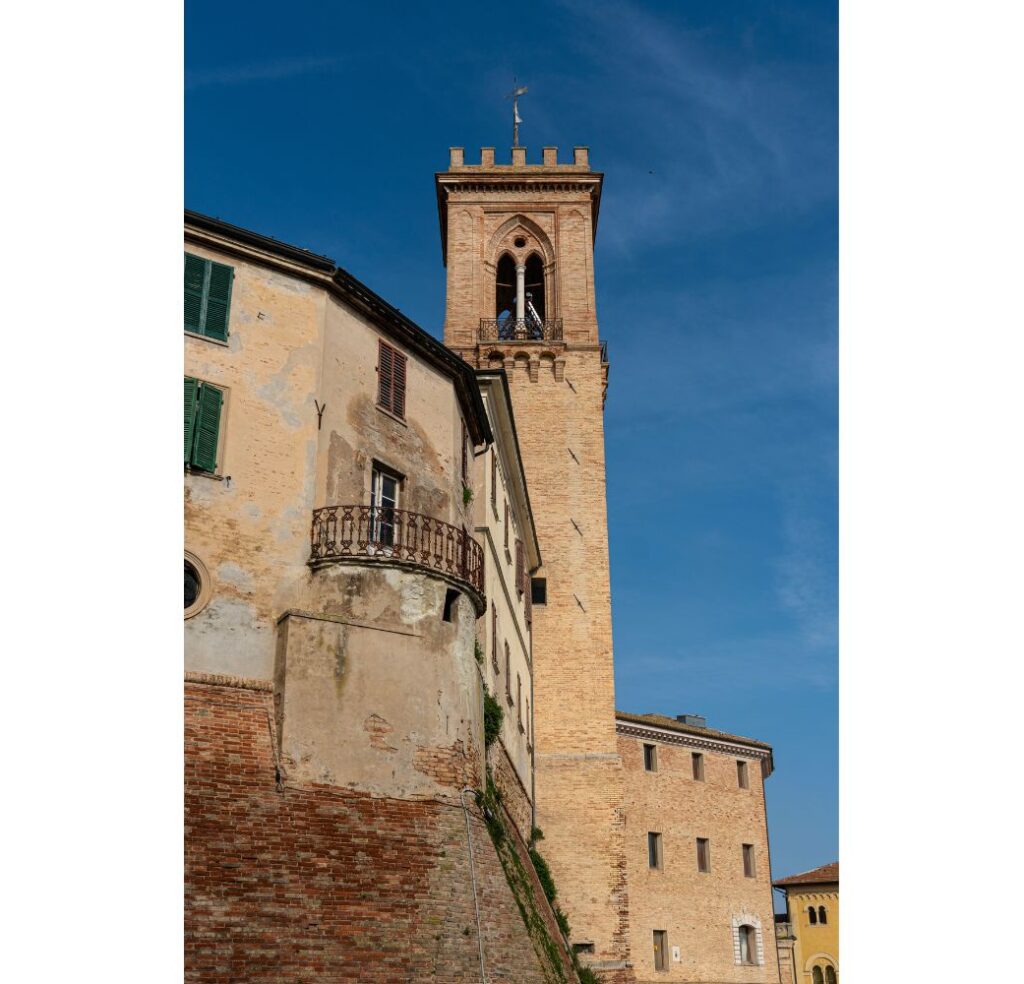
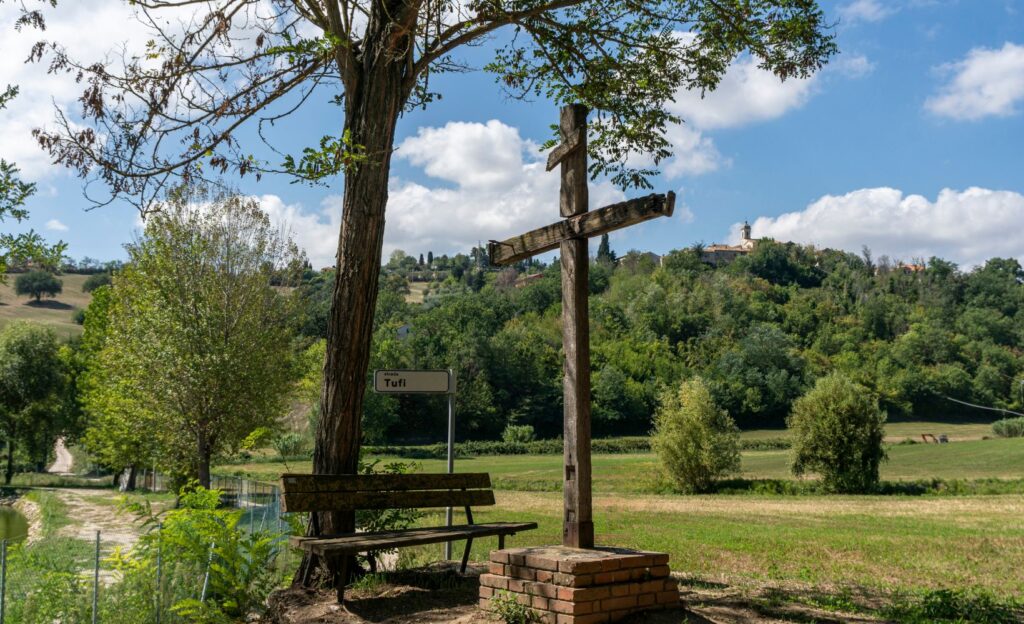
Visitors can therefore enjoy not only the breathtaking views, stretching from the mountains to the sea, but also the chance to observe one of the most fascinating species of the local birdlife at close quarters, making every visit a unique experience combining history, culture and nature. San Costanzo’s traditional festivals, such as the Polenta Festival and the Crescia Festival, offer an authentic journey through flavours, history and traditions. The Polenta Festival, with over 200 years of history, is one of the oldest in the Marche region. The ragù, prepared according to a secret recipe handed down through the generations, is at the heart of this event, which celebrates conviviality and flavour.
In Stacciola, every August, the Sagra della Crescia welcomes thousands of visitors, with an extraordinary output of 14,000 crescia in just three days. The cooking method, which uses vine shoots in keeping with ancient tradition, adds a unique touch to this speciality. For those wishing to discover the secrets of this delicacy, the Scuola della Crescia offers a course combining theory and practice, enabling participants to learn the art of traditional preparation.
Local culture is also kept alive thanks to LUIS (Libera Università Interculturale Stacciolana), which offers weekly lectures on cultural topics, providing an immersion in the traditions of San Costanzo.
Stacciola and Cerasa
Chapters of a single story
San Costanzo, with its charming hamlets of Stacciola and Cerasa, is a veritable treasure trove of experiences, set amidst a landscape that captivates with its beauty and uniqueness. Each hamlet tells a centuries-old story, one of close-knit communities and unbreakable ties to the local area. Stacciola, a little gem dating back to medieval times, retains its charm intact thanks to features such as the communal oven dating from 1795, a symbol of the tradition and spirit of sharing that characterised village life.
This oven, which is still in use today during community events, represents a living link to the ancient customs of solidarity, when bread was prepared and baked together, bringing the village’s families together. The parish church of St John the Evangelist, once the private chapel of the Counts of Mauruzi, is a historic and spiritual landmark, housing precious documents and works of art within its walls.
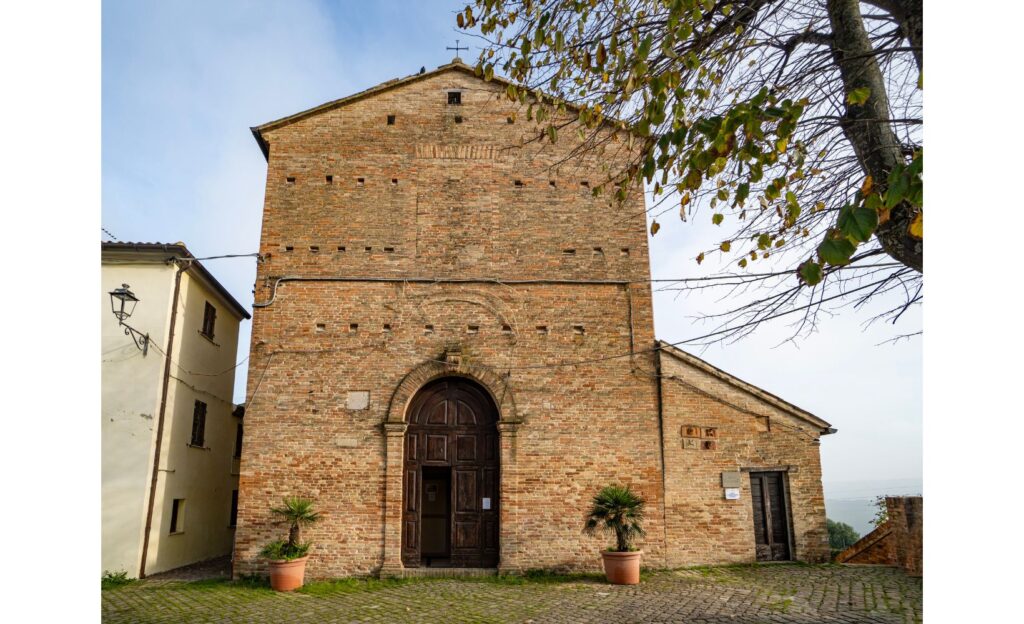
Among these, the “Book of Souls” stands out: a unique register that offers a glimpse into the religious and social life of the community, preserving names, traditions and events that recount centuries of local history. The hamlet is also deeply linked to prominent historical figures, such as Niccolò Mauruzi da Tolentino, to whom Pandolfo Malatesta granted the fiefdom in 1412 as a token of gratitude for his military victories. This interweaving of stories and figures lends Stacciola an aura of authenticity and prestige.
Cerasa, on the other hand, reveals an equally significant past, deeply rooted in its Benedictine origins. The village, originally known as ‘Querciafissa’, was rebuilt in the 13th century using the rubble of the previous castle and transformed into a fortified settlement thanks to the efforts of Abbot Martinozzi in 1380. The castle, with its imposing walls and traces of corbels, still tells its long story today. The church of San Lorenzo, built in 1346 and subsequently rebuilt, is a true architectural and spiritual gem. Inside, an 18th-century organ crafted by Gaetano Callido, a baptismal font dating from 1629 and a memorial plaque in Gothic script commemorating the original building enrich the village’s artistic heritage.

Discover the beauty of San Costanzo
The Beauty Trail comes to life
Exploring the beating heart of the Marche region has never been easier. Criluma Viaggi is proud to bring to life Confcommercio Marche Nord’s ‘Itinerario della Bellezza’ project, transforming a guide to excellence into real-life itineraries, ready for you to experience.
Romantic weekends, days spent immersed in nature or cultural tours: we’ve created itineraries to suit all tastes and time constraints. The Criluma experience is the added value that guarantees you first-class treatment, comprising continuous support, personalised attention and immediate responses.