
6 reasons to visit
Cartoceto
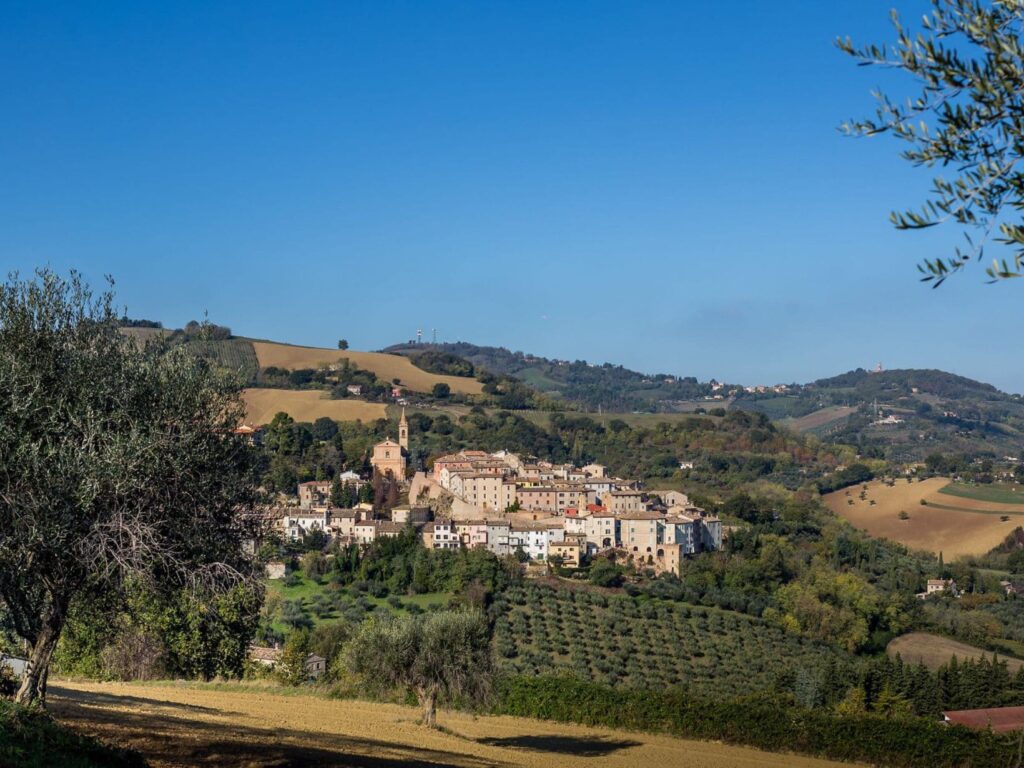
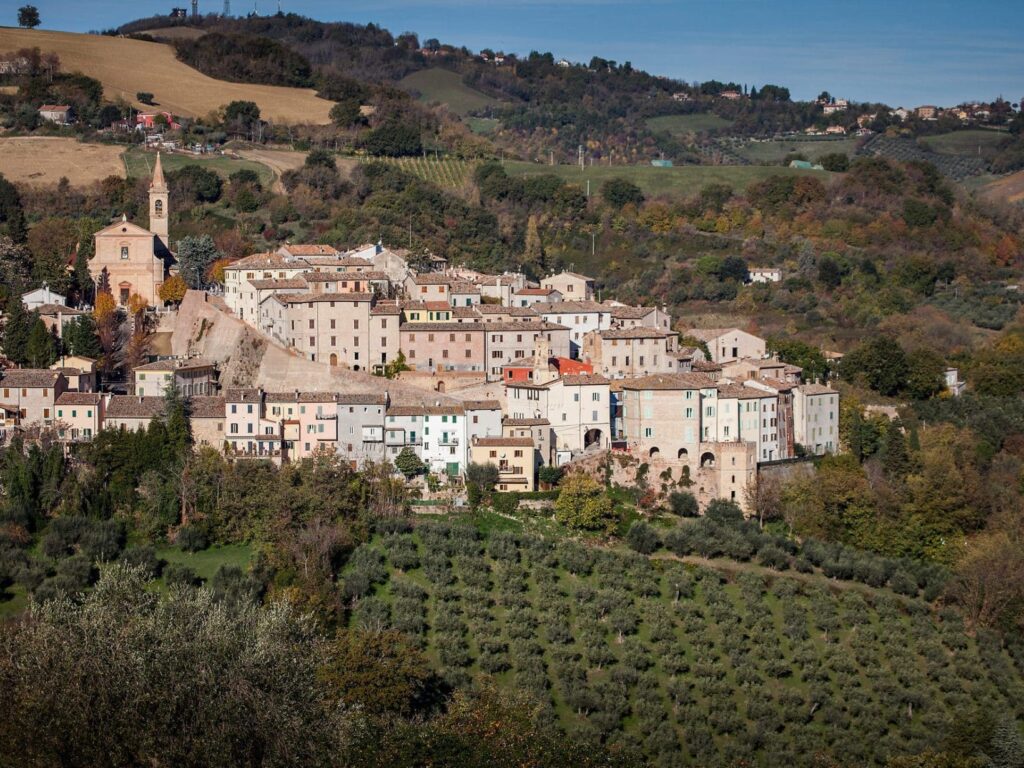
Nestled on the ridge of a sun-drenched hill, Cartoceto appears as a village frozen in time, protected by ancient walls and set amidst a silvery sea of olive trees. A sight that evokes the tranquillity of the Marche hills, where the landscape becomes an integral part of the architecture.
The village’s origins date back to Roman times, as suggested by the finds made at the ancient parish church. An inscription dated 79 BC bears witness to the sacred nature of the site, indicating the probable presence of a structure erected to honour the deities of the time.
A fascinating historical theory links the founding of Cartoceto to the Battle of the Metauro in 207 BC. It is said that the Carthaginian soldiers, unable to return home, chose this area to settle, giving rise to the name ‘Chartaginensium coetus’, from which the current place name is said to derive.
Other historical interpretations trace the origin of the name to the natural features of the area. The terms ‘Crates’ (reeds) or ‘Carex’ (sedge) refer to the herbaceous plants used in ancient times to thatch the roofs of houses, thereby linking the village inextricably to its land.
In the 12th century, Cartoceto consolidated its strategic importance as a defensive stronghold for the town of Fano. The feuds between noble families led to the construction of the castle and a sturdy set of walls, features which still define the proud character of the historic centre today.
The modern era has brought about a profound transformation: after an earthquake damaged the ancient fortress, the village ceased to fulfil its military function. Cartoceto has thus evolved into a peaceful settlement, where the elegance of modern architecture blends with the tranquillity of life in the hills.

Discover the charms of Cartoceto
The Beauty Trail comes to life
Exploring the beating heart of the Marche region has never been easier with Criluma Viaggi!
Romantic weekends, days spent immersed in nature or cultural tours: we’ve created itineraries to suit all tastes and time constraints.
A stroll through the historic village
Among the historic buildings that hold stories and tales
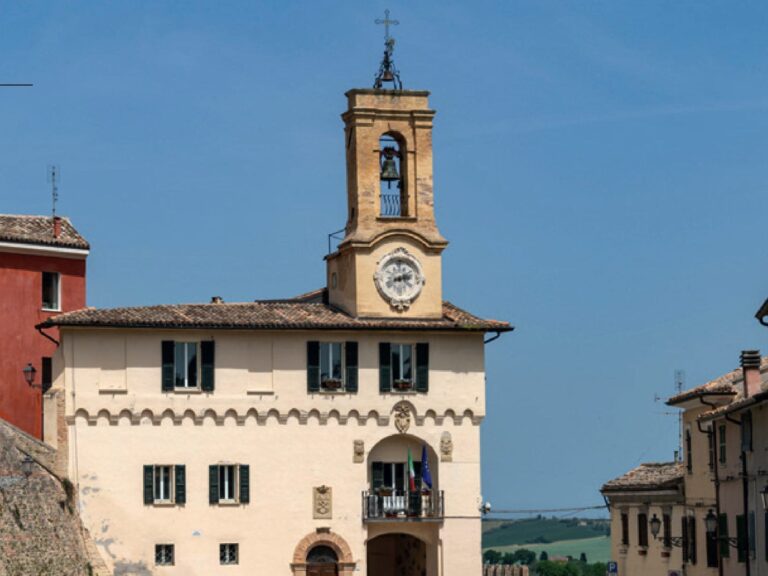
Scenes of narrow streets interspersed with charming squares, one after the other; windows opening out onto fields of olive groves and unspoilt nature; flowers and plants adorning doorways and skylights… and then there are caves, historic buildings, art studios, places steeped in history and spirituality, and a myriad of intriguing tales.
All this is the historic centre of Cartoceto, whose historic core has a distinctive and unique layout: the streets are arranged in a herringbone pattern, running along the main road (once known as the ‘via di mezzo’) which descends within the walls and continues towards Piazza Garibaldi, formerly Piazza del Mercato, overlooked by Palazzo del Popolo, a 14th-century building distinguished by its distinctive Clock Tower, on which is affixed a sundial commissioned in the 17th century and restored on several occasions.
On the façade of the Palazzo, two coats of arms of the Rusticucci family stand out: one is carved from sandstone and features two keys and a sword arranged in a cross on a blue field, with laurel and oak branches, surmounted by a crown symbolising a castle.
Beneath the palace’s archway, housed in a niche, stands a small statue of the Black Madonna of Loreto. Finally, in Piazza Garibaldi, the distinctive fountain, which has welcomed visitors to this square since 1941, also takes pride of place.
Continuing through the streets of the village, Palazzo Marcolini stands on the street of the same name.

The building, which now houses the town hall offices – having previously been the residence of Count Marcolini and later of the Bezziccheri family – served as a hotel in the 1960s.
Its defining features are the marvellous ceilings decorated with tempera paintings and the coffered ceilings with stucco mouldings. The ground floor is occupied by the ‘Afra Ciscato’ Historical Library, which now also serves as a multi-purpose multimedia space.
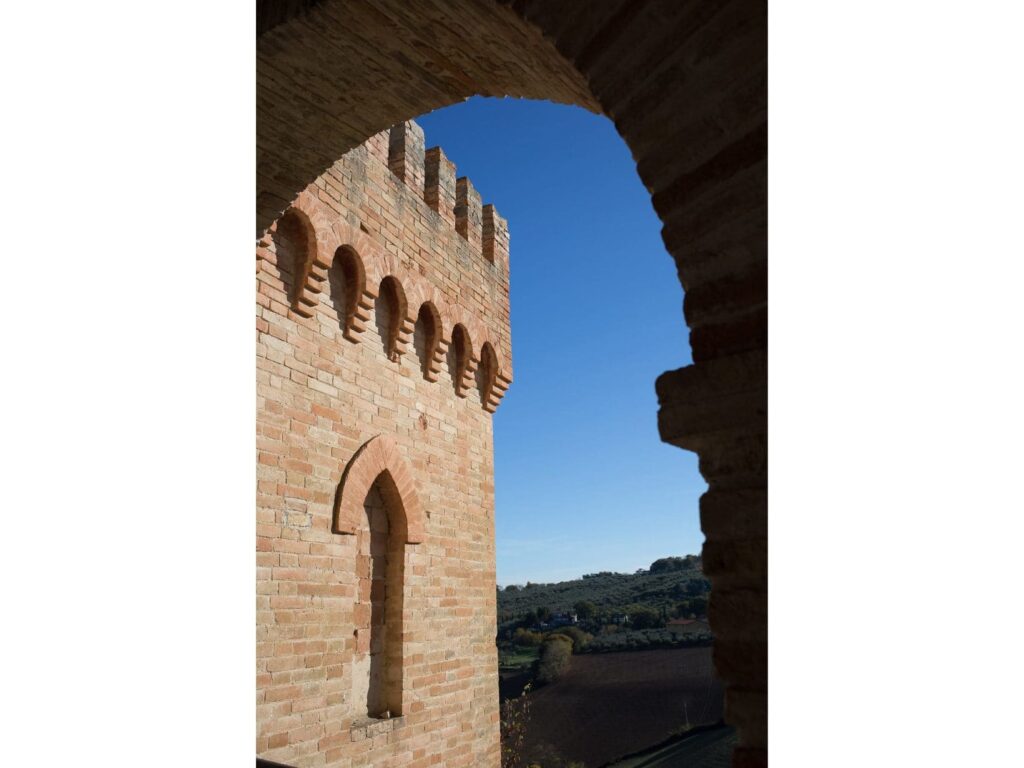
Other architectural features that contribute to the village’s magical atmosphere include the 12th-century Torre delle Mura Castellane, from which one can enjoy the surrounding landscape stretching across the olive groves and the entire Metauro region, as far as Fano; the Fontana dell’Olio (Oil Fountain) in Via Marcolini, created by the monk and sculptor Father Stefano Pigini, which draws on the village’s olive-growing tradition, metaphorically depicting the Goddess of Abundance from whose breasts the precious ‘green gold’ flows.

On the eastern side of the village we then find Piazza Marconi, known as ‘La Turchia’ – so called because it was from here that the people of Cartoceto used to keep watch for Saracen landings; and, finally, Piazza XX Settembre, in the Rocca area, opposite the Collegiate Church of Santa Maria della Misericordia and the Sanctuary of the Blessed Virgin of Graces.
But Cartoceto’s treasures are not hidden solely within the town walls: outside the town centre, in fact, on a rocky, sandy embankment, stands the ancient Malatesta watchtower ‘Torre di Ripalta’, dating from the 11th century, which, from its height of 15 metres, has witnessed clashes, duels, battles and victories.

Finally, in the hamlet of Ripalta, we find the ancient washhouse, consisting of two basins and built from square-cut pink Furlo stone and bricks.
Theatre of Triumph
A little hidden gem in the village of Cartoceto
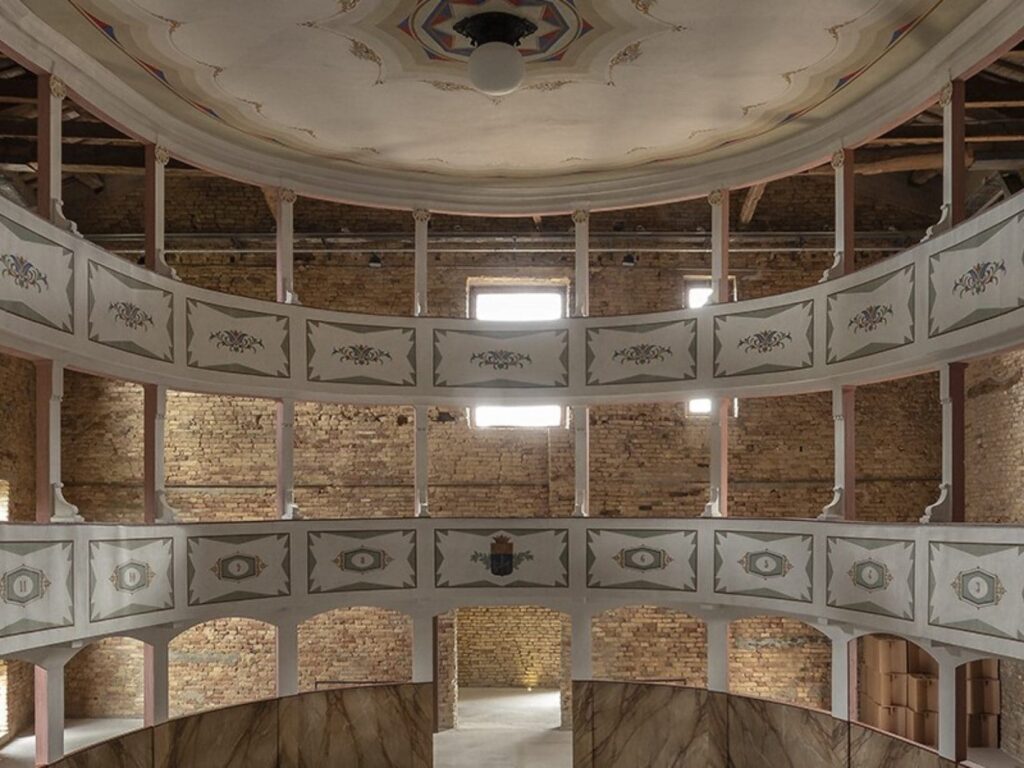
A real gem from an artistic, architectural and cultural point of view is the Teatro del Trionfo, situated in Piazza Marconi: a true vantage point overlooking expanses of olive groves and stretching as far as the blue waters of the Fano coastline.
Built in the first half of the 18th century by a group of local dignitaries on the site of a former olive press and storage facility, the theatre retains its wooden framework and many other surprising treasures that every visitor can discover upon stepping inside.
The theatre’s floor plan is horseshoe-shaped, bounded on either side by the proscenium and two vertical lines featuring paintings on the mouldings.

In the entrance hall, an antique stage curtain and stage wings dating from the mid-19th century are on display.
This is the Sala del Liverani, where the curtain created by the Faenza-born artist Romolo Liverani is kept; it depicts a rural scene, alongside which are depicted the Palazzo del Popolo in Cartoceto, the Villa del Balì in Saltara and a classical temple, which, according to legend, was erected on the Hill of San Martino in honour of Mars.
Walking up the steps leading to the upper floor, one can admire the theatre auditorium itself, which simulates the arrangement of the boxes by means of a wooden framework positioned in the centre of the room.
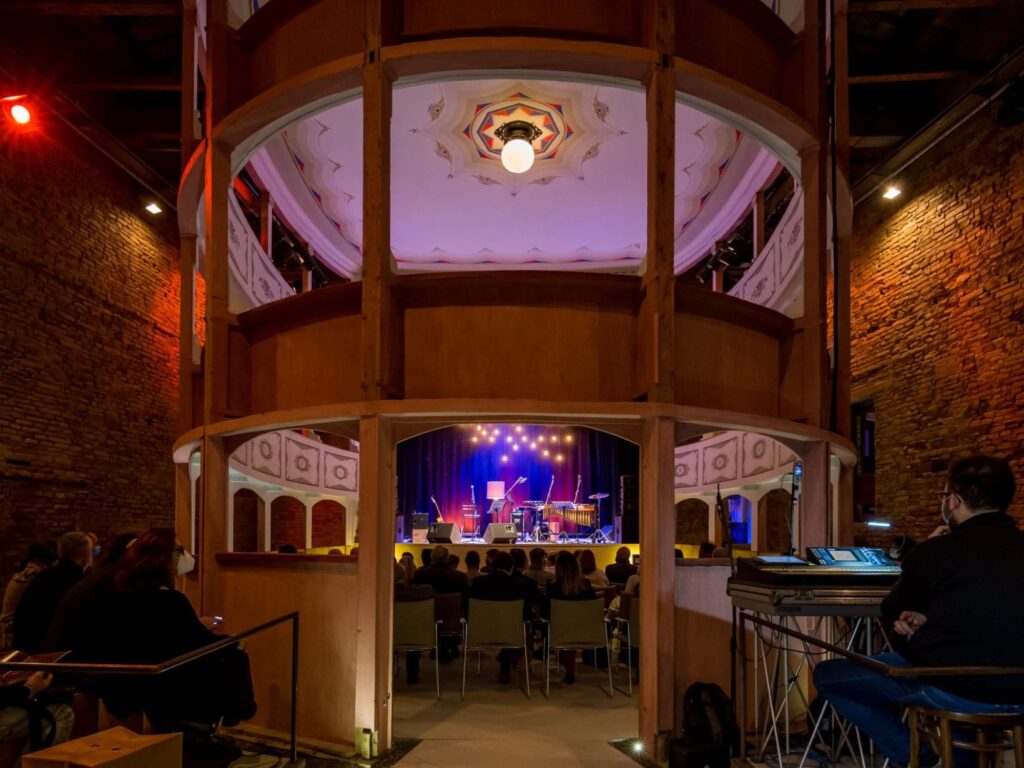
The stage area is extremely versatile, even allowing the audience area and the stage to be reversed, thus creating a small Elizabethan theatre with the stage at the centre and the audience all around it.
Inside the building is also the Sala Dondero, where visitors can admire, through a series of 20 photographs, the project that the great master of photography, Mario Dondero, dedicated to Cartoceto.
The theatre hosts various events each year, the main one undoubtedly taking place in November during ‘Cartoceto DOP, the Festival – Olive Oil and Olive Market Exhibition’, during which, from 2014 to the present day, nationally and internationally renowned artists have graced the stage.
Places of silence, faith and spirituality
A journey through places of worship and sacred art
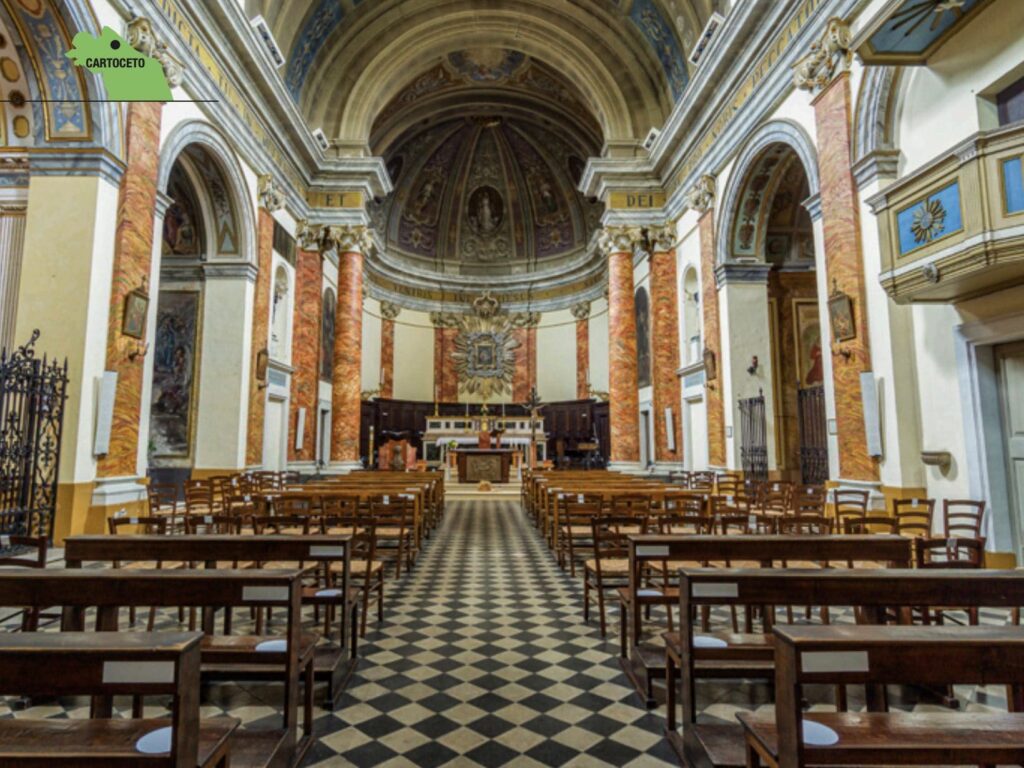
In the centre of Cartoceto there are ancient places of worship that inspire reflection, prayer and spirituality.
We begin with the Church of Santa Maria della Misericordia, in the heart of the village, a building originally constructed in the 1400s but subsequently restored several times and converted into a collegiate church. The present building dates from 1831 and stands opposite Piazza XX Settembre.
Upon entering, one immediately sees a wooden statue depicting the Holy House of Loreto, carried in procession for the veneration of the Virgin Mary; on the left-hand side of the square, meanwhile, stands the Diocesan Marian Shrine of the Blessed Virgin of Graces, which boasts a fresco depicting the Madonna enthroned with the Infant Jesus.
This work was created in the second half of the 1800s as a token of gratitude to Mary for having healed a noblewoman from an illness that seemed incurable.
In 1877, the image was transferred to the church and placed inside the chapel built specifically for the occasion by the architect Mengaroni.
The church contains other works of sacred art, such as the painting of the Madonna del Rosario, depicting Pius V giving thanks to the Virgin Mary for the victory at Lepanto; or the image of the Madonna Enthroned with St John the Baptist and St Bernardino.
Directly above the altar stands the Madonna della Misericordia, a 17th-century work, whilst near the exit is the painting of the Madonna Enthroned, flanked by Saint Sebastian and Saint Roch.
Before leaving the Collegiate Church of Santa Maria della Misericordia, we must mention an instrument that is unique in its kind, a symbol of hymns and music in the church: the organ.
The liturgical furnishings also deserve a mention, such as the altar and the ambo, dating from the 1990s and crafted by the friar-sculptor Pigini and his pupil Galiardi.
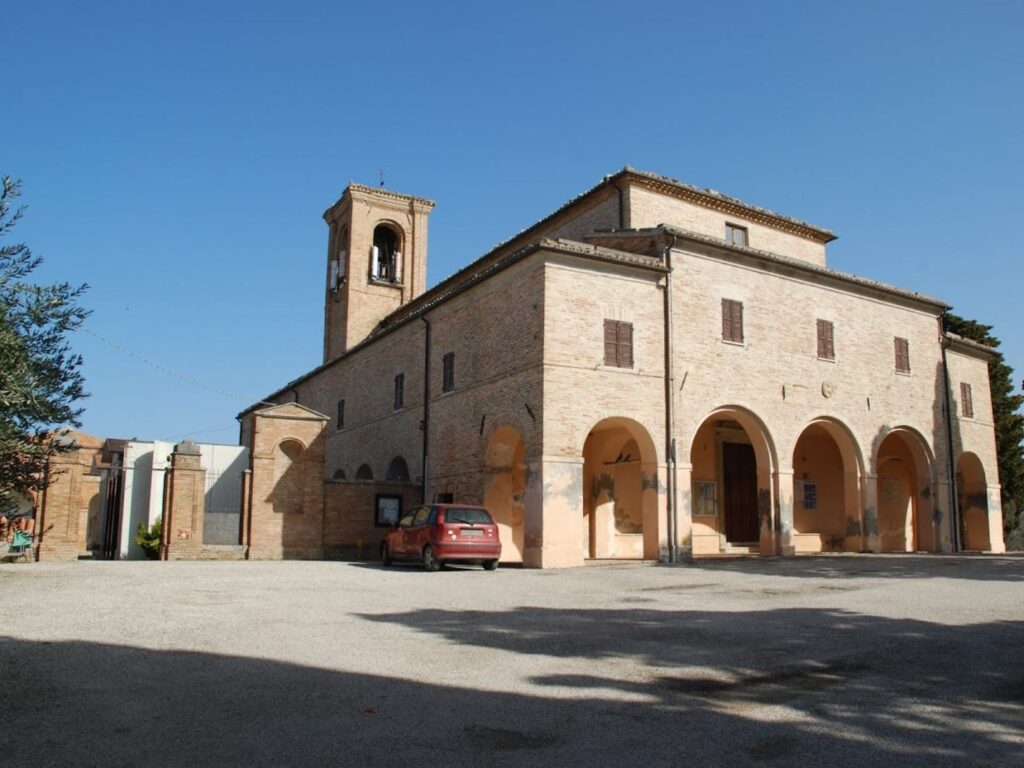
Leaving the centre behind at this point and venturing out of the village, we come across, amidst the greenery of Monte Partemio, the Convent and Church of Santa Maria del Soccorso, founded in the 16th century; however, all that remains of the original structure is part of the tower, a room in the convent and part of the church’s masonry.
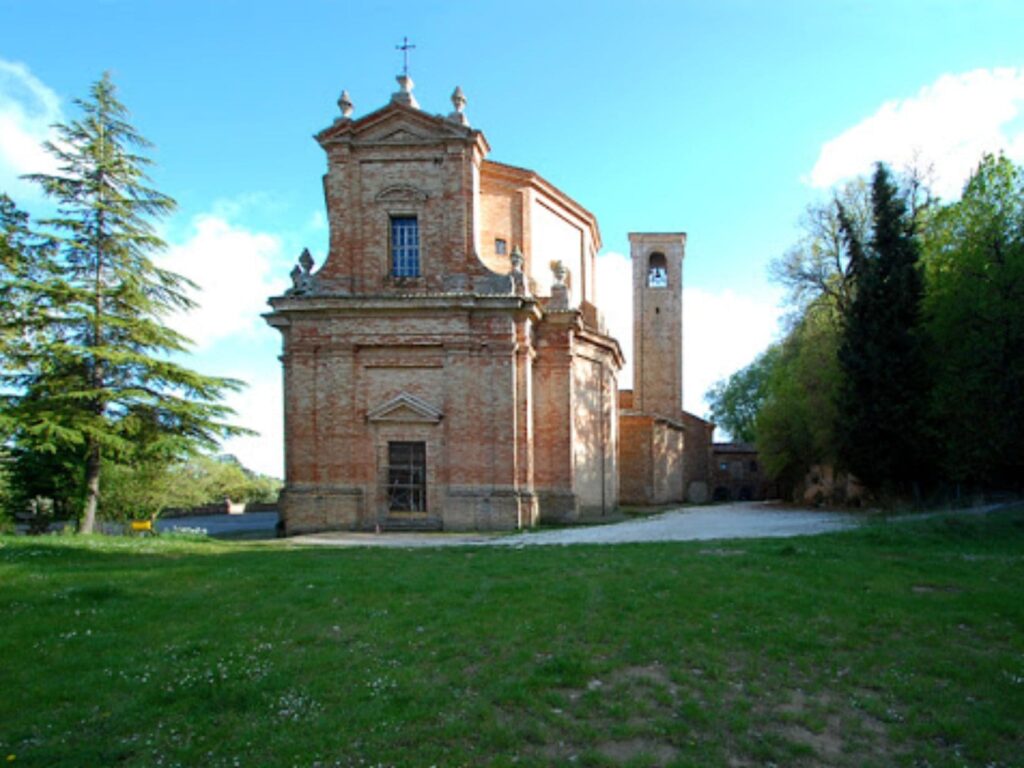
Rebuilt in 1782, the building houses many paintings that are true gems, including a ‘Conception’ by the artist Morganti, who worked in the 1500s; three 18th-century altarpieces by Pietro Tedeschi of Pesaro; the painting *Madonna del Soccorso*, housed in the church’s chapel. Another building of great importance to the area is the Parish Church of Saints Peter and Paul, which stands atop a hill overlooking the Metauro valley.
This structure, of Roman origin, is distinguished by a striking five-arched portico supported by pillars that frame the entrance. Inside, three paintings and a recently restored 18th-century Fedeli organ stand out. Another place worth noting is the parish church of Saints Biagio and Cesareo in the hamlet of Ripalta, where an ancient wooden statue depicting the Madonna and Child, also known as Santa Maria in Campo Fiori or di Campofiori, is kept. The little church of St Anne also deserves a mention; it is a small gem of rural architecture dating from the 17th century, situated along the street of the same name.
Directly above the altar stands the Madonna della Misericordia, a 17th-century work, whilst near the exit is the painting of the Madonna Enthroned, flanked by Saint Sebastian and Saint Roch.
Before leaving the Collegiate Church of Santa Maria della Misericordia, mention must be made of a unique instrument, a symbol of hymns and music in the church: the organ.
The liturgical furnishings also deserve a mention, such as the altar and the ambo, dating from the 1990s, created by the friar-sculptor Pigini and his pupil Galiardi.
Leaving the centre behind at this point and venturing out of the village, we come across, amidst the greenery of Monte Partemio, the Convent and Church of Santa Maria del Soccorso, founded in the 16th century; however, all that remains of the original structure is part of the tower, a room in the convent and part of the church’s masonry.
Cartoceto: home to outstanding food and drink products
Oil, wine, goat’s cheese: a treat for the taste buds
Cartoceto offers a feast for the eyes and the taste buds to anyone wishing to treat themselves to unique delicacies that are recognised both nationally and internationally, and to savour certified produce.
The village, in fact, is at the forefront of the region’s only PDO olive oil scheme and is characterised by a dense network of farms producing prized products such as goat’s cheese, ‘di fossa’ cheese, cream cheeses, preserves and wines.
The history behind the certification of the Protected Designation of Origin (PDO) is long-standing.
As early as the 16th century, olive oil was subject to strict controls: all consignments of olives arriving at the mills had to be recorded, to prevent any instances of theft or smuggling.
But what makes Cartoceto olive oil so special is the area where the olive trees grow, a region that benefits from its unique microclimate, its moderate altitudes, the surrounding Partemio and Mattera mountains, the predominantly tuff and sandstone soil, the currents of the River Metauro and the cold winds blowing down from the Cesane: all of which has allowed the olive trees to thrive, and the oil encapsulates the very essence of this area in its flavour.
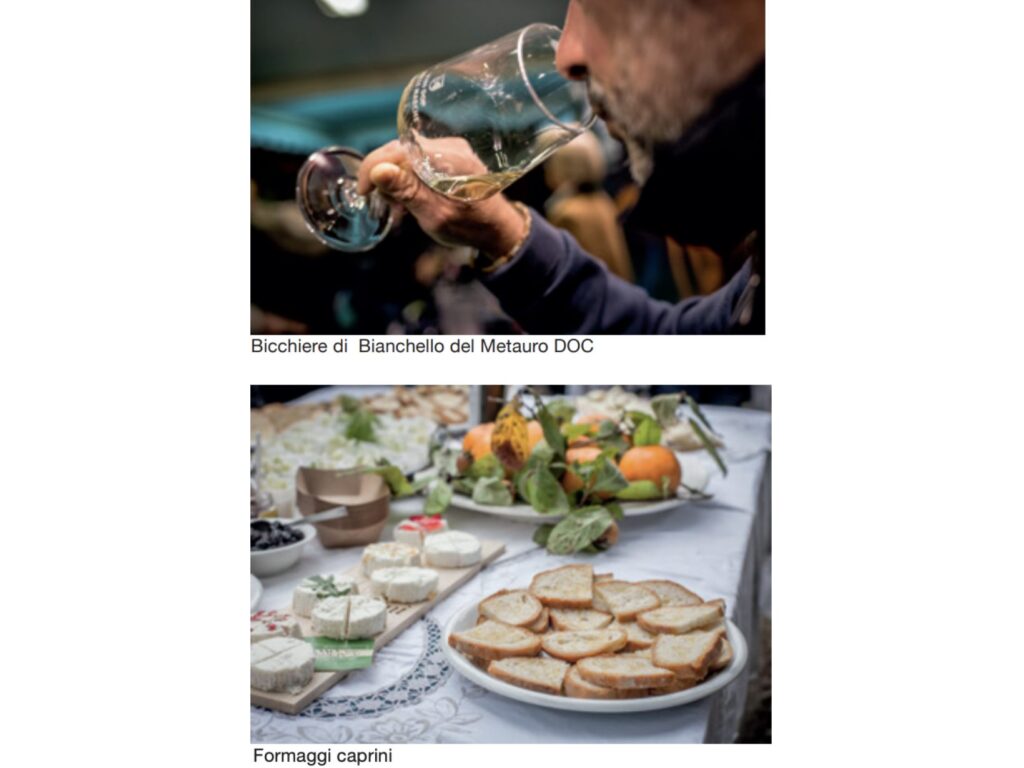
Near the sea, on the other hand, Bianchello del Metauro grapes – which date back to ancient times – are grown: indeed, it is said that Hasdrubal, commander of the Carthaginian army, in 207 BC, suffered a crushing defeat in the famous Battle of the Metauro because he was intoxicated by the pleasure he had derived the evening before the battle from sipping none other than Bianchello.
This wine is made from a native grape variety, typical of the Pesaro area, which has developed distinctive characteristics and a strong personality. It is a dry, pleasant wine with a delicate aroma that complements its straw-yellow colour.
Another wine of exceptional quality is the Sangiovese, a wine with distinctive organoleptic qualities that set it apart from wines made from the same grape variety grown in other regions. Its intense red colour and flavour evoke notes of cherry and wild berries.
Turning to the gastronomic sector, it is the goat’s-milk cheeses and the ‘fossa’ cheeses – made from sheep’s milk or a blend of cow’s and goat’s milk – that make Cartoceto a centre of excellence in the food industry. Fresh and often garnished with herbs and flowers from the Cartoceto hills, the goat’s-milk cheeses become veritable works of art to be served at the table.
What sets the ‘fossa’ cheeses apart, however, is their maturation process, which lasts for three months in oval pits carved into the rock beneath the village houses, as the ancient tradition dictates, between late August and early September.
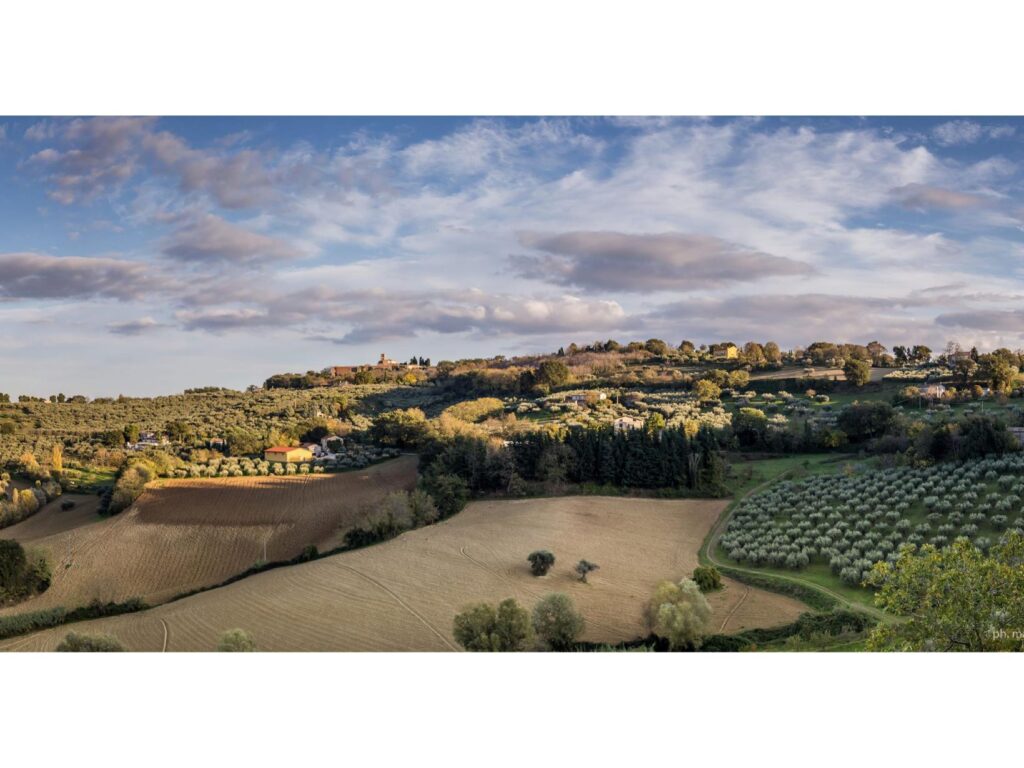
From the hills to the sea, a landscape of olive groves – a landscape to be experienced
Go for a walk or a bike ride to immerse yourself in nature
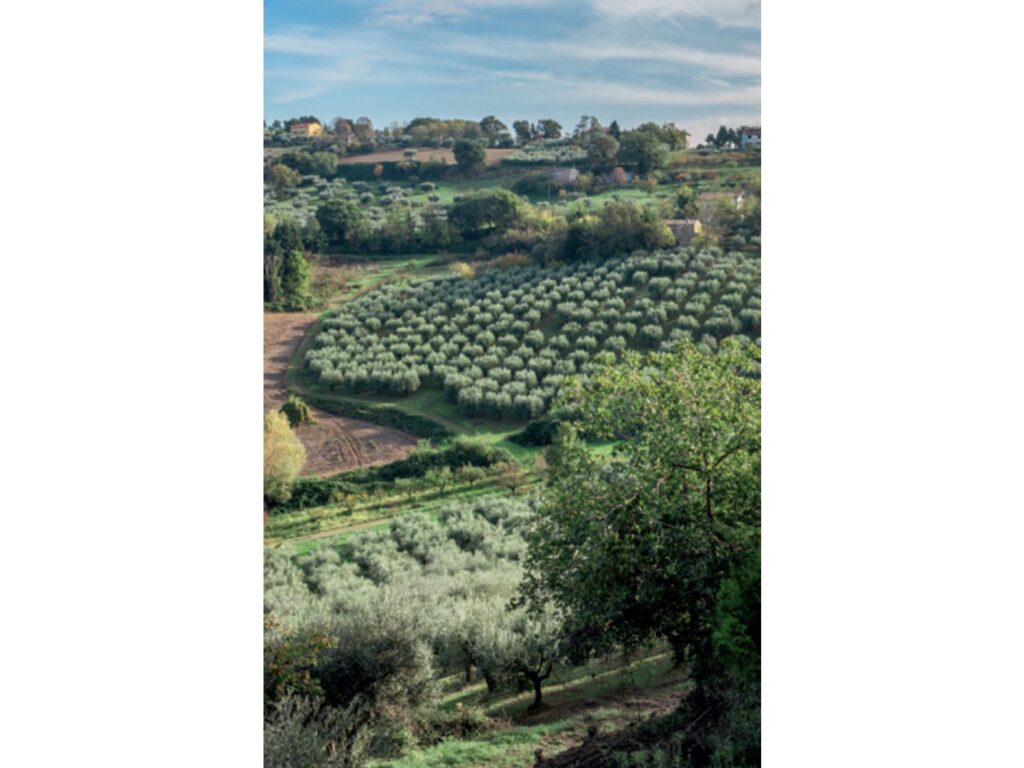
From Piazza Marconi or the ‘copertelle’ in Via delle Mura, your gaze wanders along the gentle curves of the hills and is drawn to the intense green of the olive groves that embroider them – a green that gradually blends into the blue of the sea.
This, too, is Cartoceto: a fascinating and enchanting landscape to experience and explore by road, via numerous routes, on foot or by bicycle.
Just past the hamlet of Lucrezia, the hills seem to close in, piling one upon the other, blocking the view of the horizon; but, once you reach the parish church of Saints Peter and Paul, the view suddenly opens up and your gaze is drawn across the entire Metauro valley, from the peaks of Mount Catria to the Adriatic Sea lapping at Fano.
Cartoceto lies there, nestled and sheltered by this expanse of olive groves and ancient copses, in a captivating, timeless landscape that enchants the eyes, the mind and the heart.
Of particular note is a route taking in ancient mills, old springs and wash houses; this is ‘La via dell’acqua’ (The Water Trail), comprising ten circular routes that cover themes ranging from nature and art to culture, history and religion.
The aim of these routes is to explore little-known paths and discover hidden routes and places.
These are simple routes, accessible to everyone, along which you can admire new and unfamiliar scenic views, sometimes framed by the clarity of a clear spring sky, and at other times veiled by the mist that envelops everything in autumn.

Cartoceto and its events
A packed programme of events running throughout the year
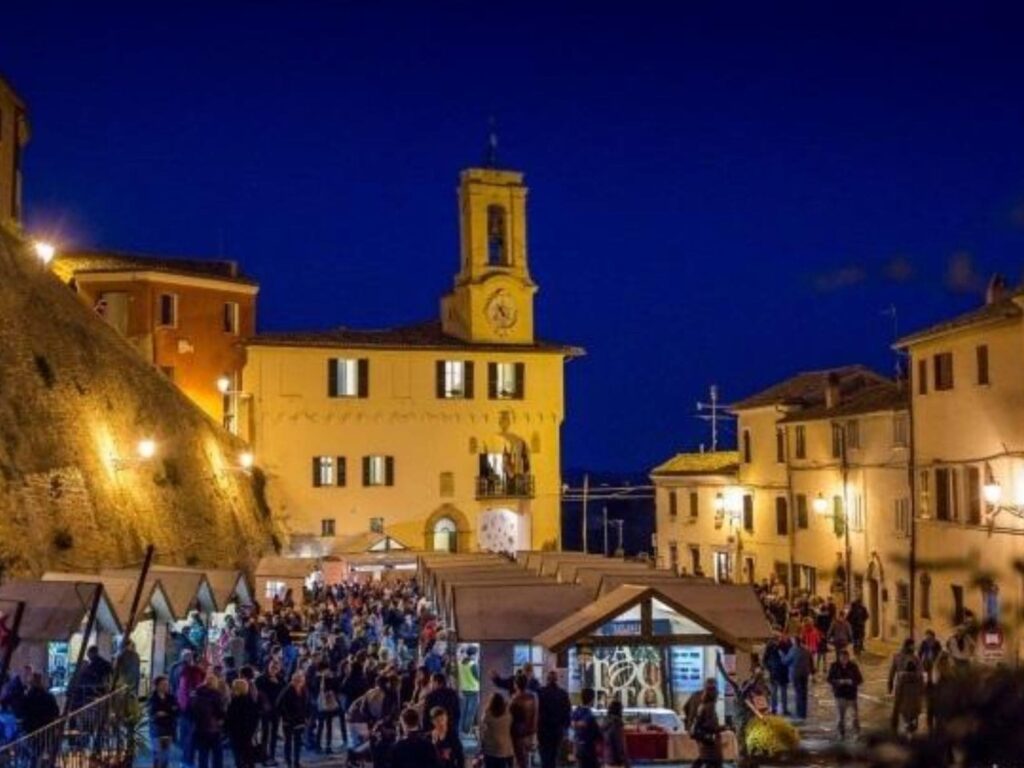
Food and wine, cycle tourism, art, music and culture.
These are the keywords that define the packed programme of gatherings and events taking place in Cartoceto throughout the year. In autumn, on the first two Sundays in November, the area’s main event takes place: ‘Cartoceto DOP, the Festival – Olive Oil and Olive Market Exhibition’.
This historic olive oil and olive fair, with its half-century of history, is complemented by a wide range of activities: wine tours, tastings of olive oil and other delicacies, food and wine workshops, shows designed for children, as well as major concerts in the picturesque Teatro del Trionfo, exhibitions, nature walks or cycle routes, and visits to farms and olive oil mills; in short, a way to experience the region in all its facets.
The highlight of the winter months, however, is ‘Trionfo Gourmet’, an event in which the Teatro del Trionfo is transformed into a dining venue where guests can dine in style, enjoying gourmet cuisine and wines selected by expert sommeliers, all accompanied by a delightful musical programme setting the tone for the evenings.

In spring, “Conterranea” takes place: a tour of the municipalities within the Cartoceto PDO production area, combining food and wine with stories of the local area in places of great artistic and cultural significance.
Summer then comes alive with “Stelle d’Argento”, featuring food and drink alongside music on the enchanting night of the shooting stars, and “Parchi d’estate”, which offers theatre performances, concerts and events for children to enjoy on warm evenings, in the cool of the municipality’s many green spaces.


Discover the charms of Cartoceto
The Beauty Trail comes to life
Exploring the beating heart of the Marche region has never been easier. Criluma Viaggi is proud to bring to life Confcommercio Marche Nord’s ‘Itinerario della Bellezza’ project, transforming a guide to excellence into real-life itineraries, ready for you to experience.
Romantic weekends, days spent immersed in nature or cultural tours: we’ve created itineraries to suit all tastes and time constraints. The Criluma experience is the added value that guarantees you first-class treatment, comprising continuous support, personalised attention and immediate responses.