

6 reasons to visit
Borgo Pace
In the very heart of the Marche region, Borgo Pace, nestled within the green embrace of the Apennines, touches the soul with its history. A land where paths converge, where the Meta and Auro streams meet, it has witnessed the passage of the Picentes, Etruscans, Romans and Lombards, each leaving an indelible mark.
The ancient Massa Trabaria, with its forests that once provided timber for Rome’s buildings, lives on in the architecture and traditions of villages such as Palazzo Mucci, which bear witness to nobility and heroic times.
Parchiule, with its stone houses and slate roofs, speaks of a simplicity that has stood the test of time, whilst Figgiano and Lamoli, with their churches and legends, echo with a profound spirituality that permeates both the land and the soul.
In Sompiano, whose origins date back to the 15th century, red potatoes are grown, and their unique flavours are safeguarded by strict production regulations.
Here, the absence of modern noise and horror heightens the beauty of a landscape where life flows in its natural course – a haven for those seeking authenticity and a refuge from the hustle and bustle of the world.
Borgo Pace, therefore, is not merely a place that many describe as fairytale-like; it is a sprawling village, a symphony of tranquillity and beauty, a journey through time where every stone and every street reveals a chapter in a timeless epic.

Discover the charms of
Borgo Pace
The Beauty Trail comes to life
Exploring the beating heart of the Marche region has never been easier with Criluma Viaggi!
Romantic weekends, days spent immersed in nature or cultural tours: we’ve put together itineraries to suit all tastes and time frames.
Apennine Harmony
Exploring the magic of Parchiule
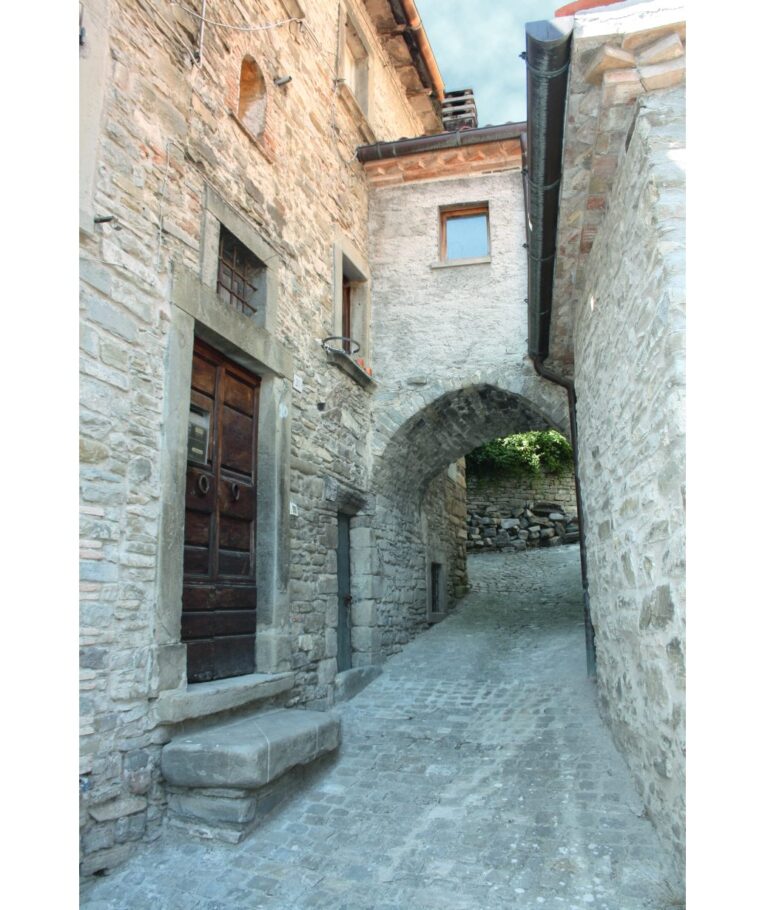
On the border with Tuscany, cradled in the silent embrace of the Apennines, lies Parchiule, a village where nature and spirituality weave a timeless tapestry.
At an altitude of 600 metres, this ancient rural settlement stands proudly, nestled within a landscape that seems to have been painted by an artist’s hand. The houses, built from sandstone blocks and ashlars, are ancient witnesses with thick walls that evoke the lives of those who once inhabited these mountains, striking a perfect balance between the essence of human habitation and the untamed breath of nature.
Protected by the Alpe della Luna, an ancestral guardian whose rock formations resemble a crescent moon, and surrounded by tranquil forests of beech, maple and lime trees, the village proves to be an ideal retreat for hiking, trekking and horse riding.
From Parchiule, a network of trails winds its way through the countryside, promising adventures that are as physical as they are spiritual. The Nature Trail is a journey of discovery amongst the forest’s inhabitants, under the watchful eye of the medieval towers – silent guardians of a past that still watches over wayfarers today.

Places well worth visiting in Parchiule include the church of ‘Santa Maria di Parchiule’, built in 1538, a symbol of unshakeable faith and the heart of a community that has weathered the storms of history, and the ‘Cappella dei Crociani’, also known as the ‘Oratory of the Madonna del Bell’Amore’.
With a door bearing centuries-old dates, it is a sanctuary of peace, where the sacred and the secular merge.

A picturesque landscape: Alpe della Luna, the Cappella dei Crociani and the natural pool of the Auro; a small bridge links the two historic buildings, spanning the Fosso di Parchiule.
Parchiule is not merely a cluster of houses and stones; it is a place where spirituality blends with the grandeur of the surroundings.

Its footpaths, veritable terrestrial arteries, lead through woods and valleys towards the Piscine dell’Auro, where the crystal-clear water invites visitors to renew both body and spirit. Thus, Parchiule stands out as a destination that is not only physical but also spiritual – a corner of the world suspended in time, inviting its visitors to slow their pace, listen to the silence and immerse themselves in the simple, profound beauty of creation.
Under the sky of Borgo Pace
Smoke of Memories: The Art of the Charcoal Burner
Within the village community, the figure of the charcoal burner keeps alive the memory of an era of hard work, set against the enchanted and legendary atmosphere of the forest.
His life, marked by solitude and an intimate connection with nature, is recounted in stories that reveal a world now on the fringes of collective memory.
The charcoal kiln, an alchemical place where wood is transformed into pure heat, stands as a testament to a practice that has fascinated mankind for millennia.
The lighting of the charcoal kiln – a delicate and crucial moment – is a ritual that puts the charcoal burner’s skill to the test.
The smoke rising from the ventilation holes tells tales of fire, wind and time, and only the expert eye can interpret the signs and guide the wood through its metamorphosis into charcoal.


After days of watchful vigilance, the coal miner reveals to the world the gleaming black result of his labour through ‘coal extraction’, the final act of this epic.
At this moment, charcoal-making reveals itself as hard, dirty work in which the charcoal burner becomes one with the element he has created.
Shrouded in smoke and dust, almost mythical figures emerge: men clad in black who embody the essence of a millennia-old craft.
The municipality of Borgo Pace stands as the guardian of the scent of fresh charcoal and the wisdom of a craft which, in expert hands, keeps alive the flame of innovation and tradition.
Hornbeam, manna ash, Turkey oak and, occasionally, beech are the species chosen for the production of charcoal and wood charcoal.
Beyond the Abbey walls
Lamoli, guardian of spirituality, history and colour

Lamoli is a haven of peace and devotion. The village, home to fewer than a hundred souls, is dominated by the Benedictine Abbey of St Michael the Archangel, a bastion of spirituality rising above the waters of the Meta stream.
Founded in 543, shortly after the death of St Benedict, the monastery stands on the site of what was once Castrum Lamularum, a landscape dotted with rocky outcrops that characterise the Apennine countryside. The Abbey, the beating heart of Lamoli, has for centuries been a beacon of culture and religious devotion, a landmark for travellers on the ancient routes linking Rome with the Adriatic cities.
Its presence catalysed the development of the village, which once played a central role in the trade in fine timber, subsequently becoming a papal fiefdom and then, as historical events unfolded, an integral part of the municipality of Borgo Pace. Even today, the Abbey’s walls echo with the mantra ‘Ora et Labora’.
The interior of the church, with its austere Romanesque beauty, is an oasis of contemplation.
The darkness enveloping the naves is broken only by the rays of light filtering through the central rose window and the single-lancet windows, creating a play of shadows on the raised altar and within the spacious apse.
The crypt preserves fragments of an even more distant past, with sculptures dating back to the 6th century.

The ‘Delio Bischi’ Museum of Natural Colours is nestled within this sacred setting, celebrating the ancient wisdom of the Benedictine monks in the art of herbalism.
The museum is not merely an exhibition, but a living experience that connects visitors with the tradition of plant-based dyeing.
Here, visitors can explore the evolution of pigments and learn how dye plants were cultivated and transformed into the vivid colours that once adorned fabrics.
As well as art and history, the museum immerses visitors in the practical side of things, offering demonstrations of colour extraction and application on various materials.
Outside, medicinal and dye plants are cultivated using traditional methods, and visitors are invited to stroll through the surrounding meadows, where biodiversity unfolds in a riot of colour.
Lamoli, with its abbey and museum, is a hidden treasure where the echo of ancient prayers blends with the deep green of the woods, a place for reflection where every stone and every plant tells the story of a community that has made faith and nature the pillars of a life lived in harmony with the surrounding world.

Watercourses in Borgo Pace
Nature, writing and hospitality
In this mountainous landscape, the river plays a central role.
Here, the Meta and Auro streams come together in perfect harmony to form the Metauro, a river that has always played an important role in the landscape and history of the Marche region.
The confluence of these two watercourses symbolises a perfect union, a place where nature and humanity merge in a calm and steady flow, just like the river itself.

The Casa della Scrittura, a historic building that has been renovated to create a cultural space, overlooks this idyllic setting.
Now a hub of creativity, it brings together artists, writers and thinkers under the banner of the written word.
It is a place for exploring and celebrating literary heritage, strengthening the community through art and culture.
In this space, which harmonises the magic of a ‘fairytale landscape’ with the reliability of new technologies, the exhibition itinerary becomes a journey into the art of writing.
Around sixty exhibits, arranged across twelve ‘narrative aquariums’, explore the art of literature, challenging perceptions and inviting visitors to immerse themselves in the depths of writing.
Each text is a piece of a larger mosaic, a window opening onto worlds of meaning waiting to be discovered and understood.

Around sixty works, spread across twelve ‘narrative aquariums’, explore literary art, challenging our perceptions and inviting us to immerse ourselves in the depths of writing.
Each text is a piece of a larger mosaic, a window opening onto worlds of meaning waiting to be discovered and understood.

The historic inn ‘La Diligenza’, situated in the main square of Borgo Pace, is an outstanding example of hospitality and fine dining, inviting visitors to savour the flavours of the local area.
Dating back to the nineteenth century, the inn is what one might call a harmonious blend of tradition and modernity, offering comfort to both the explorers of yesteryear and the gourmets of today.
Culinary excellence, combined with a welcome steeped in history, guarantees an authentic and fulfilling experience
The rooms, elegantly furnished in French style, and the romantic suites ensure a peaceful and relaxing stay, a tribute to the gentle art of living well.
Through the confluence of waters, the writing workshops and the warm welcome, Borgo Pace reveals itself as a destination that embodies the essence of hospitality, offering a unique experience in which every visit becomes a chapter in a broader narrative, traced by the voices of the past and projected towards the future.

A feast combining flavour and meditation
A showcase of culinary heritage

The land of Borgo Pace yields its bounty generously, and the dining table becomes the stage for a timeless culinary heritage. Among the local treasures, dishes featuring white truffles and delicious prugnoli mushrooms stand out, whilst game – from wild boar to hare – brings with it the intense flavours of the woodland.
The undisputed star, however, is the Sompiano Red Potato, a prized tuber with a ruby-coloured skin, still grown using traditional methods – a symbol of farming that rejects pesticides in favour of quality. Its harvest follows the ancient ritual of hands digging into the earth.
This gift from the soil, with its skin that opens up as it cooks, lends local dishes a texture and flavour that celebrate tradition.
It is the ‘star’ of dishes ranging from gnocchi with game sauce to roasts, where it reveals itself in all its robust delicacy.
Every August, the Red Potato Festival pays tribute to this tuber with conferences and tastings that transform Borgo Pace into a celebration of the senses and conviviality.
But the culinary experience at Borgo Pace goes beyond the dishes: Sompiano, with its vibrant spirit alongside the Meta stream, also boasts an architectural and historical heritage, where two churches reflect the style of local religious architecture.
Higher up, the village of Figgiano clings to the slopes, presenting itself as a sanctuary for artists and thinkers, with its retreat, far from the tumultuous waves of everyday life.
This is also a place of walks, where the paths lead to the Fonte di San Francesco, a witness to miracles and stories spanning the centuries. Figgiano, with its natural and cultural heritage, is a melting pot of creativity, a place where fresh air and unspoilt woods blend with authentic cuisine that draws its strength from simplicity.
Aphorisms carved in stone enrich the journey, nourishing the spirit in a place that has always attracted creative minds and hearts in search of inspiration.
Thus, between the celebration of the Red Potato and the tranquillity of Figgiano, Borgo Pace reveals itself not only as a food and wine destination, but as a journey through the flavours, history and soul of a region that nourishes both body and spirit.

Green trails, golf and dressage
A paradise for sporting experiences

Borgo Pace is a paradise for lovers of outdoor sports, an ideal haven for recharging your batteries or keeping fit.
Here, sports enthusiasts will find the perfect setting for activities such as running, trail running, orienteering, Nordic walking and rafting, surrounded by lush greenery that lines every path.
For golf enthusiasts, the Alpe della Luna Golf Club offers a technically challenging course featuring six of the nine holes that make up the course. Nestled between the slopes of Alpe della Luna and the historic walls of Castello della Pieve.
The club is renowned for its tranquillity and its programmes catering for all levels of experience, from the children’s and beginners’ school to expert players.
The clubhouse, with its fresh, international-style bar and bistro, is the heart of the Golf Club.
Borgo Pace’s excellence extends to horse riding, where the local nursery fosters future Olympic dressage champions.
The estate, run with dedication and passion by the Volpi family, has become a leading centre for the training of dressage horses, a discipline characterised by precision and elegance that originated in the Italian Renaissance and has been an Olympic sport since 1912. Over 200 Hanoverian horses are trained at the centre, following a meticulous training method that respects animal welfare – a approach highly sought after by top-level athletes.
The Volpi family embodies the very essence of tenacity and love for their land, managing to excel despite the challenges of a remote area.
Borgo Pace, therefore, is not merely a place to practise sport, but fertile ground for excellence in the world of equestrianism – a place where the beauty of nature meets humanity’s passion for sport and the great outdoors.


Discover the charms of Borgo Pace
The Beauty Trail comes to life
Exploring the beating heart of the Marche region has never been easier. Criluma Viaggi is proud to bring to life Confcommercio Marche Nord’s ‘Itinerario della Bellezza’ project, transforming a guide of excellence into real-life itineraries, ready for you to experience.
Romantic weekends, days spent immersed in nature or cultural tours: we’ve created itineraries to suit all tastes and time constraints. The Criluma experience is the added value that guarantees you first-class treatment, comprising ongoing support, personalised attention and immediate responses.