
6 reasons to visit
Gradara
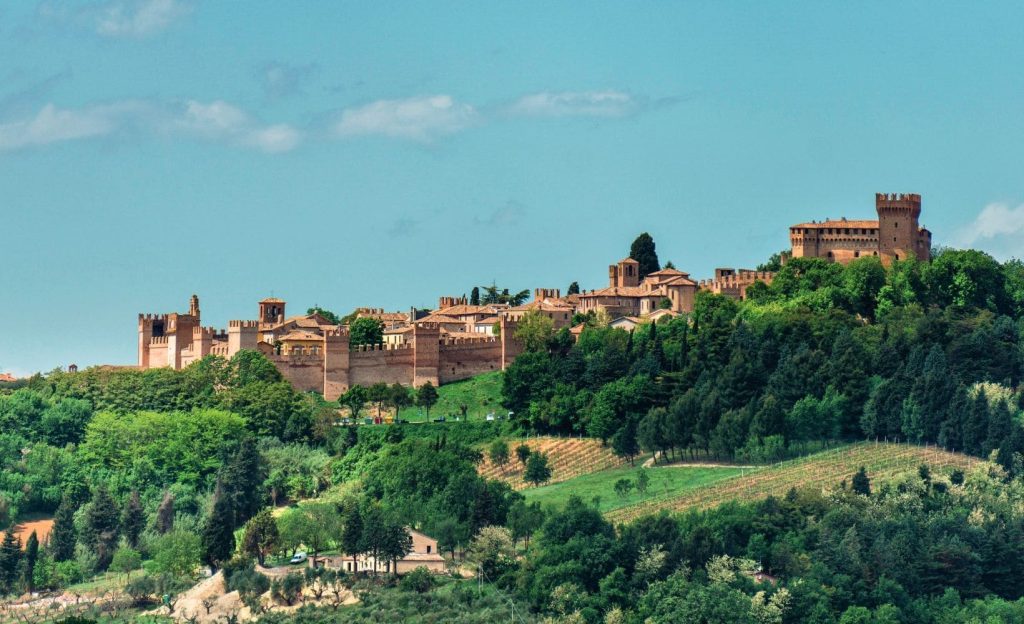
Gradara is an extraordinary gateway to a truly unique place. A border village just a stone’s throw from Romagna, nestled in the hills yet close to the Adriatic, it has for centuries served as the magical gateway from the northern lands to the Marche, a passageway leading into another dimension of time.
As you step through the clock gate – the main entrance to the castle – any sense of the present fades away. The hands of the two large dials at the top of the tower seem to turn backwards, transporting visitors straight into the heart of the Middle Ages.
The village’s main street runs steeply upwards, still echoing with the clatter of horses’ hooves. The path leads to the majestic fortress, once home to lords and soldiers, the setting for historical events and tragic love stories that have become the subject of immortal poems.
On either side of the street and along the criss-crossing alleyways, the shops display traditional ceramics, whilst the taverns lovingly prepare dishes using produce from the countryside. Within the imposing walls, the flavours of the region help to gently blur one’s sense of time.
The boundary between yesterday and today is blurred by the inhabitants of Gradara, who proudly preserve their legendary past. Through period costumes and spectacular re-enactments that bring the village to life, history is not merely a memory, but a vibrant, shared experience.
This ability to preserve the spirit of its history and to showcase its unique architectural heritage has propelled Gradara to the very pinnacle of national tourism excellence, earning it the prestigious title of ‘Borgo dei Borghi’ in 2018.

Discover the charms of Gradara
The Beauty Trail comes to life
Exploring the beating heart of the Marche has never been easier with Criluma Viaggi!
Romantic weekends, days spent immersed in nature or cultural tours: we’ve put together itineraries to suit all tastes and time frames.
The imposing fortress
The symbol of Gradara, a fortified gem
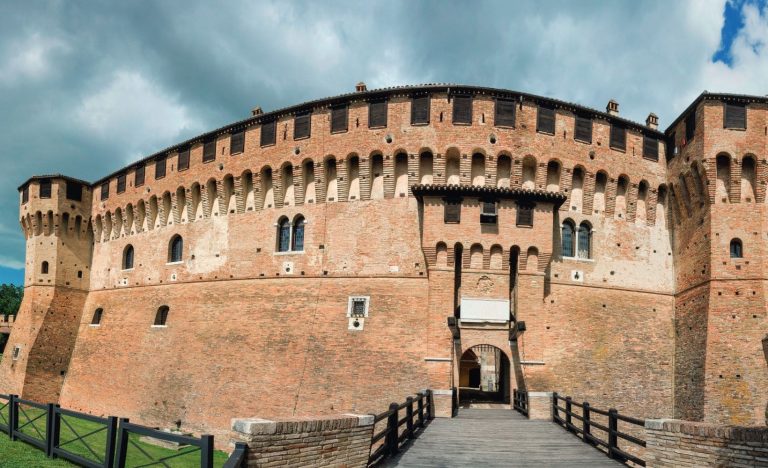
Gradara has always been synonymous with its fortress. Protected by its ramparts, the fortress – which for centuries has defended noble and famous dynasties – forms the historic yet vibrant heart of the surrounding town.
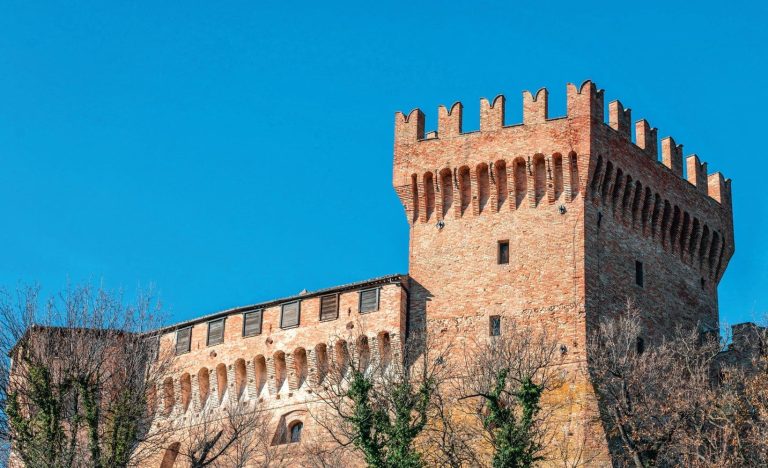
The keep, the main tower, dominates the entire surrounding valley from a height of almost forty metres. It was built in the 12th century by the De Grifo family, who were later succeeded by the Malatesta family.
The fortress, now state-owned, has undergone various alterations throughout its long history.
Extensions and alterations were made to the original structure under the rule of the Malatesta and Sforza families. In particular, Giovanni Sforza, on the occasion of his marriage to the very young Lucrezia Borgia, daughter of the infamous Pope Alexander VI, added two wings to the inner courtyard and a grand staircase leading to the halls on the main floor.
Inside the fortress’s strong and imposing shell, once you have crossed the drawbridge, you discover a delightful blend of art and beauty.
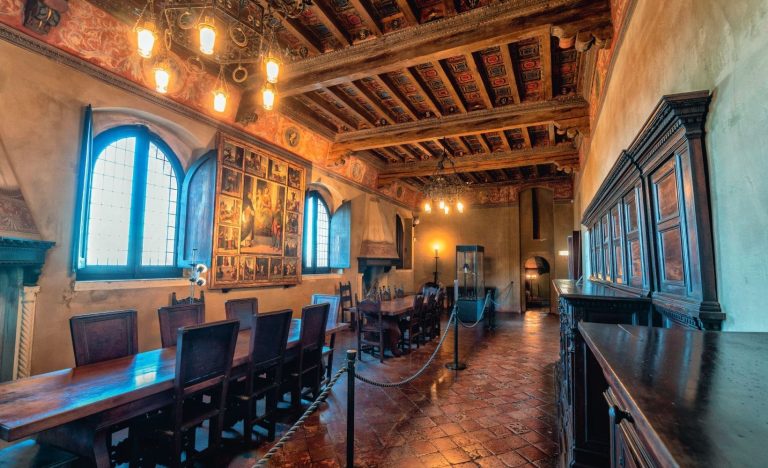
The interiors are characterised by antique furniture, scattered throughout rooms with evocative names; as well as featuring prestigious frescoes, they offer stunning views from the windows overlooking the lush natural landscape of San Bartolo.
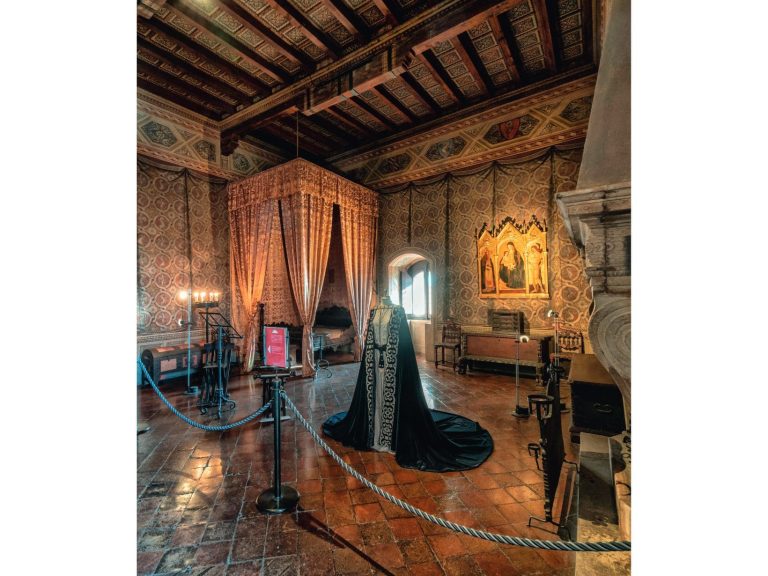
Passing through private rooms and soldiers’ quarters, one reaches the famous Francesca’s Chamber.
Inside, as well as a four-poster bed, there is a trapdoor which is said to have been the passageway used for Paolo’s amorous visits; it is here that he is said to have met his end alongside his beloved, both struck down by Giangiotto’s vengeful blade.
The room also features a replica of a splendid stage costume designed by the fashion designer Alberta Ferretti, modelled on the one worn by Eleonora Duse, D’Annunzio’s lover and muse, whom he cast in the role of Francesca da Rimini in the tragedy of the same name.
The Rocca is also home to a number of valuable works of art, among which the altarpiece by Giovanni Santi – father of the great Raphael – and the glazed terracotta altarpiece by Andrea Della Robbia, inside the chapel, stand out.
Love, which forgives no one who is loved
Gradara, the town of love
Love has been celebrated by countless poets over the centuries, depicted in every possible way and set in every conceivable place. Yet, “it is in that land situated between Romagna and the realm of Charles” (Dante in Purgatory, alluding to the Marche) that what is perhaps the greatest and most poignant of all love stories unfolds.
Gradara Castle is the setting where the tragic tale of Paolo and Francesca is said to have unfolded, immortalised by the verses penned by Dante Alighieri in his Divine Comedy.
The events are true: Francesca da Polenta, daughter of Guido, Lord of Ravenna, was given in marriage to the lame Giovanni Malatesta, known as Gianciotto, in a marriage of convenience aimed at strengthening the bond between the two families.
Francesca was forced to submit, but she carried on a clandestine affair with Paolo, Giovanni’s charming and courteous brother, within the walls of the Malatesta Fortress in Gradara, where Gianciotto rarely visited, being occupied with his political duties in the Pesaro area.
But one day the two are discovered, and Giovanni puts them to death by the sword.
Dante elevates the story to poetry. Canto V of *Inferno* is dedicated to the story of the two lovers. The triptych of tercets beginning with the anaphoric ‘Amor’ remains, centuries later, one of the greatest masterpieces of poetry.

Dante condemns the couple’s adultery, yet even amidst the infernal storm he depicts them as inseparably united. The Rocca and the whole of Gradara are steeped in the echoes of those verses.
Amidst the greenery surrounding the city walls, the lovers’ walk offers a romantic route to be enjoyed hand in hand, amidst the sounds of nature and the splendid views.
Touch, sight, hearing, but also smell: a start-up from the University of Camerino has created, with meticulous attention to detail and using local produce, two fragrances dedicated to Paolo and Francesca, designed to complement their respective strong and sweet personalities, which can be combined to create a third scent; by blending the two aromas, it recreates the magic of the embrace that not even death could break.
Places of worship and culture
Between holiness and cruelty
In the ancient villages, the bells would ring at regular intervals, filling the air with their reassuring tones that marked the passing of the day. In Gradara, two bells ring in two places that are very different yet equally linked to the town’s history, both sacred and secular.
In the Historical Museum, a miniature bell rings only if struck in just the right spot with a coin. If the gong sounds, tradition has it that the visitor will enjoy great good fortune.
The bell is the final stop on a tour of a museum that traces some of the most grimly typical practices of an era when violence was the primary means of resolving a dispute.
Alongside a display of old weapons, including scale models of throwing machines and catapults, there is also a collection of faithful reproductions of instruments of torture, which were used to force even the most honourable of knights to speak – comprising whips, pickaxes, Procrustean beds and spiked chastity belts.
As well as the weapons, the museum also provides access to a section of the many caves that wind their way beneath Gradara. These tunnels were used not only to defend against the constant battles but also to perform the pagan rites that the Church had banned.
And it is precisely a church – that of St John the Baptist, situated beneath the fortress – which houses the other bell, this time a traditional one, which visitors can ring, allowing them to step into the shoes of an old sacristan.
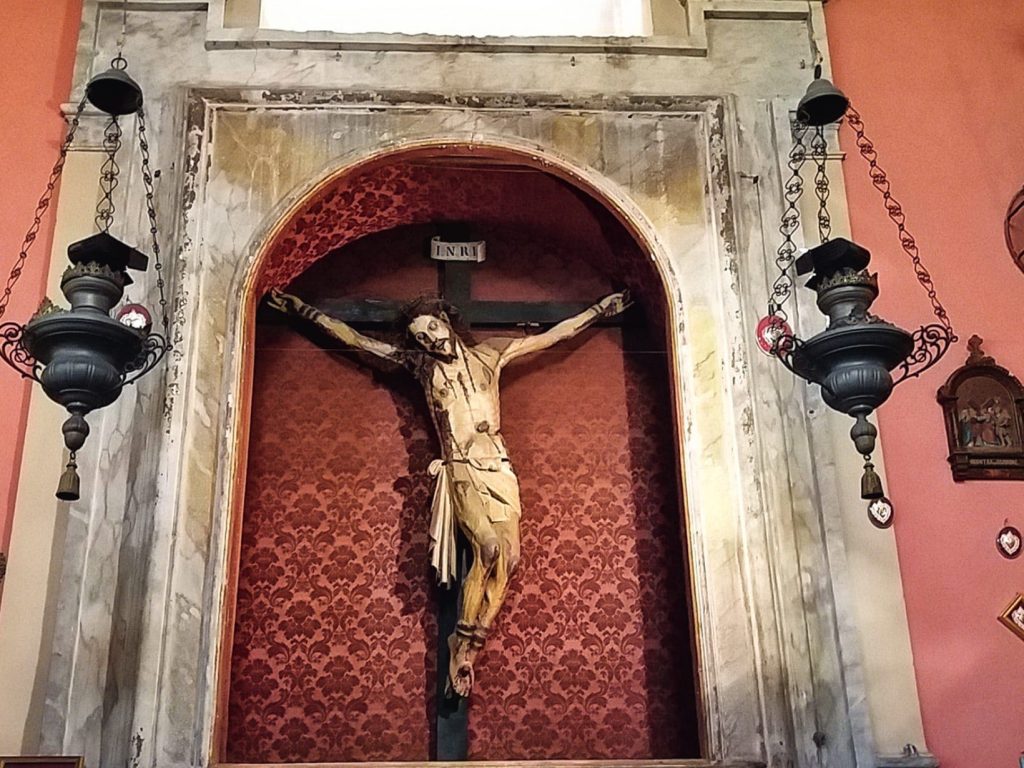
Of ancient origin, once you pass through the 14th-century façade, you’ll find inside a splendid wooden crucifix, the distinctive feature of which lies in the perspective used to render the face.
Moving from right to left through three carefully marked positions, it seems, in fact, that at first the suffering Christ might still utter a few words, before passing into a state of fatal agony, and finally reaching an expression of peace in the serene repose of death. The artist behind this beautiful work may well have sought to encapsulate, by carving it from polished wood, the sacredness and mystery of the Christian Trinity.

The rampart walk
The castle walls and the magnificent landscapes
There are ways of doing things that we have forgotten, ways of appreciating life that we can draw from the past, make our own and use to enjoy every moment to the full.
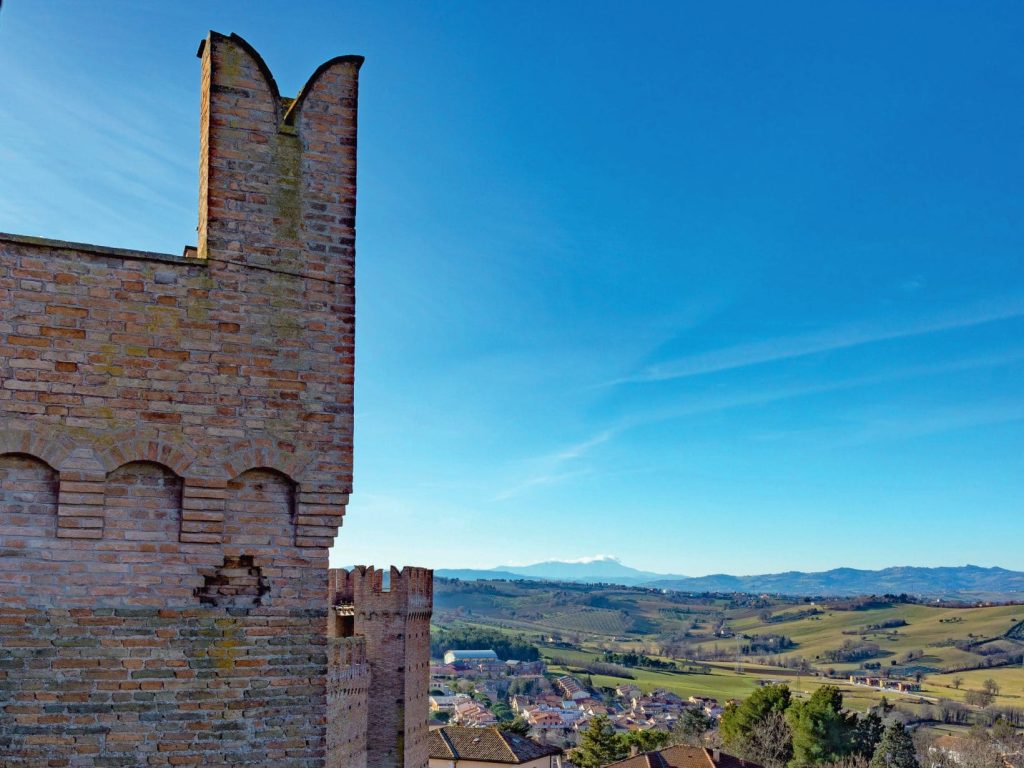
One such way is to stroll through splendid places like Gradara with a measured, calm and steady pace, in time with one’s own breathing: the even, controlled stride that soldiers used to adopt whilst on patrol along the nearly eight hundred metres of imposing walls surrounding Gradara.

A route that can still be followed, at least in part, today, amongst watchtowers, loopholes and battlements, which, step by step, open up to reveal dazzling views.
Along this elevated perimeter, the view stretches to unexpected distances, taking in San Marino or the Malatesta-era Rimini, the crystal-clear blue of the Adriatic or the green expanses of San Bartolo Park, which borders the town of Gradara.

You can continue this revitalising walk by descending from the rough stone and passing through one of the village’s side gates to reach the various paths that wind around the fortress, or sit in the shade of the trees in the Garden of the Olive Trees, which is the subject of research due to the rarity of its particular variety.
Gradara is also a centre for environmental education, dedicated to the protection and promotion of its natural heritage, which, within a small area, encompasses a vast variety of tree species, ready to be explained by the knowledgeable guides on hand. The spectacle is not limited to the ground, however: whilst strolling through the greenery, you may hear loud cries coming from the sky.
If you look up, in summer you can admire the splendid soaring of eagles and falcons at the Teatro dell’Aria, a falconry centre offering magnificent displays of this hunting art—so widespread in the Middle Ages—based on the predatory skills of these elegant birds of prey.

Gradara, the town of games
History becomes theatre
How many schoolchildren have despaired whilst trying to remember dates, names and events linked to the study of history.
In Gradara, the past comes alive, but it does so in unexpected and entertaining ways, managing to entertain and educate at the same time, offering experiences that link the past to the present.
It is no coincidence that this approach has taken root in Gradara, which boasts a rich tradition linked to the world of play, having hosted Italy’s first public play centre.
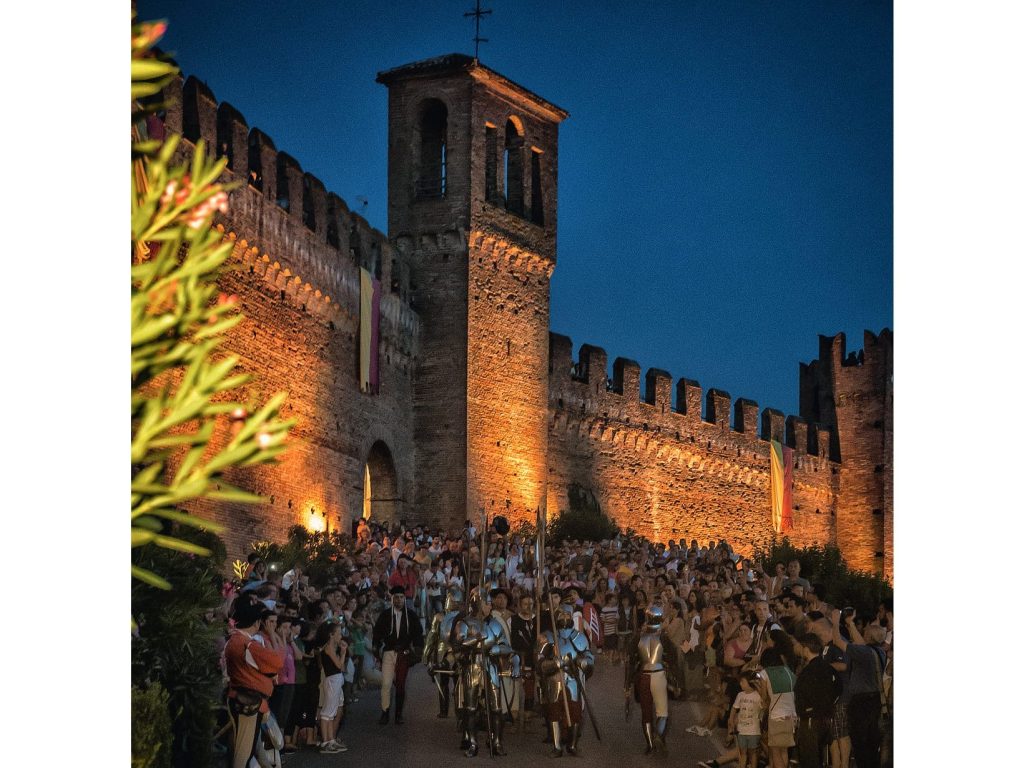
Today, this spirit is reflected in the opportunity to attend shows and historical re-enactments that combine meticulous historical accuracy with spectacular pyrotechnic and musical displays, such as the summer evenings of ‘Thursday at the Castle’ or the ‘Siege of the Castle’, an event that re-enacts the stoic resistance of the Malatesta Fortress under attack from the allied forces of Sforza and Montefeltro.
On these and many other occasions, the people of Gradara wear traditional costumes, skilfully recreated down to the smallest detail using authentic materials by specialist tailors, such as Vanessa Menghi, who, from her ‘Sartoria dei Malatesta’, dresses these re-enacted ladies and knights. So it is not uncommon to stroll through the streets of Gradara and witness traditional dances from every era, from the Renaissance to the Baroque, as well as historical performances prepared and staged with passion in the village theatre.

Anyone can step back in time and experience first-hand the animated, interactive tours that come to life in the village’s most picturesque spots – a unique opportunity to discover historical events by playing an active part in them.
And if you’re looking for an alternative to those heavy history textbooks from school, a famous illustrator from Gradara, Alan D’Amico, has created an entire graphic novel that traces the town’s history through speech bubbles and stunning illustrations, as well as a board game in which the fortunes of the ruling families who once governed Gradara are decided by illustrated cards and coloured pieces moved by the players.

Traditional flavours on the border
between two lands
Explosive traditional recipes
Gradara is a border town whose history is intertwined with that of the neighbouring Romagna region, as are its flavours, to the extent that people have come to speak of ‘Marchignola’ cuisine. A culinary journey straddling two regions, as suggested by the name of the Cibovagando tavern or the selection of dishes on offer at the ‘Emporio del gusto’ — a blend of Marche and Romagna specialities — which, alongside typical Marche products such as olive oil and wines, offers ‘grappone alla pera’, a fruity pear brandy, or the intriguing salami preserved in a golden casing made of beeswax, typical of Romagna. Gradara also boasts products deeply rooted in its own history, such as ‘Gradarino’ brittle or the ‘Cioccolatino Galeotto’, which evokes on the palate the sweet passion between Paolo and Francesca. But the traditional recipe par excellence is ‘Tagliolini con la Bomba’.
A typical winter dish that used to be prepared in the large fireplaces of country houses by the ‘azdora’ – the matriarch and queen of the hearth – who would fry onion and lard (or fatty pancetta) in the region’s exquisite olive oil; meanwhile, tagliolini were cooked in salted water; the excess water was drained, leaving the dish slightly broth-like, and the fried lard and onion were poured into the pot, with a sprinkling of pepper added.

The effect of the hot oil being poured into the water caused a veritable explosion of steam, which gives this dish its name; it was devoured eagerly by the children, driven by ravenous hunger and the eagerness to secure a second helping.
The rapid suction caused the piping-hot tagliolini to bounce against the children’s noses, scalding them, and as the dish was served almost every day as their only meal, the minor burns never had time to heal.
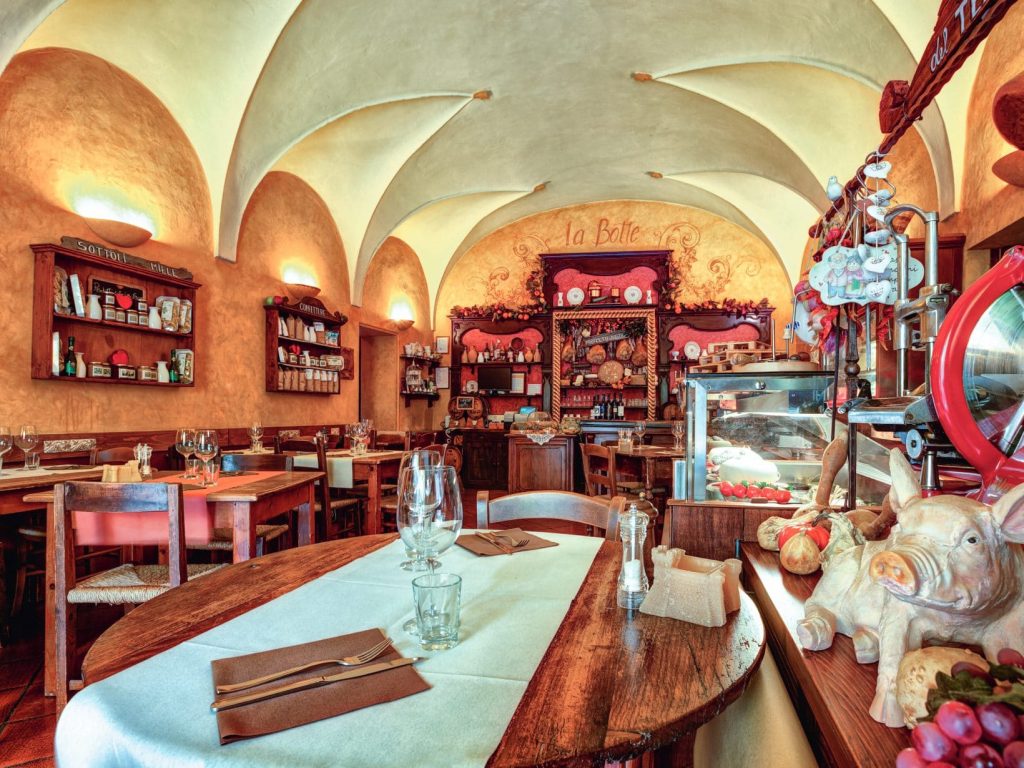
Today, it is still possible to enjoy this ‘humble’ yet tasty dish at the restaurant ‘La Botte’, which follows Gradara’s philosophy of maintaining a link with culinary tradition – a tradition that comes to life during ‘Il Medioevo a Tavola’, a series of events dedicated to medieval cuisine organised throughout the year, during which the village’s restaurants are transformed into authentic 15th-century taverns.


Discover the charms of Gradara
The Beauty Trail comes to life
Exploring the beating heart of the Marche region has never been easier. Criluma Viaggi is proud to bring to life Confcommercio Marche Nord’s ‘Itinerario della Bellezza’ project, transforming a guide to excellence into real-life itineraries, ready for you to experience.
Romantic weekends, days spent immersing yourself in nature or cultural tours: we have created itineraries to suit all tastes and time constraints. The Criluma experience is the added value that guarantees you first-class treatment, comprising continuous support, personalised attention and immediate responses.