
6 reasons to visit
Piobbico
A story woven from passions, wars, narrowly averted attacks and uneasy friendships: Piobbico welcomes visitors with the magnetic charm of an adventurous past. Today, this tranquil little town, nestled in an Apennine valley, holds within its very stones the echoes of human stories that seem to have stepped straight out of a historical novel.
Protected by two imposing natural ‘guardians’, Monte Nerone and Monte di Montiego, Piobbico enjoys an extraordinary geographical location. The village is surrounded by stunning mountain landscapes, offering scenes that change with the seasons and captivate anyone who loves unspoilt nature.
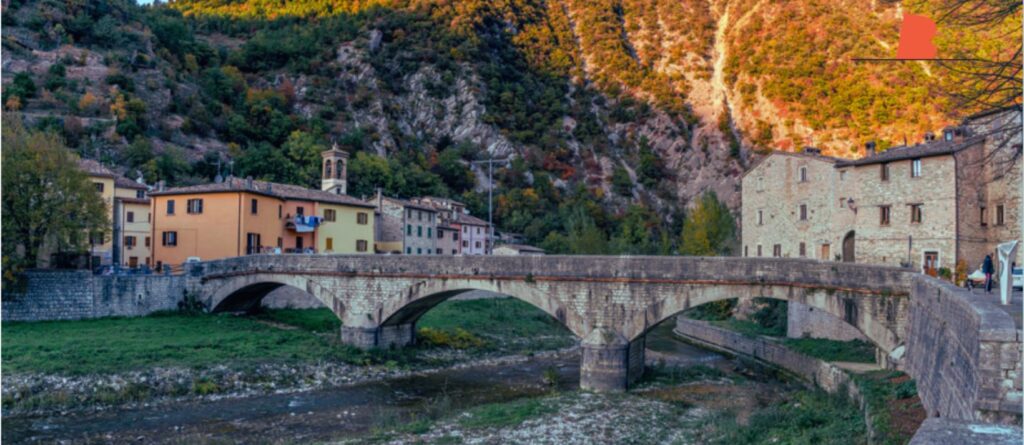
Nestled 339 metres above sea level, the village is crossed by two vital watercourses: the Biscubio, which rises at Bocca Serriola, and the Candigliano, which flows from the lands of Città di Castello. This interweaving of rivers lends the town a constant sense of freshness and a musical quality, defining its hydrographic profile.
The history of Piobbico is inextricably linked to that of the Brancaleoni, a noble family that guided the village’s development for centuries. Their rule left a legacy of power and culture which, even today, remains the cornerstone of the town’s identity and its sense of historical pride.
The monumental Palazzo Brancaleoni is a treasure trove of local artefacts: amongst its precious frescoes, it houses the Civic Museum of Ancient Crafts and a significant geo-paeontological section. A cultural centre of excellence that takes visitors on a journey through time, from prehistoric eras to everyday life in the Middle Ages.
Combining tradition and magic, Piobbico is renowned for its famous ‘Club dei Brutti’, an international organisation with over 30,000 members. This sense of humour goes hand in hand with the folklore of the Sentiero dei Folletti (Path of the Elves), a fairy-tale trail that takes visitors on a journey of discovery through the village’s most breathtaking and hidden corners.

Discover the charms of Piobbico
The Beauty Trail comes to life
Exploring the beating heart of the Marche region has never been easier with Criluma Viaggi!
Romantic weekends, days spent immersed in nature or cultural tours: we’ve put together itineraries to suit every taste and every timeframe.
The history of the ‘Piobici’, between nature and the Middle Ages
A village steeped in a magical atmosphere
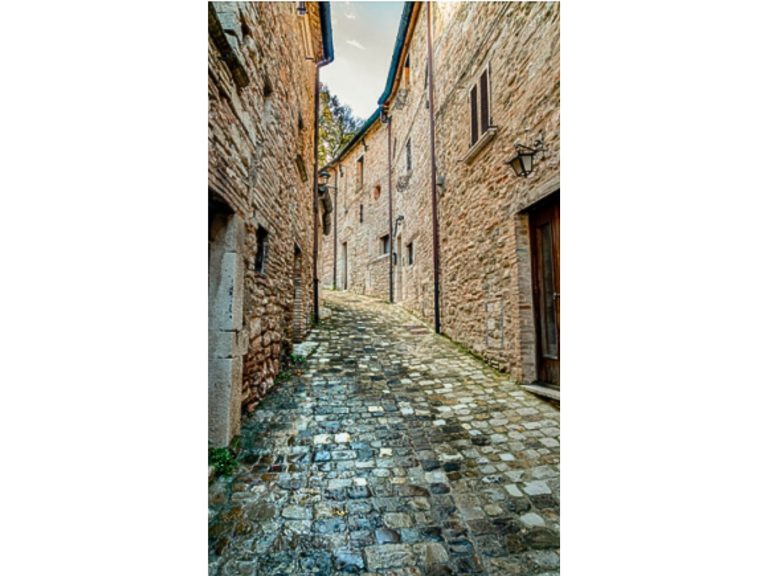
Anyone visiting Piobbico for the first time – a cosy little village nestled in a valley in the heart of the Umbrian-Marche Apennines – will feel as though they have stepped into a fairy-tale setting: rivers, streams, waterfalls, woods and mountains provide the perfect backdrop for reliving the ancient fairy tales that are still told to children today.
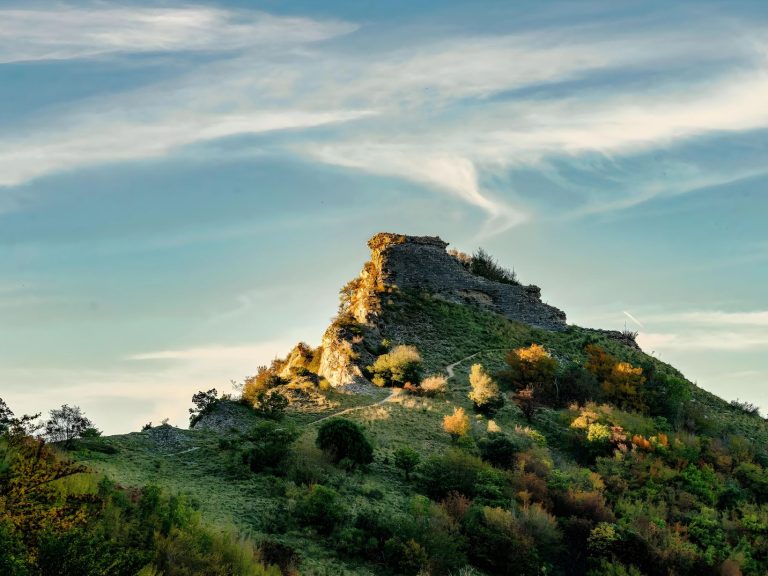
Piobbico lies right here, at the foot of Mount Nerone and Mount Montiego, where the River Biscubio flows into the Candigliano. The waters flow peacefully through the village, passing under the bridges and winding their way along the streets of the old hamlet. The history of Piobbico’s origins dates back to medieval times, around the year 1100, when the Brancaleoni family, likely of German origin, took up residence on a small hill along the ridge of Mount Nerone, where they built an imposing castle, a symbol of strength and majesty, in an area known as ‘Mondellacasa’ and which is now called ‘Muracci’ because of the remaining ruins.
Moving down into the valley later on – we are now around the year 1200 – after initially living alongside the local people, the Brancaleoni gradually took possession of their homes, eventually driving them out for good and establishing the ancient village. The name ‘Piobbico’, in fact, derives from the earlier Roman settlement known as ‘publicum’, from which came ‘plobici’ and, ultimately, Piobbico. To reach today’s historic centre, one must pass through two gateways: the Porta di Ponente and the Porta di Levante.
The first, also known as Felignino, was connected via a humpback bridge spanning the Candigliano – which was demolished during the Second World War – to the Mercatale, a plain which, as the name suggests, once hosted the castle’s market, with numerous artisan workshops, traces of which remain in the Romanesque and Gothic arches – now bricked up – visible on the façades of the buildings lining Via Mercatale, which retains the name of the ancient site.
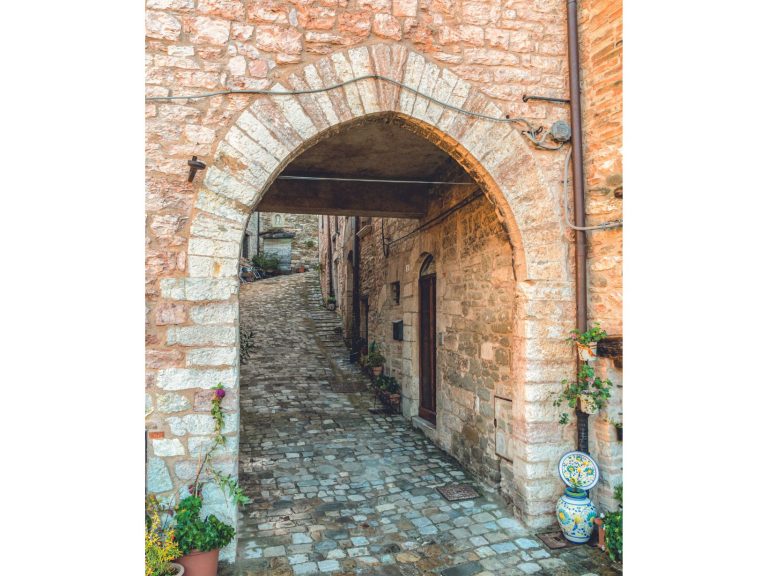
Once through the gate, the road splits into two branches: one leads to the Porta di Levante, whilst the other leads to the steps of Palazzo Brancaleoni via a looping route.
The second entrance to the ancient village, the Porta di Levante, features a distinctive depiction above the arch: the allegory of Nicolosa, that is, Prudence. From ‘nihil osa’, meaning ‘do not dare’, today the meaning of this figure is associated with duplicity and falsehood, due to the saying ‘to have more faces than the Nicolosa’; in reality, originally, the meaning of Nicolosa’s faces – this triple face of a bearded man – signified a prudent man, capable of seeing the past, present and future simultaneously, assessing everything with foresight and care.
Finally, as you venture further into the narrow streets of the village, your gaze is captivated by the distinctive and unique colours of the houses: from the red of the stone from Monte Montiego to the white of the carnelian stone that adorns the door and window frames.
Brancaleoni Castle
A labyrinth of 135 rooms, a symbol of the Brancaleoni family’s power
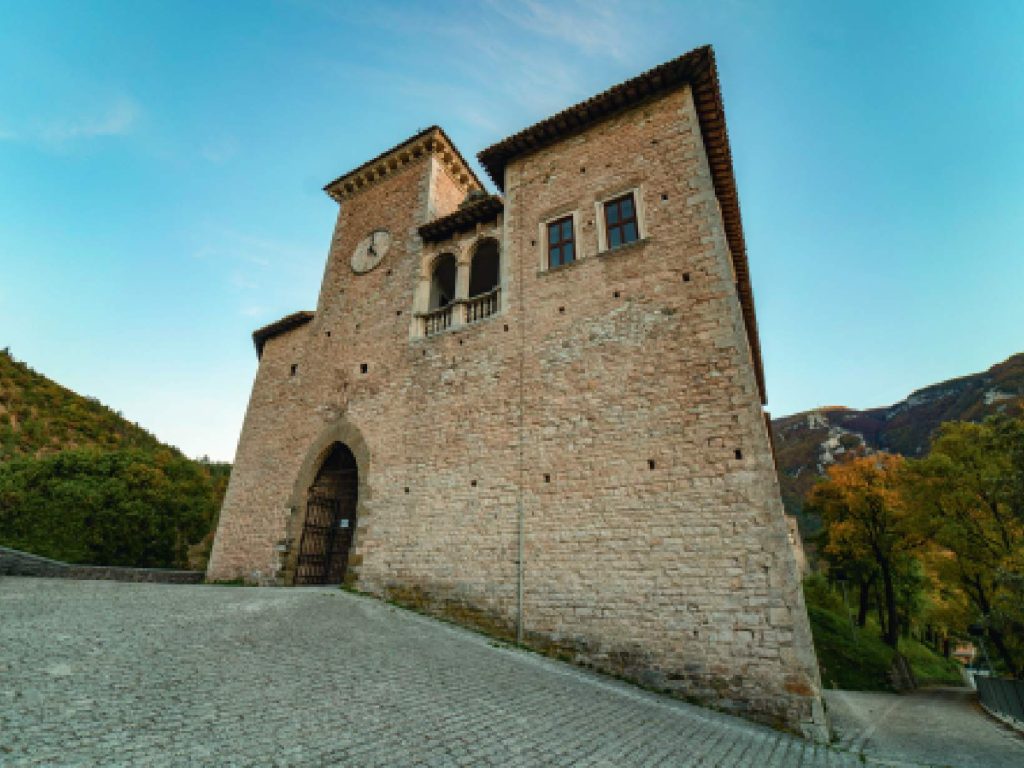
Greek, Latin and vernacular Italian cultures blend together, just as medieval, Renaissance and Baroque styles merge in the majestic and enchanting Palazzo Brancaleoni (now the Castle), which, with its more than 135 rooms, bears witness to intrigues and harbours a treasure trove of secrets.
A palace that is a veritable historical treasure trove: even if the documents chronicling its history were to be lost, it could be reconstructed from the dates and names inscribed above each window and at the ends of each doorway. Construction began in 1200, the Castello is distinguished first and foremost by its travertine entrance portal, the work of the architect Genga, on which stands out the rampant lion beneath the inverted cross – the Brancaleoni coat of arms and a symbol of the family’s membership of the Knights of Malta.
‘Praos kai tolmeros’, ‘meek and bold’, is the Brancaleoni motto on the coat of arms, even though meekness was not exactly in their blood. From the evocative open-air corridor – walking along which, as if leafing through a book of stone, one can see windows and doorways bearing inscriptions in Greek, Latin or the vernacular – one enters the Renaissance courtyard and, subsequently,
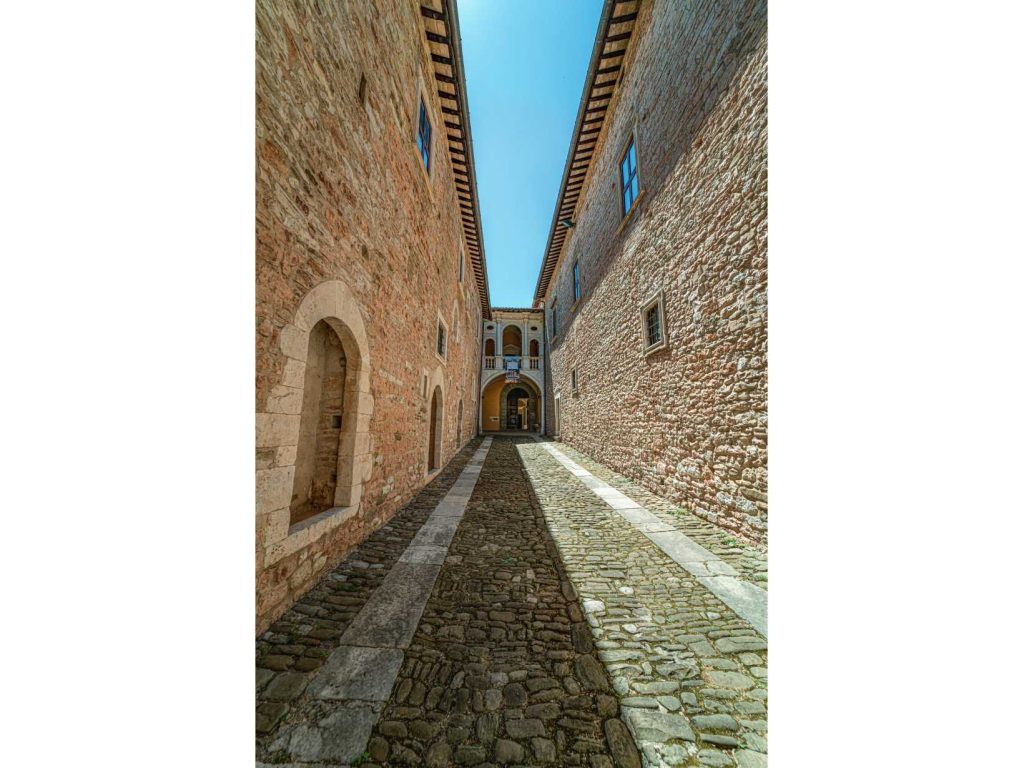
to the chamber of torture and traps (a notable feature being the pit in one corner of the room, surrounded by long, sharp knife blades, into which the unsuspecting victim – locked up here in the dark – would often fall). Walking up the castle’s main staircase – which has now been rebuilt as it was worn down by constant use, though it retains its original travertine handrail – one reaches the noble apartments, including the Sala Leon d’oro, so named because legend has it that a golden lion was once actually kept there.
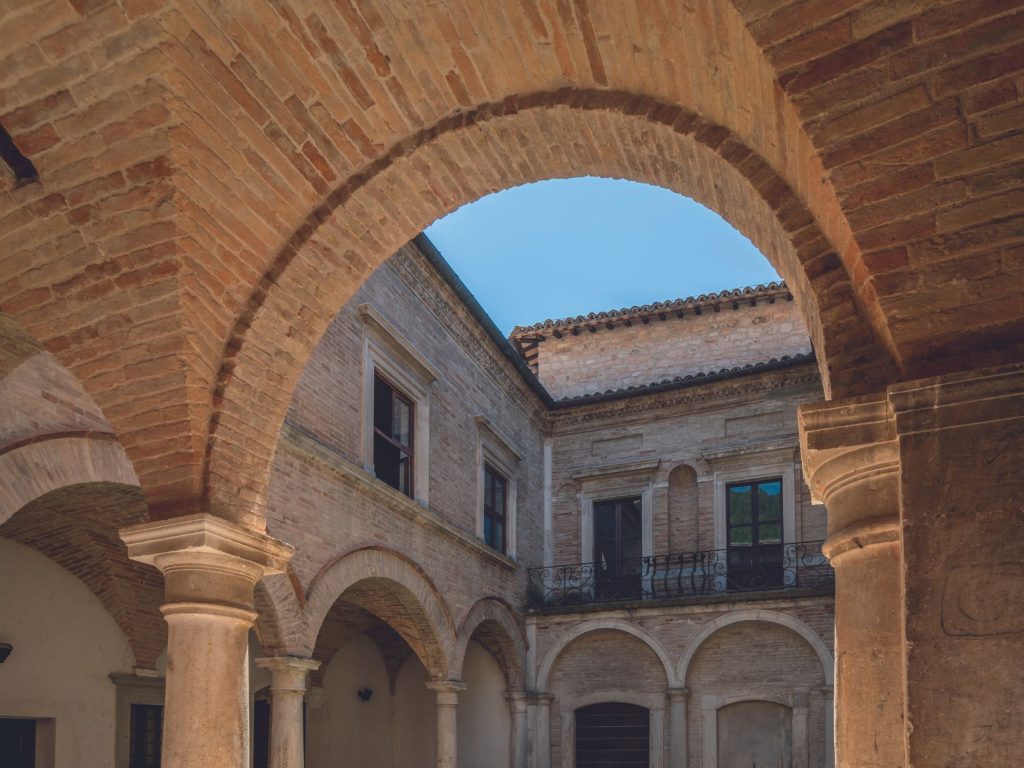
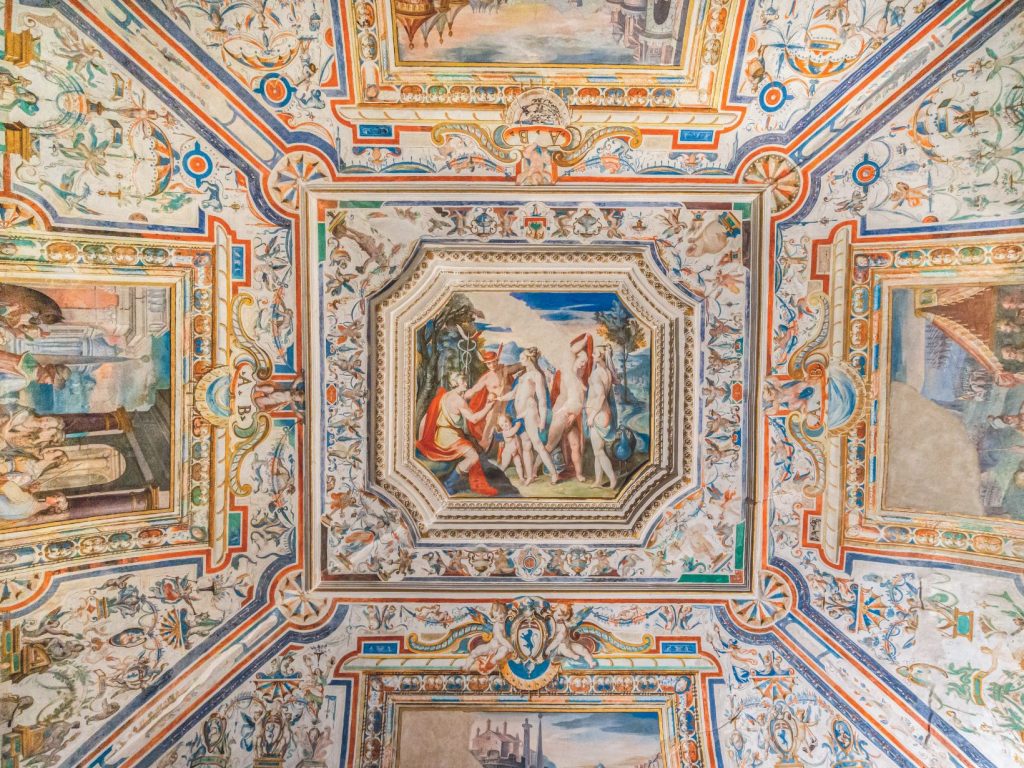
Here, the gold stucco work by the painter Federico Brandani – who also worked on the Ducal Palace in Urbino – is on splendid display. Continuing the tour and making our way up through the labyrinth of the majestic castle, walking across the original terracotta floor, we arrive at the Camera Romana, the Countess’s chamber, adorned with frescoes depicting scenes from ancient Rome and stucco work by Brandani; then the room of Count Antonio II, also known as the Greek Chamber, a small study for meditation with frescoes depicting episodes from the Old Testament.
All the paintings, restored some 40 years ago, feature bright, vivid colours. Looking out from the balcony, the tower clock, built in 1610, can be seen in the distance; it has a distinctive feature: the side facing the village displays standard Roman numerals, whilst on the side facing the interior of the palace, the numerals are inverted and the hands move anti-clockwise.
Last but not least, from the kitchen area one can admire the indescribable series of doors along which the eye seems to lose itself into infinity.
It’s not just traditional crafts in Piobbico
Weaving, carpentry and a slice of polentone alla carbonara
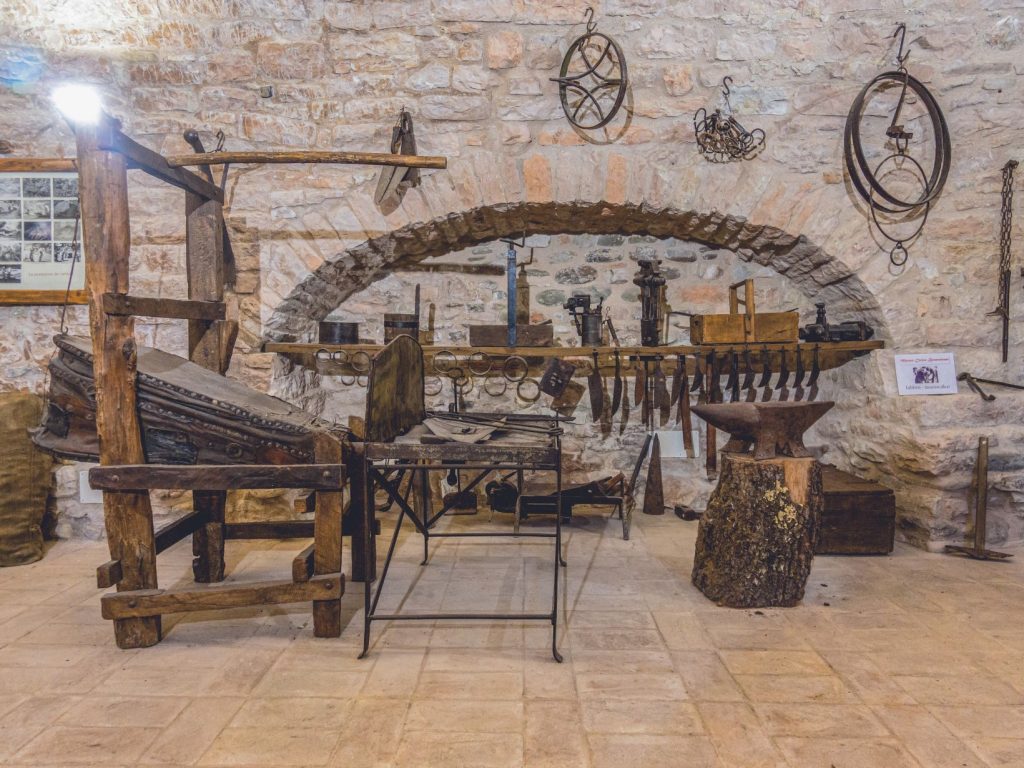
Inside Brancaleoni Castle, you can step back in time by at least a thousand years and see at first hand how people used to live.
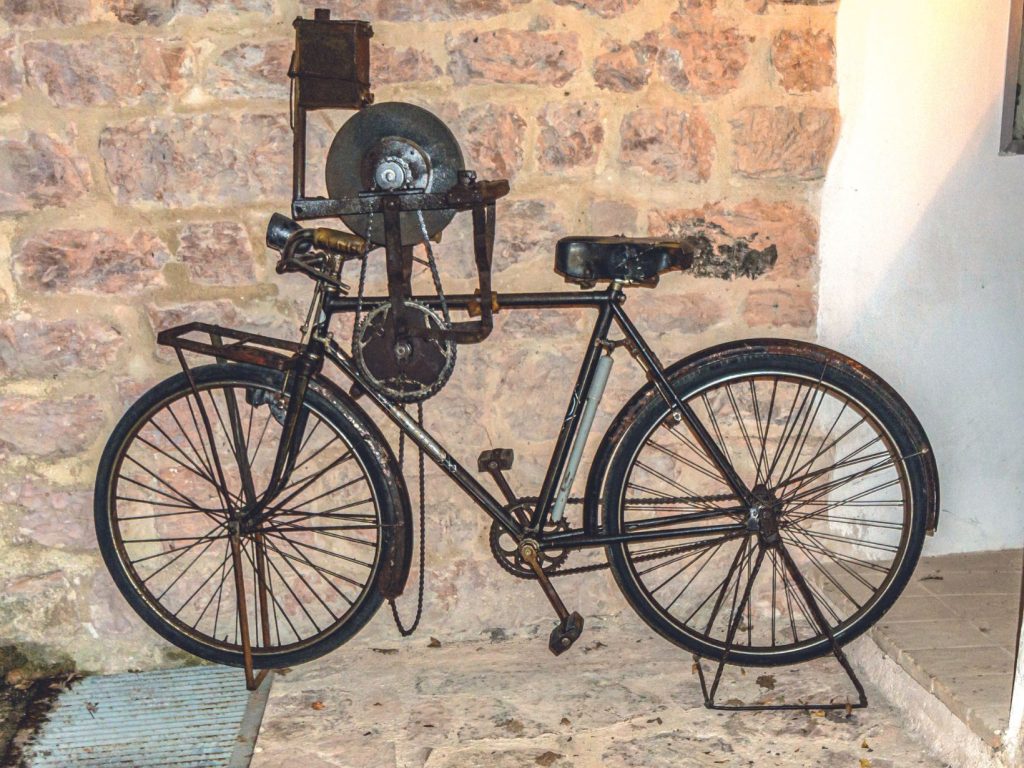
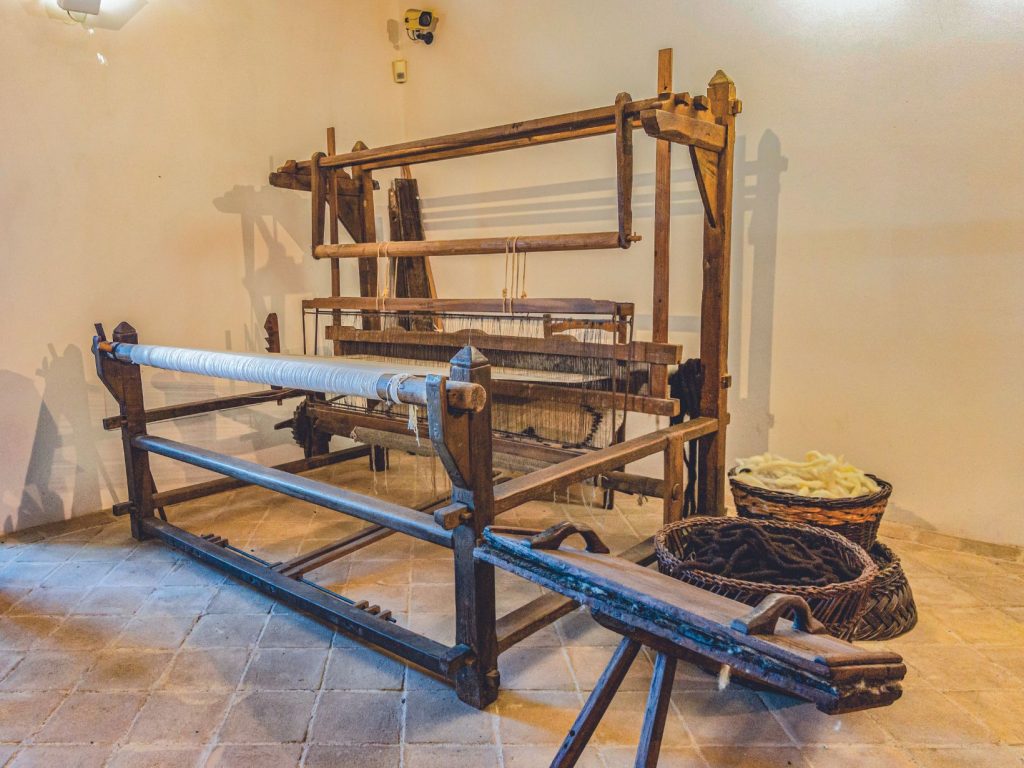
Indeed, one section of the Brancaleoni Civic Museum is dedicated specifically to the ancient trades, customs and traditions of the local area. We can, for example, imagine mothers sitting at their looms, making their daughters’ trousseaus for their upcoming marriages: sheets, pillowcases and fabric for dresses, woven from hemp or wool.
It was precisely with wool that the traditional rugs of Piobbico were hand-woven (and still are today by the master weaver Michela Formica), with their vivid natural colours extracted from dye plants (notably woad), cultivated by local farmers. Another widespread trade in Piobbico was that of the woodcutter, who produced charcoal and wood charcoal from the wood of the forest, much sought after by those who cooked on grills.
Linked to this trade is the exquisite ‘polentone alla carbonara’, a simple dish prepared by the woodcutters by hanging a cauldron from a tripod, into which they sprinkled polenta flour as soon as the water
It was boiled, stirring constantly.
Once it had thickened, the polenta was turned out onto a tea towel and cut with a piece of string, then seasoned with pecorino: in short, a simple and nutritious meal that enabled the tireless workers to carry on with their strenuous labour with renewed energy.
Once the wood had been cut, it was loaded onto carts pulled by mules. It was, of course, the blacksmith-farrier who shoed the mules that carried the wood.
Among the other trades practised in Piobbico was that of the carpenter, and in the museum we can see the tools in use at the time, from the lathe to the planer-saw.
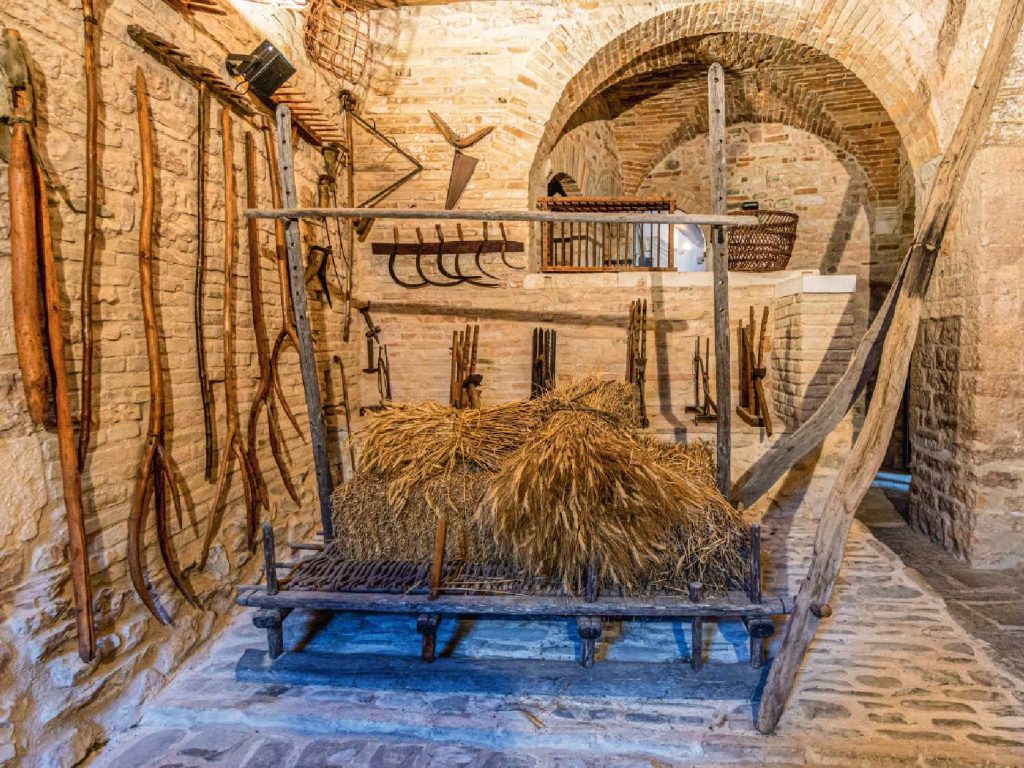
Finally, we find tools associated with farming, from the two-wheeled cart to the sickles used to harvest the wheat by hand and then stack it into sheaves using the presses. The wheat was then transported on an ox-drawn sledge to the farmer’s threshing floor.
A tour of palatial museums and places of worship
Culture and meditation in Piobbico
Brancaleoni Castle is now home to the Civic Museum, which is divided into several sections. The oldest part of the building houses the archaeological section, where magnificent ceramics from the medieval and Renaissance periods are on display.
These are highly colourful pieces, mostly majolica, unearthed in various parts of the castle during the restoration work carried out in the 1980s. They were mainly produced in the Duchy of Urbino, for the most part in Casteldurante di Urbania. There
are also other artefacts bearing witness to the passage and settlements of pre-Roman and Roman peoples: in a remote part of the village, in fact, a Roman kiln was discovered inside a house undergoing restoration (small bronze figurines bearing Roman votive symbols were also found on the summit of Monte Nerone).
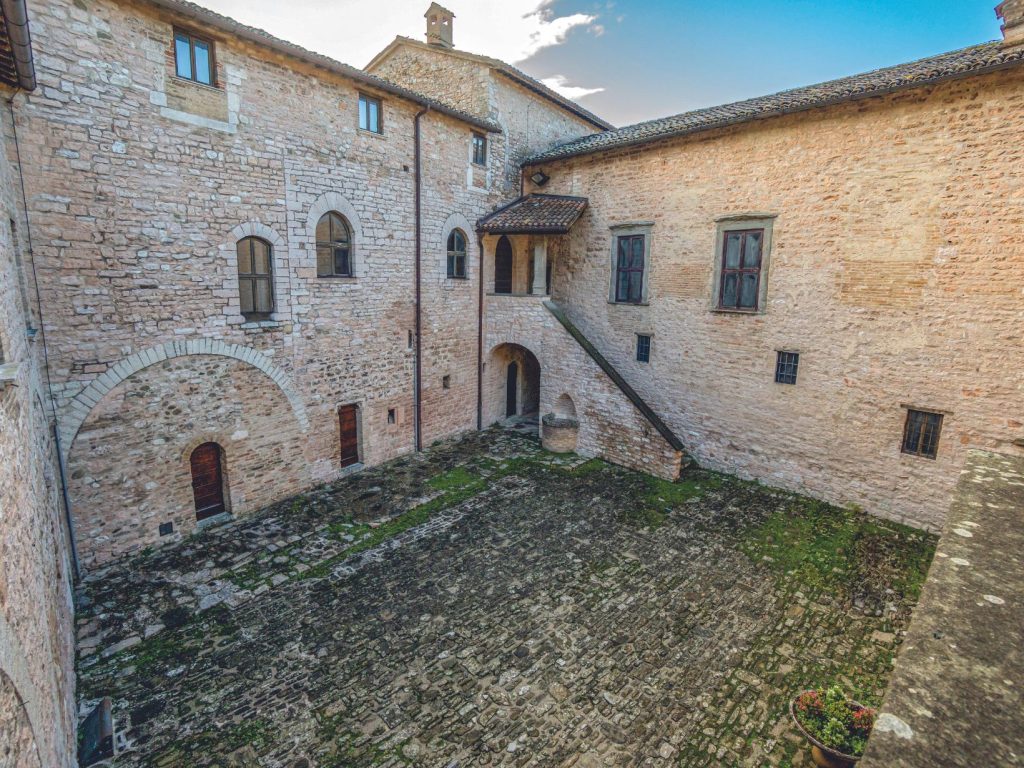
But the Civic Museum boasts even older artefacts, ranging from those of Gallic origin to Bronze Age finds (2nd millennium BC). Another section of the museum is the geo-paeontological section, which houses samples of rocks found in the local area as well as Jurassic artefacts, all originating from Monte Nerone. And that’s not all: along the corridors of this section, you can see one of the last
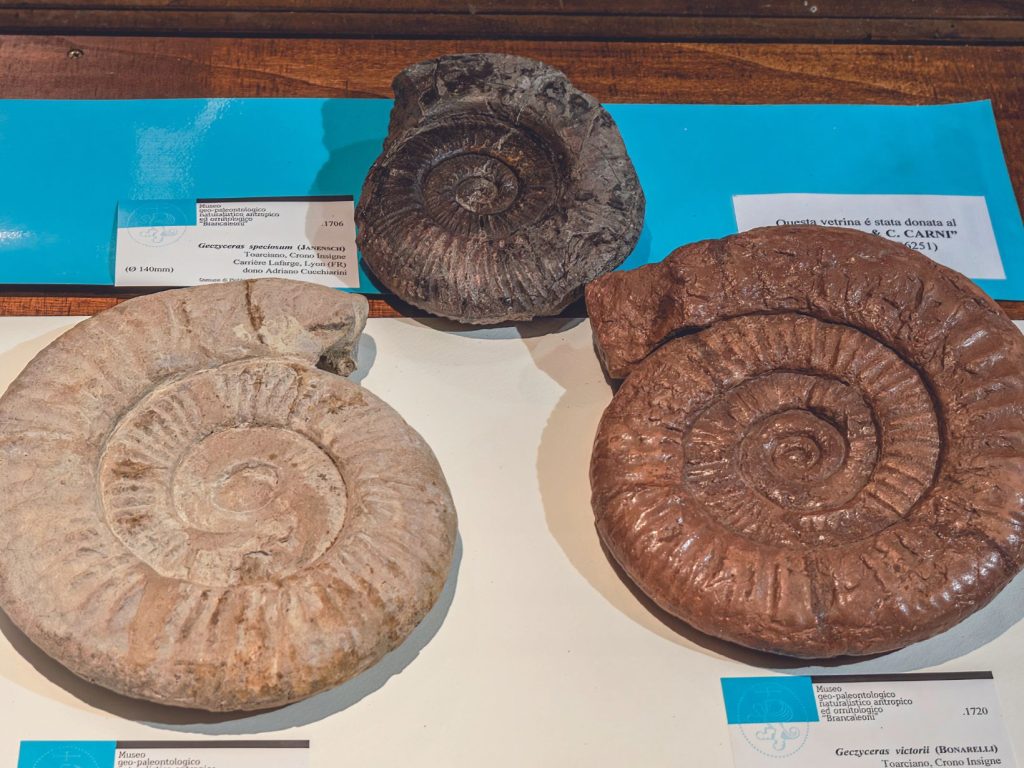
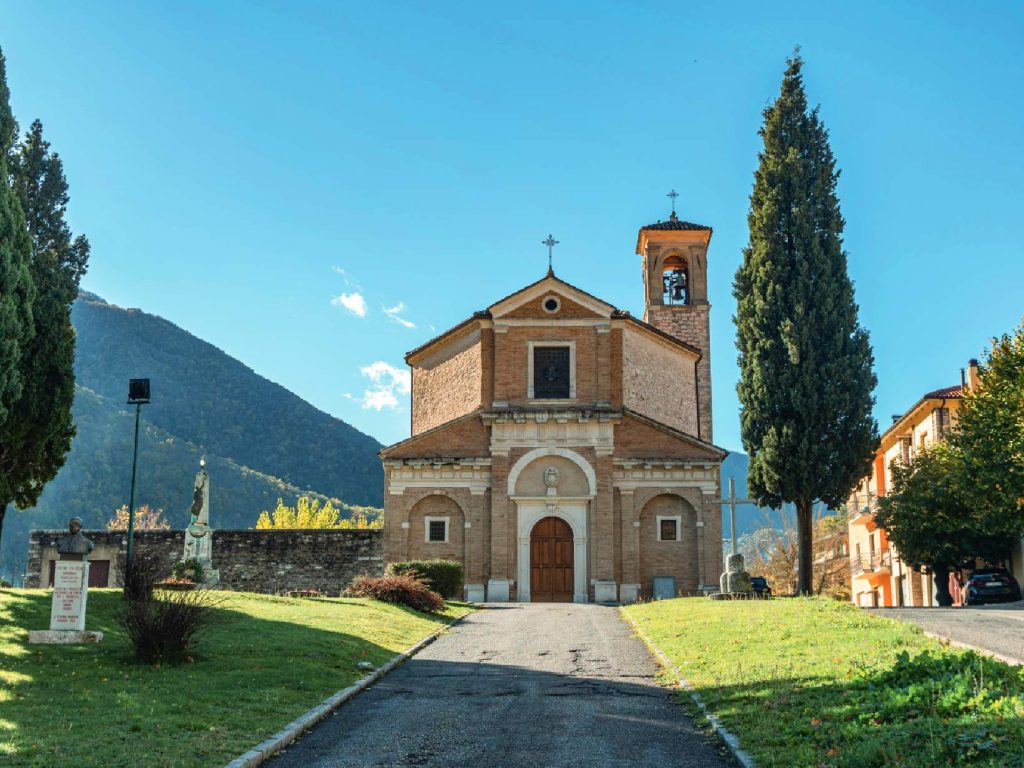
the mechanisms of the tower clock. The name of the Brancaleoni family is also linked to the places of worship built in Piobbico, from the Church of Santo Stefano to the Sanctuary of Santa Maria in Val d’Abisso.
As for the history of the former, credit must be given to the Brancaleoni family, several members of whom served as rectors of the church, for rebuilding the structure from the ground up after it was completely destroyed by the 1781 earthquake, which claimed the lives of 22 people.
The church is a terracotta building with travertine elements and an ellipsoidal plan; it houses paintings of great value, which miraculously survived the earthquake. Of particular note, amongst others, is Federico Barocci’s masterpiece ‘The Rest on the Return of the Holy Family from Egypt’, unique for the tempera technique employed.
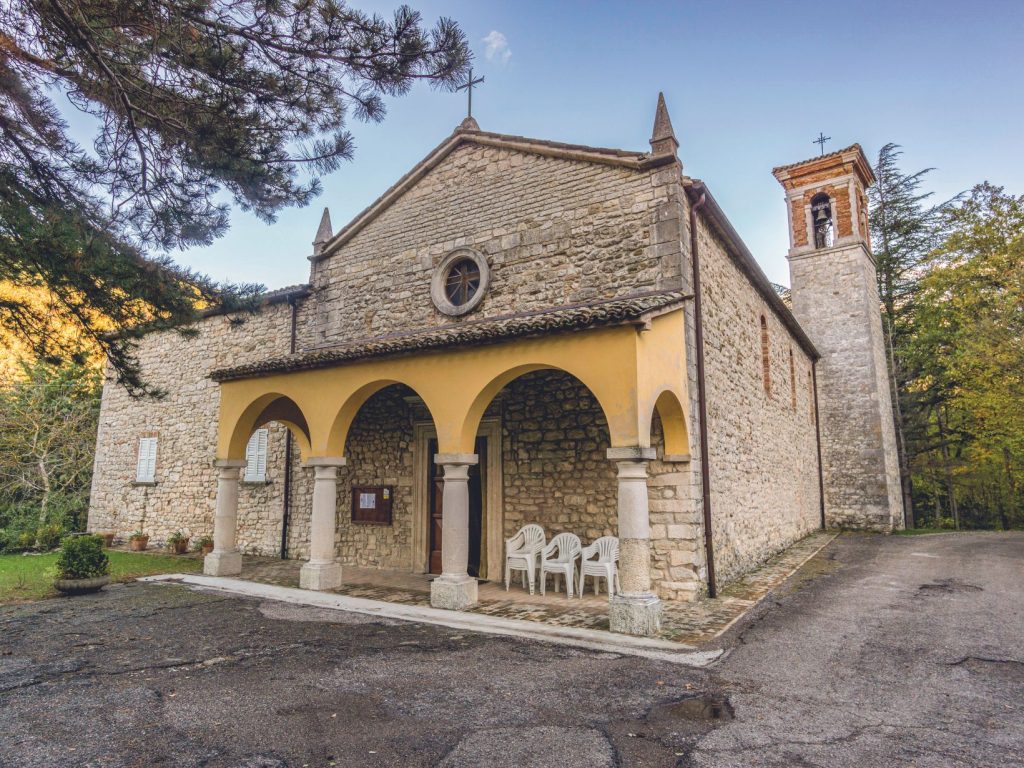
The Sanctuary of Santa Maria in Val d’Abisso, on the other hand, stands on the slopes of Mount Nerone, where the Virgin Mary is venerated; according to legend, she appeared to some shepherds on the mountain itself. Built in the Romanesque style and dating back to the 11th century, the sanctuary – chosen as a burial place by several members of the Brancaleoni family – features, inside, a single nave with a trussed ceiling.
Several valuable artistic treasures are housed within, including a majolica crucifix by Valerio Valeri of Civita Castellana and a 16th-century fresco depicting the Virgin Mary.
Piobbico, a paradise for rock climbing enthusiasts
The Piobbico Caves and the mystery of the cave bears
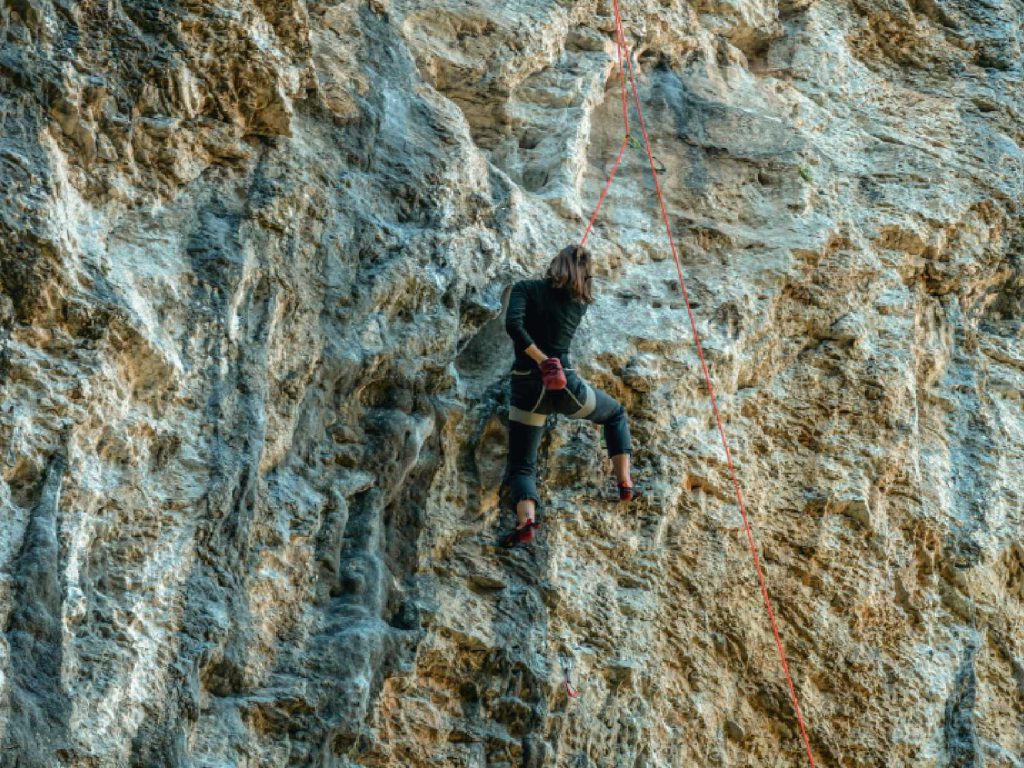
Trekking and caving enthusiasts here in Piobbico will find plenty to get their teeth into… or, rather, plenty of rock for their boots! The area around the town is home to the deepest cave in the Marche region, the Tassare Cave, situated on the north-eastern slope of Monte Nerone, towards Piobbico, and a full 445 metres deep. It was the setting for the first experiment carried out by the renowned ‘time explorer’ Maurizio Montalbini, who settled here for a while; he later repeated this experiment by spending five months inside the Frasassi Caves.
Another cave is the Cinque Laghi Cave, discovered in 1982 by a group of cavers from Città di Castello. As its entrance is situated on a sheer cliff face, hidden by a bush, the cave remained unknown to humans for a long time. Approximately 1 kilometre long and with various branches, the Grotta dei Cinque Laghi – whose name derives from the presence of several small lakes within it – shares the same characteristics and features as the Frasassi Caves, with their striking stalactites and stalagmites, whilst differing from the Genga Caves in the more modest size of its chambers.
Due to the difficulty of access, the Grotta dei Cinque Laghi can only be visited as part of an organised caving group.
This cave was discovered by Marco Bani, a true enthusiast of caving and trekking who, during the summer, pitches his tent – along with other experts like himself – right on Monte Nerone and is always on the lookout for other caves scattered across the massif.
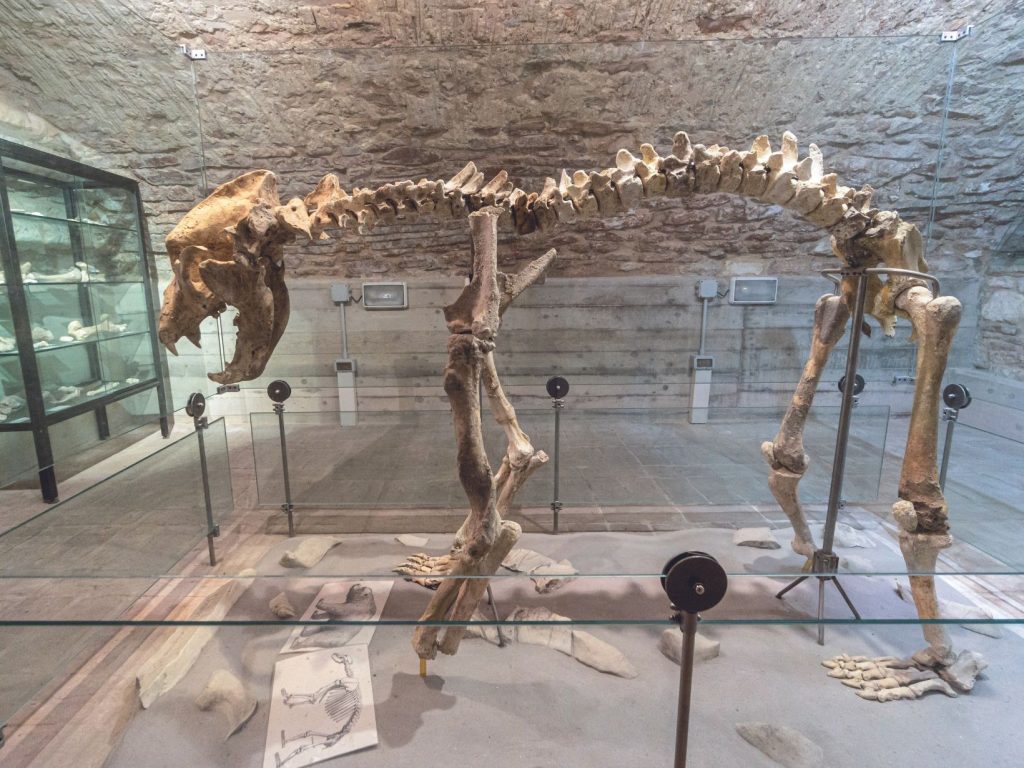
In the Brancaleoni Civic Museum, a section dedicated to caving also recounts life inside the caves of Monte Nerone: in a display case, the floor of the cave has been reconstructed exactly as the researchers discovered and studied it, complete with unique finds: sixty skeletons of Ursus spelaeus, the cave bear.
Experts are still unable to explain the presence of these animals’ remains: some suggest that the bears may have allowed themselves to die in that particular area during hibernation; others have put forward the hypothesis that a landslide blocked the entrance to the cave and the bears were trapped inside.
Finally, skeletal remains of several brown bears – a species that disappeared from Monte Nerone many years ago – have been found inside the Grotta delle Tassare.
The Ugly People’s Club and the Goblin Trail
The first dating agency in Piobbico and the scenic walk with the elves
Perhaps not everyone knows that Piobbico is famous for having founded one of Italy’s first marriage agencies. It all began way back in 1879 when there were too many unmarried women in the village who were over twenty years of age and whose upkeep was a burden on their families.
To remedy the problem, and with the aim of marrying off Piobbico’s ‘spinsters’, the Club dei brutti was founded: the village’s landowners, mayor, notary and priest established the role of President of the Ugly (appointed on 9 September each year), who was tasked with finding husbands for these women, deemed ‘ugly’, much like a proper marriage bureau.
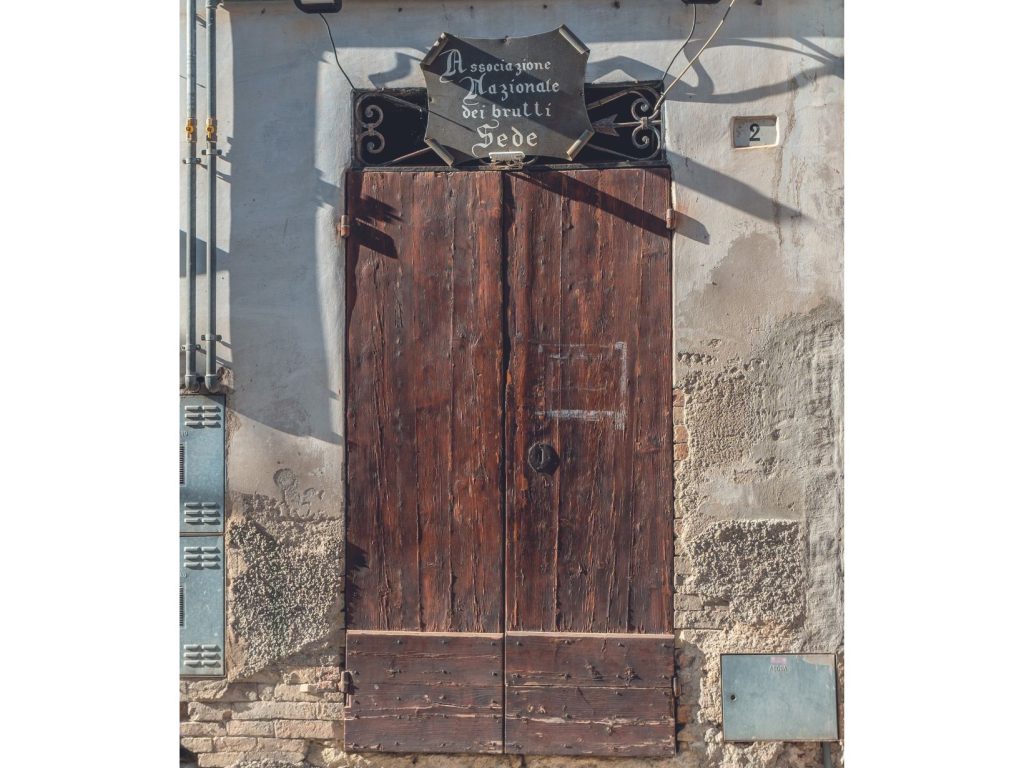
Between the First and Second World Wars, the ‘Club of the Ugly’ took on a light-hearted, student-like character: it was traditional to elect ‘the ugliest person’ in the village, load him onto a cart with a demijohn of wine and get him drunk, thus turning the marriage bureau’s role into a parody.
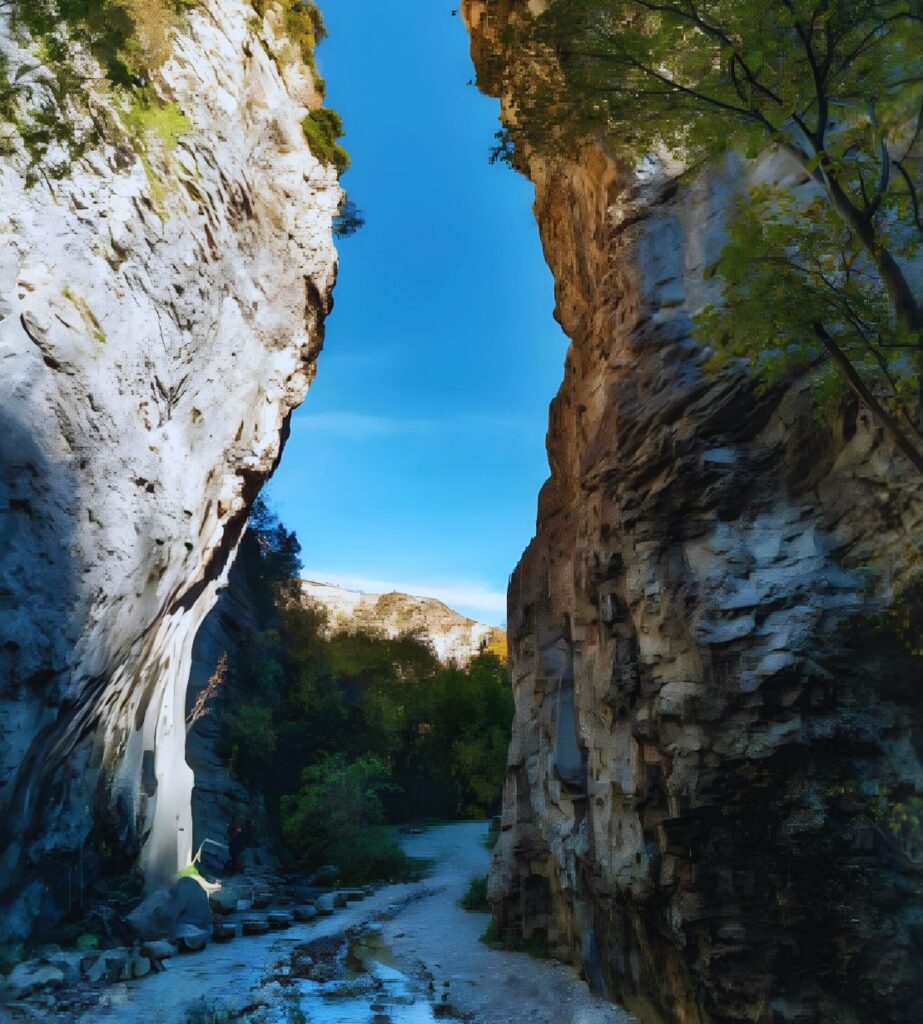
It was then Telesforo Iacobelli, in the 1970s, who brought the ‘Club dei brutti’ to national attention in Italy by appearing on the television programme *Portobello*. To round off this tour of the curiosities and mysteries that surround Piobbico, one cannot fail to mention the Sentiero dei Folletti (Path of the Elves), a scenic walk that starts from Via Garibaldi and is suitable for everyone, adults and children alike.
Along the route, which takes about twenty minutes to complete there and back, you can walk along a secure footbridge suspended over the void, offering visitors a breathtaking view. The trail is called the ‘Sentiero dei Folletti’ because, just beyond the starting point of the walk, an iron figure shaped like a goblin greets walkers with open arms.
A photo with the children is, therefore, a must!

Discover the charms of Piobbico
The Beauty Trail comes to life
Exploring the beating heart of the Marche region has never been easier. Criluma Viaggi is proud to bring to life Confcommercio Marche Nord’s ‘Itinerario della Bellezza’ project, transforming a guide of excellence into real itineraries, ready for you to experience.
Romantic weekends, days spent immersed in nature or cultural tours: we’ve created itineraries to suit all tastes and time constraints. The Criluma experience is the added value that guarantees you first-class treatment, comprising continuous support, personalised attention and prompt responses.