Descrizione
Discovering ancient traditions through an unrivalled exhibition
There is a place in San Lorenzo in Campo where the culture of the people of the Marche region is brought together and celebrated. It is the Museo delle Terre Marchigiane, home to the Straccini Collection.
The museum houses more than two thousand objects relating to the rural traditions of the Marche region, dating from the turn of the 19th and 20th centuries.
It is an unrivalled exhibition, brought to life by images and sounds, offering a comprehensive insight into rural life – an era characterised by hard work, ingenuity and genuine community spirit.
The museum is organised into four themed sections. As we immerse ourselves in the ‘places of life’, we can feel the warmth of the domestic spaces in a sharecropper’s home and observe, for example, the kitchen with its lard-beater, graters, pasta strainers and solid sideboards. The ‘places of gathering’ bear witness to moments of community and social life.
The reconstruction of a school classroom is almost moving, with its blackboard and wooden desks. In the ‘old trades’ section, we see recreations of the workshops and workplaces of artisans, such as the ‘Sali e Tabacchi’ (salt and tobacco shop), which is overflowing with items for sale, including scales and small weighing machines. We see a succession of rooms and tools belonging to the barber, the cobbler, the knife-grinder and others besides.
It feels as though we’ve been transported into an old black-and-white photograph at our grandparents’ house, but here everything is in colour and so skilfully arranged that it conveys a vivid sense of life.
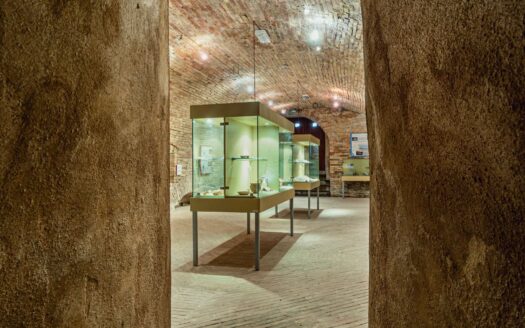
Finally, there are ‘the collections’ – a museum within a museum – featuring an extraordinary display of objects from the 16th to the 20th centuries, made of ceramics, iron and copper. The collection of majolica, in particular, is impressive.
True masterpieces from various specialist centres such as Fabriano, Fratte Rosa, Urbania and Pesaro are proudly on display. Many objects, although originally created for practical purposes – such as oil cruets, sauce boats, bottle coasters and hot-water bottles – have been elevated to the status of works of art thanks to the beauty of their forms and the delicacy of their decorations.
Countless other items are on display, ranging from the milkman’s bicycle and early models of typewriters to the wheel of fortune used at local festivals, which stands out above the entrance.