
6 reasons to visit
Cagli
Sometimes, one need only look to heraldry to discover the true essence of a place. The coat of arms of Cagli, originally created as a tribute to the Medici and Della Rovere families, encapsulates the very essence of the region, elevating the symbols of the nobility to icons of an entire community.
Catria, Petrano and Nerone: these are the elemental guardians that encompass, protect and sustain the town. These imposing peaks are not merely a natural backdrop, but pillars of a striking beauty that help to make Cagli a unique place in the Apennines.
The very soul of Cagli is inextricably linked to its rivers, the Bosso and the Burano. Their gentle flow runs through the town’s history, symbolising a continuous flow between past and future, in a constant dialogue between the strength of stone and the vitality of water.
The historic centre unfolds in a grid-like layout inherited from the Romans, set within an urban fabric so advanced that it may well have inspired the design of the Ideal City. A walled city that is only seemingly austere, concealing a dynamic and vibrant heart.
Amidst imposing churches and historic palaces, artisanal activities thrive, passing on centuries-old trades. In Cagli, tradition is not a static relic, but blends with the new in an organic evolution that keeps the town’s industrious and creative spirit alive.
As strong and tenacious as its mountains, Cagli has demonstrated extraordinary resilience over the centuries. Set ablaze during the wars between the Guelphs and the Ghibellines, it rose again like the Phoenix, returning more vibrant and splendid than ever, a proud guardian of its freedom.

Discover the beauty of Cagli
The Beauty Trail comes to life
Exploring the beating heart of the Marche region has never been easier with Criluma Viaggi!
Romantic weekends, days spent immersed in nature or cultural tours: we’ve put together itineraries to suit all tastes and time constraints.
The Fondarca Arch
A gateway to natural wonders
Cagli is surrounded by lush, majestic countryside that reveals itself gently to the visitor.
Setting off from the small hamlet of Pieia, where the locals still sit outside the charming little church chatting cheerfully in a picture-postcard scene, you can reach a place steeped in charm.
Following a path nestled amongst the greenery that springs from the ancient rocks, you climb a steep scree slope running alongside the Grotta delle Nottole, in whose shade the bats of the same name hide, sheltered from the sun.
Excavations carried out by the University of Tuscia in Viterbo have unearthed artefacts dating back to the Bronze Age, which are now housed in the Archaeological Museum of Cagli.
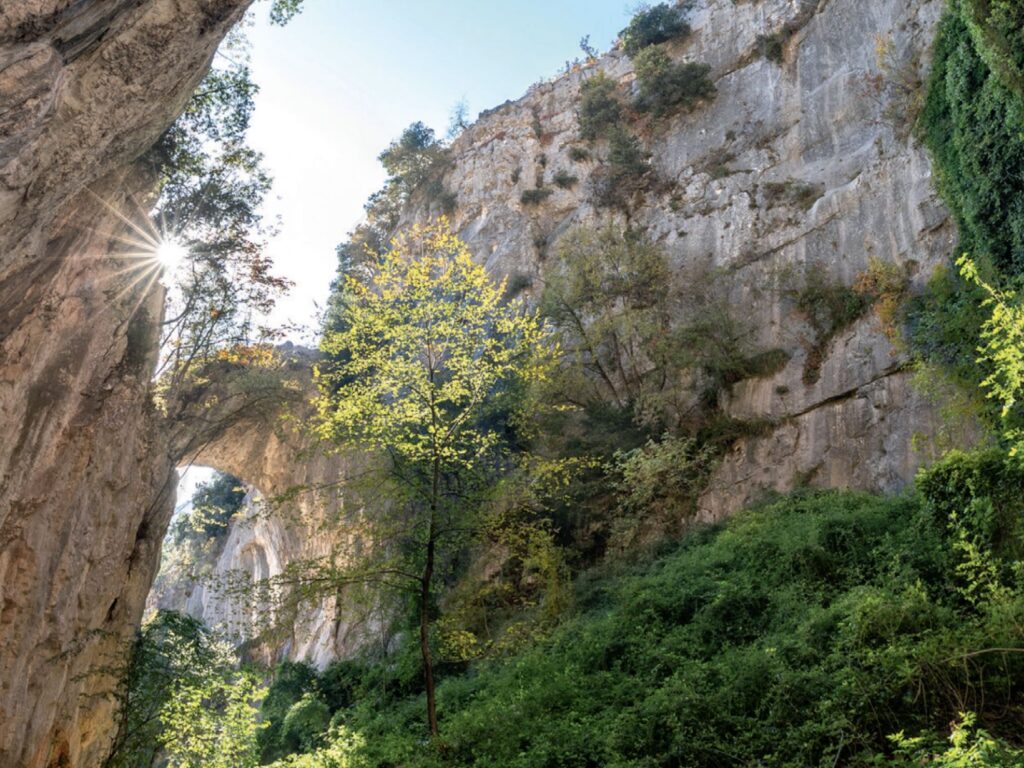
From here, one can already glimpse the Fondarca Arch in all its majestic splendour.
It is a spectacular rock arch, serving as the entrance to a large natural amphitheatre, with walls up to 80 metres high.
This evocative site is what remains of an ancient, vast cave whose ceiling collapsed, leaving behind the formation that so amazes us today.
Several climbing routes have been set up on the inner walls, turning the area into a veritable caving gym, one of the most beautiful in the region.
Crossing the amphitheatre and emerging on the opposite side, the path forks: taking the right-hand fork, you can climb up onto the arch itself to experience the thrill of crossing from one wall to the other via a narrow walkway that is accessible to everyone.
If, on the other hand, you continue straight on, you’ll arrive beneath a hanging waterfall that flows all year round, forming a cascade of fine droplets that trickle gently, joining the small Giordano stream as it falls, which then becomes a tributary of the Bosso.
On this side of Monte Nerone, you can therefore enjoy this and many other walks in the heart of nature, following paths that wind their way through the wonders of Cagli.
Religious architecture
An archipelago of magnificent churches
There is an old saying that has been repeated since time immemorial on the streets of Cagli, which goes that in the town “there are as many churches as there are taverns”.
The imposing presence of religious architecture in the small historic centre is truly astonishing, both in terms of number and beauty.
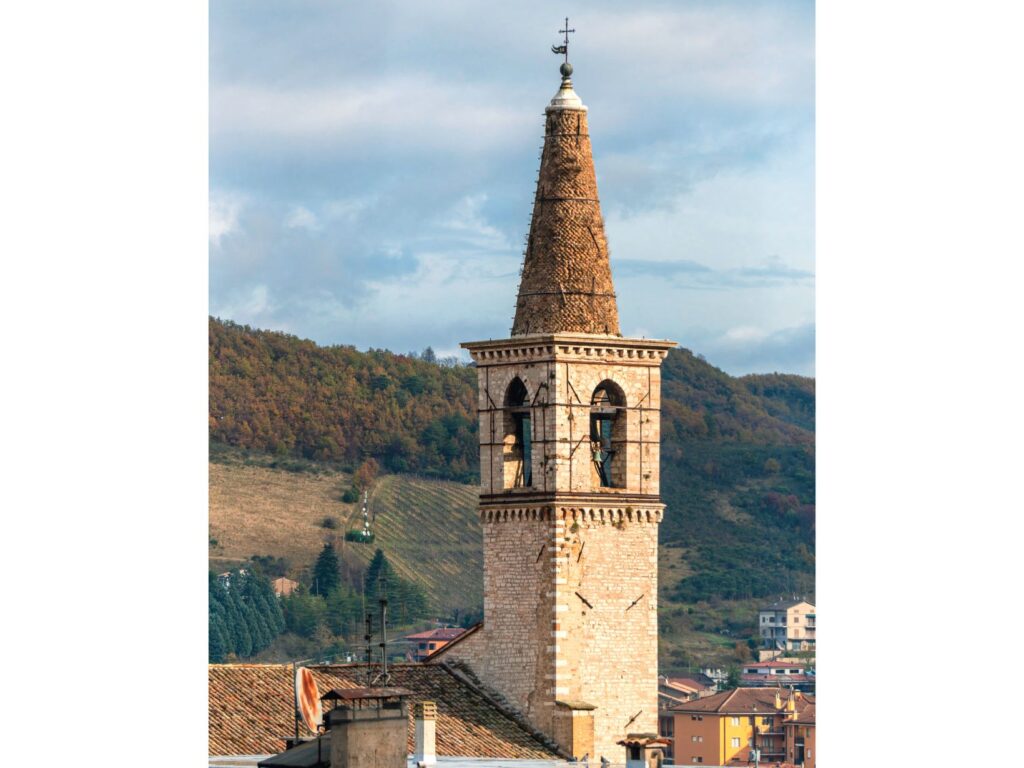
At every street corner, you can catch a glimpse of the grand façades of places of worship, such as the Church of San Francesco – the oldest church in the entire Marche region dedicated to the Saint of Assisi – or the Basilica of Santa Maria Assunta, Cagli’s principal place of worship.
The Church of San Domenico deserves special attention, as it houses one of the town’s crowning glories: a work of art of immense value. This is the famous Tiranni Chapel, created in the early 1490s by Giovanni Santi, the father of the immortal Raphael; it is considered his masterpiece and served as inspiration for some of his son’s early works.
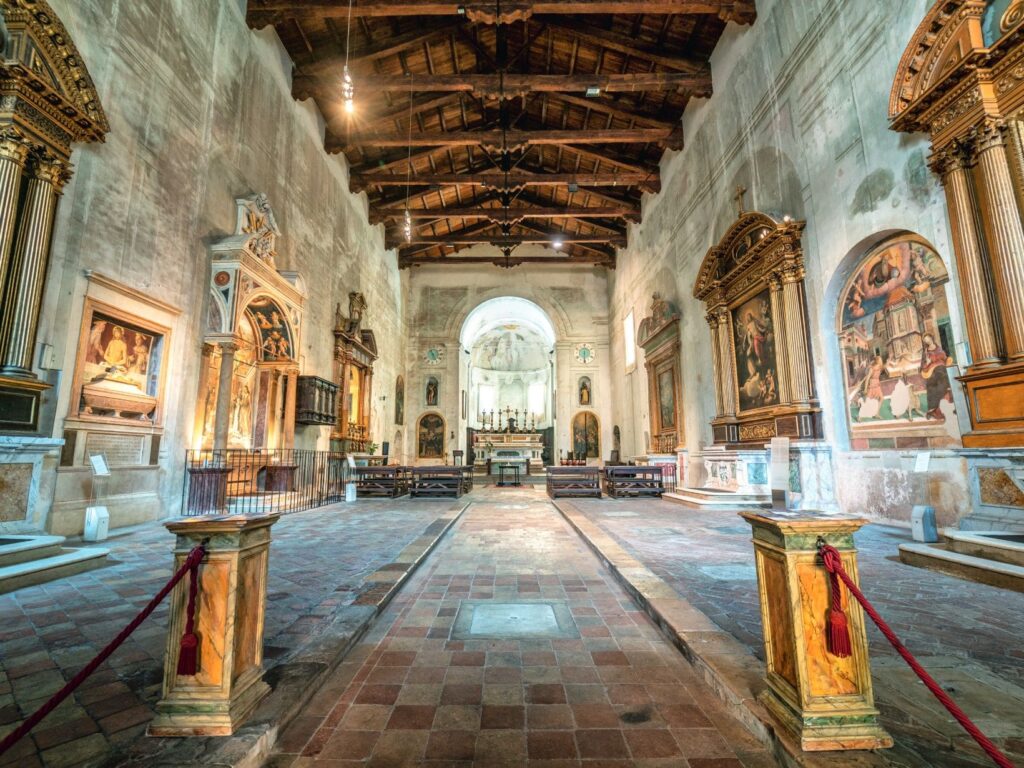
Commissioned from the artist by Pietro Tiranni, who sought to overcome his despair at the death of his beloved wife by sublimating it through art, the chapel depicts the Annunciation in the two roundels of the arch’s spandrels, whilst the back wall features, at the top, the Resurrection of Christ, and lower down, the Holy Conversation.
In the skilful composition of the latter, painted with magnificent detail, it is possible to recognise the young Raphael in the little angel to the right of Mary, just as the artist’s own features can be discerned in the face of St John the Baptist.
The Chapel is in good company within the church, alongside other works of outstanding value, created both by Santi himself and by other renowned artists, including Gaetano Lapis from Cagli with his ‘Presentation in the Temple’.
However, the churches worthy of note are not confined to the historic centre. Just outside Cagli, the Sanctuary of Santa Maria delle Stelle has recently been restored; it was built on the site where, according to tradition, the Virgin Mary appeared. The restoration work has brought to light splendid 16th-century frescoes that are certainly worth a visit.
The Great Guardians of Cagli
The Palazzo Pubblico and the Martiniano Tower
Perhaps it is fate that saw it burnt to the ground and reborn, but in Cagli, more than anywhere else, the sense of building and rebuilding seems to have taken concrete form in some of its principal architectural features.
This layering is evident, for example, in the Palazzo Pubblico, which arose from the amalgamation of two distinct complexes: the Palazzo Grande, the seat of the town’s judiciary overlooking Piazza Matteotti, and the Palazzo del Podestà.
Now home to the town council offices, the almost fantastical Palazzo Pubblico also houses the ancient prisons, whose cramped spaces still retain the sense of forced confinement experienced by those who were held there; it is also home to the Archaeological Museum and the Via Flaminia exhibition, with its numerous artefacts from neighbouring areas, particularly Fondarca.
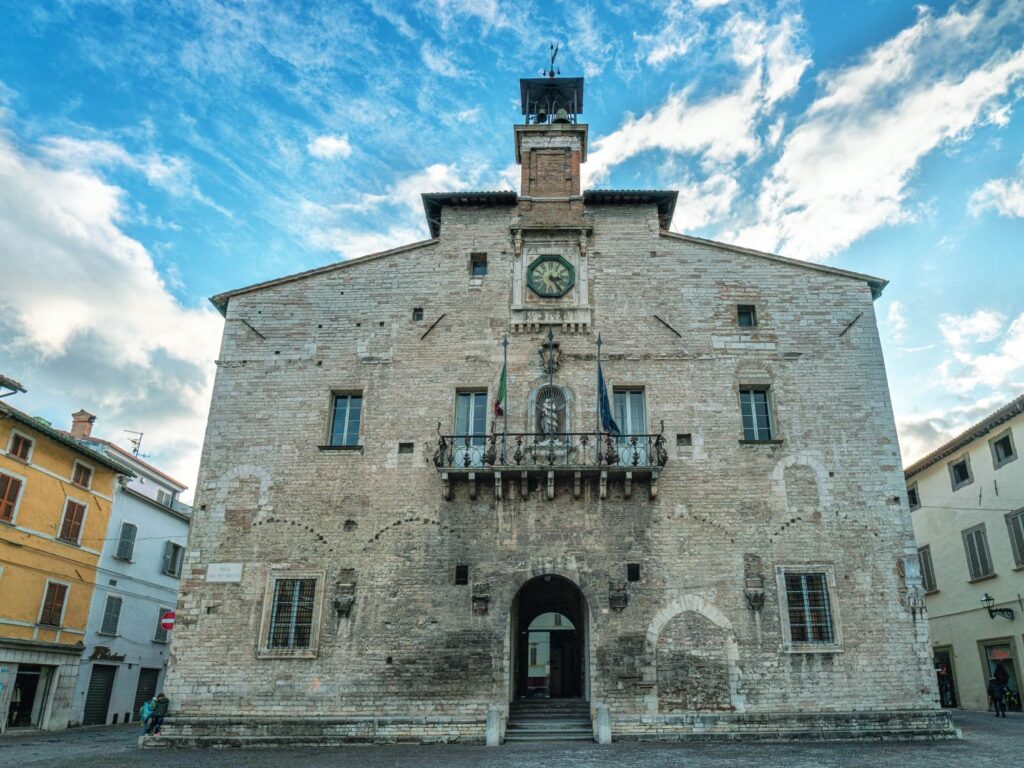
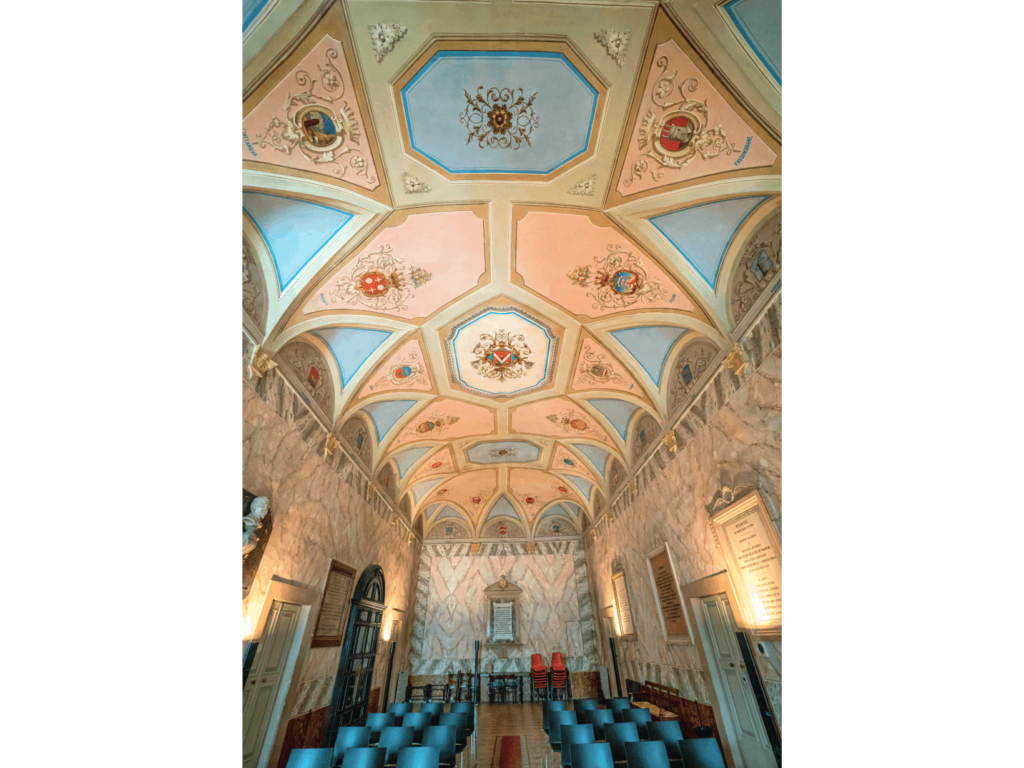
The building also houses the Hall of Coats of Arms, which was decorated in 1889 to commemorate the 600th anniversary of the rebuilding of Cagli, featuring the coats of arms of all the towns that contributed to the reconstruction.
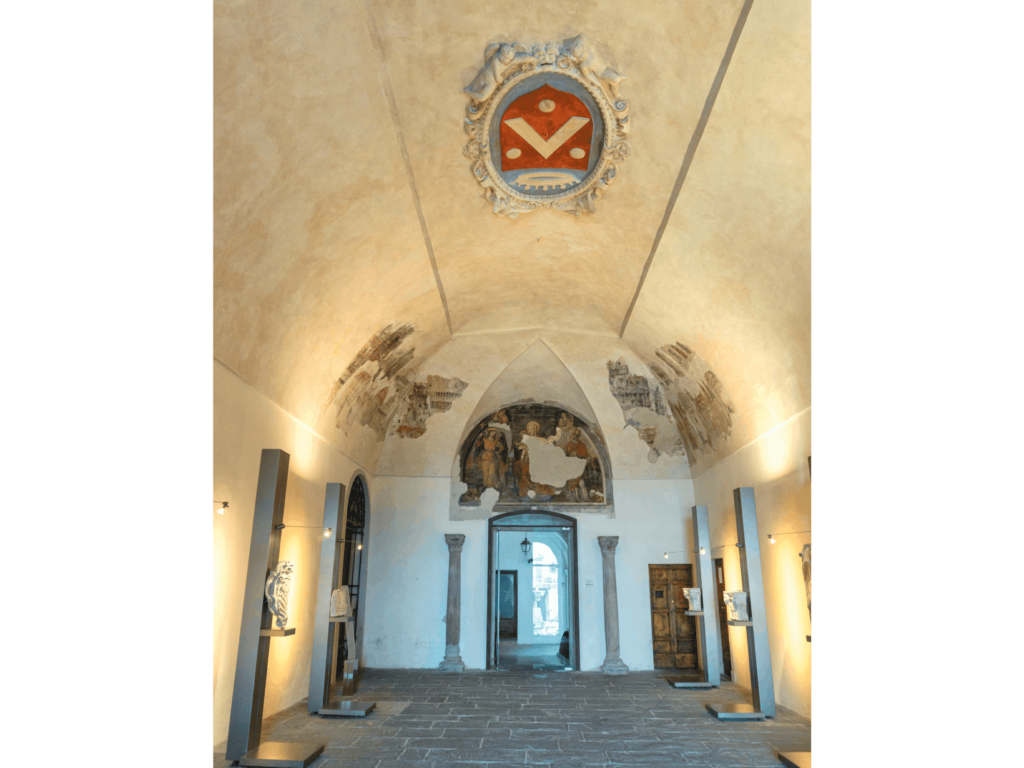
To complete this alchemy of elements so diverse in nature and age, the courtyard is home to *L’Ordine cosmico* (The Cosmic Order), a sculpture by the renowned contemporary artist Eliseo Mattiacci.
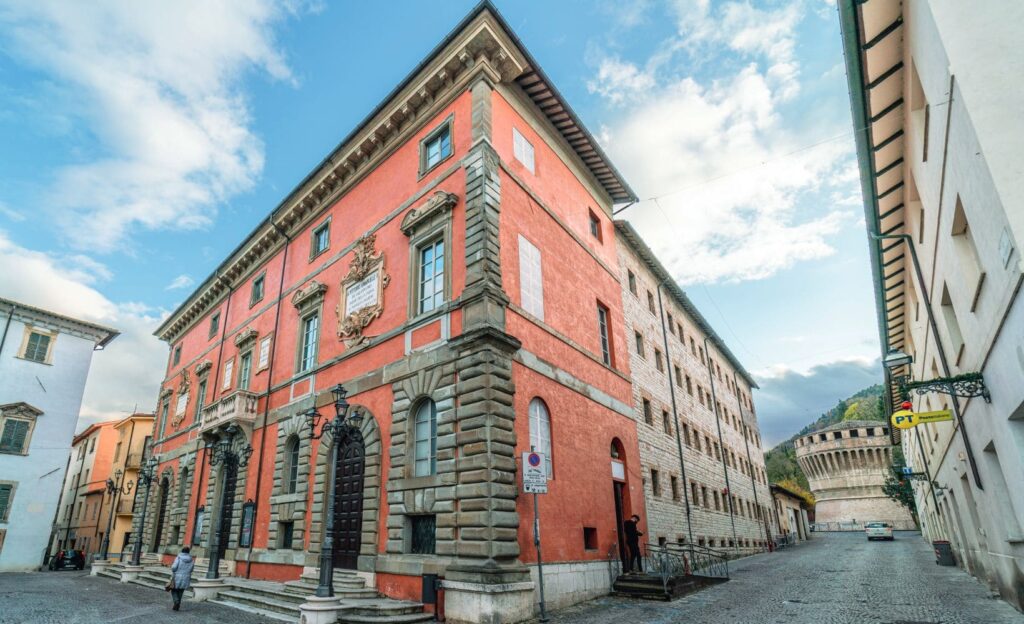
The presence of the new within a deeply historic setting links the Palazzo Pubblico to the Torrione Martiniano, the city’s true symbol.
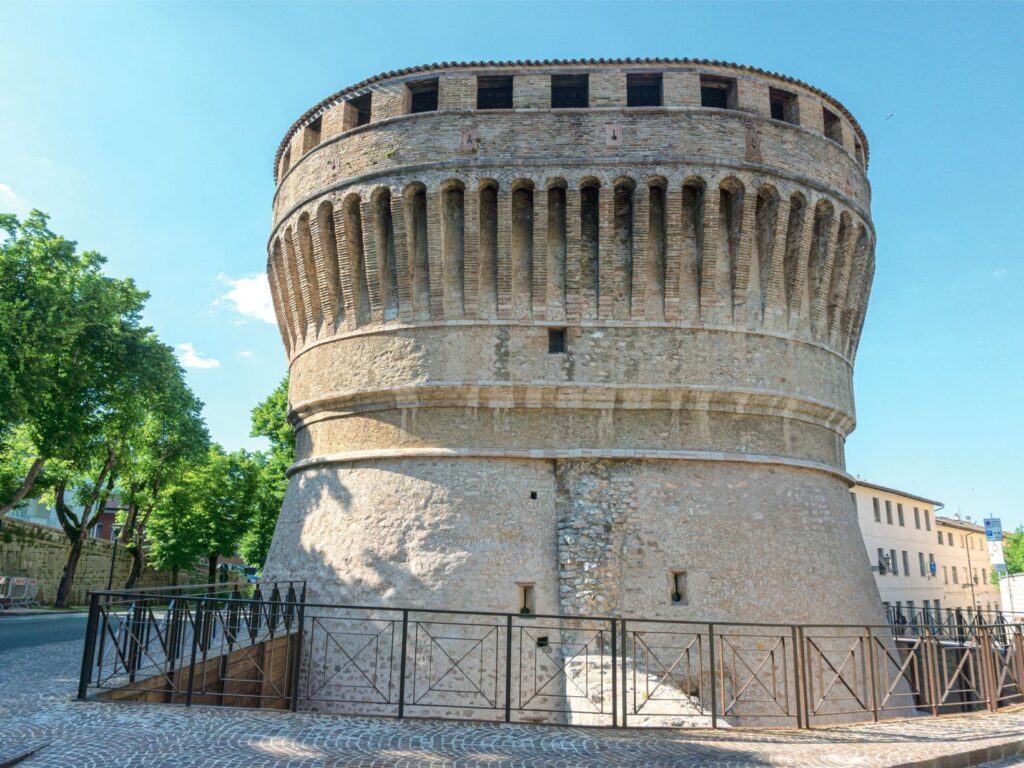
So named because it is the work of the brilliant architect Francesco di Giorgio Martini, who took particular pride in this creation of his, the tower – originally built for military purposes – now houses the Centre for Contemporary Sculpture, featuring works by internationally renowned artists, including Mattiacci himself, as well as Kounellis, Nagasawa and Icaro.
The Torrione is also the starting point of the evocative ‘soccorso coperto’, a structure unique in Italy.
It is an underground escape passage which, via 367 steep steps, winds its way into the depths of the hills to lead to the Rocca above – now lost – where the Capuchin Monastery stands today.
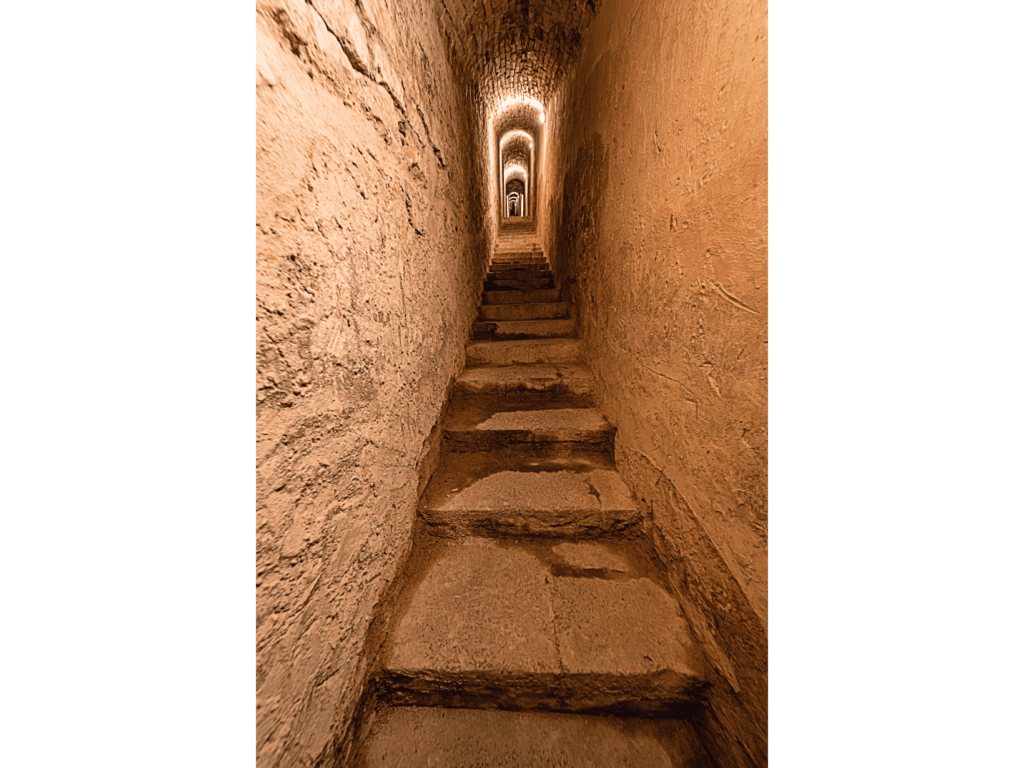
Climbing to the top of the tower offers visitors the chance to admire an incredible panorama taking in the natural landscape surrounding Cagli, dominated by its mountains.
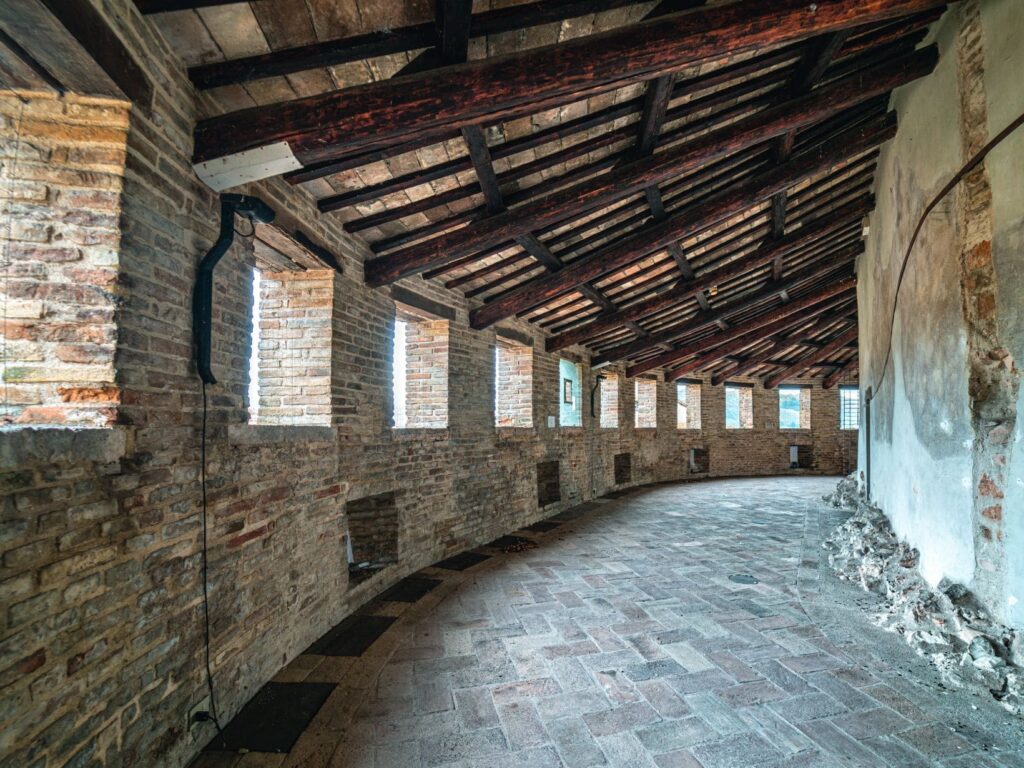
Cagli Municipal Theatre
The city’s cultural gem
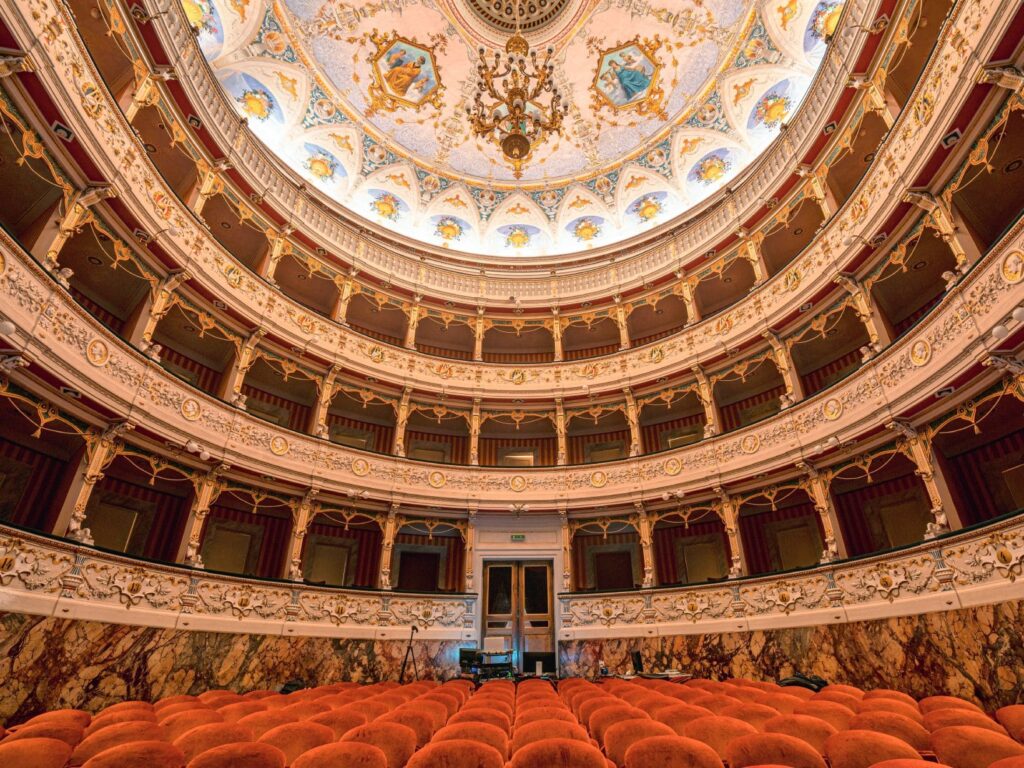
Cultural life in Cagli thrives thanks to its historic theatre, a architectural gem opened in 1878. The theatre’s splendour is evident the moment you step through the door: the foyer is dominated by four imposing columns that rise up into an elegant cross-vaulted ceiling adorned with iridescent decorations.
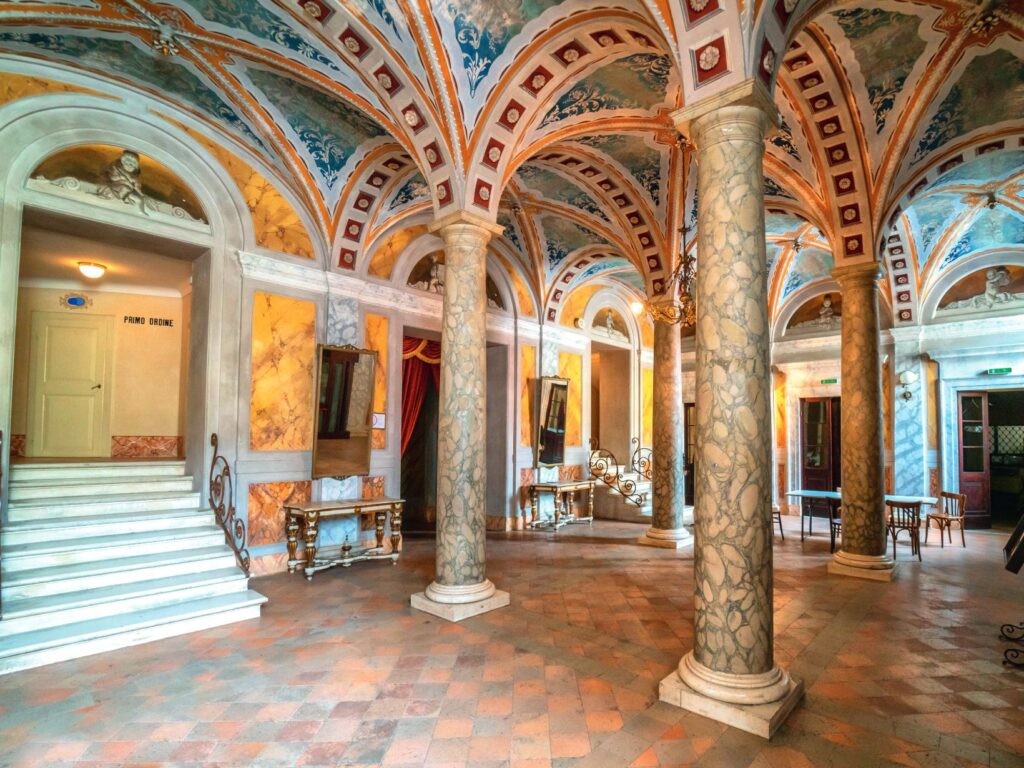
The beauty of this space serves to prepare visitors for their entry into the main hall.
Here, the seating is arranged not only in the stalls but also in three tiers of boxes and a gallery, each adorned with refined decorations, differing on each level, all the work of Alessandro Venanzi, to whom the entire theatrical décor is attributed.
The stage entrance is decorated with statues of Comedy and Tragedy, beneath which stand the busts of Goldoni and Alfieri, who act as patrons ensuring the success of the performances.
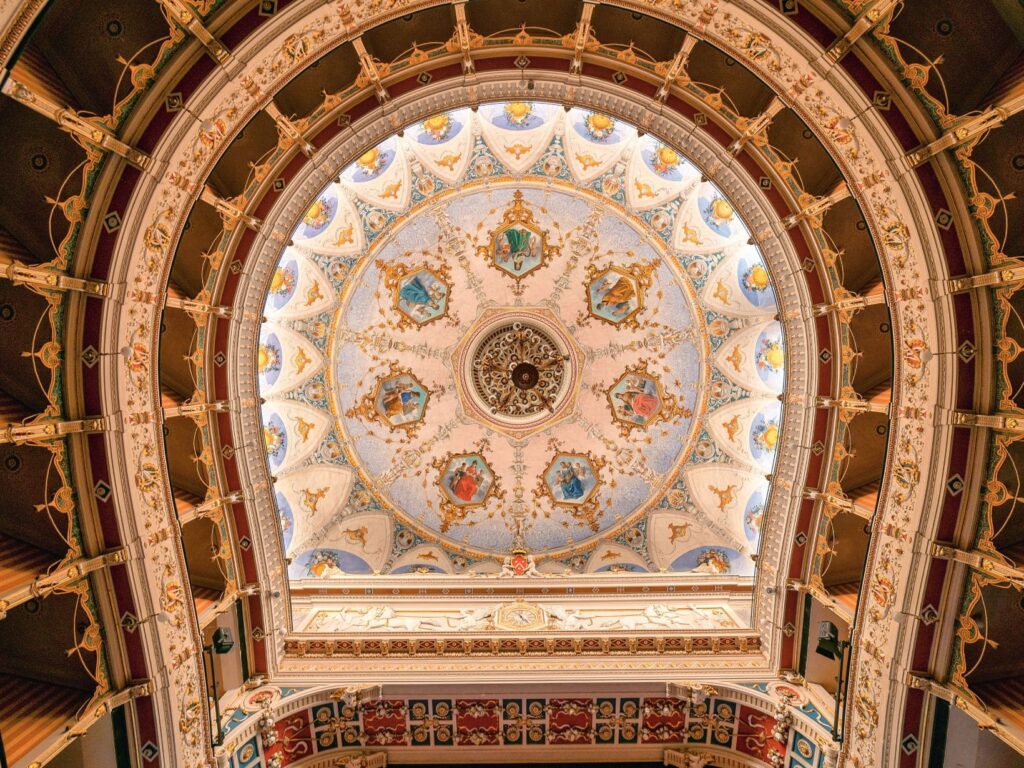
The spectacle continues when you look up to admire the vaulted ceiling in shades of blue, so skilfully painted as to create the optical illusion of a concave ceiling, where allegorical depictions of the seven liberal arts surround the chandelier, which conceals a particular stage trick. In fact, it can be raised and lowered via a mechanism to adjust lighting effects and plays of light in the hall.
This technical ingenuity, which almost feels like a magic trick, is mirrored in the floor, which is also fitted with a mechanism that allowed it to be raised to the level of the stage.
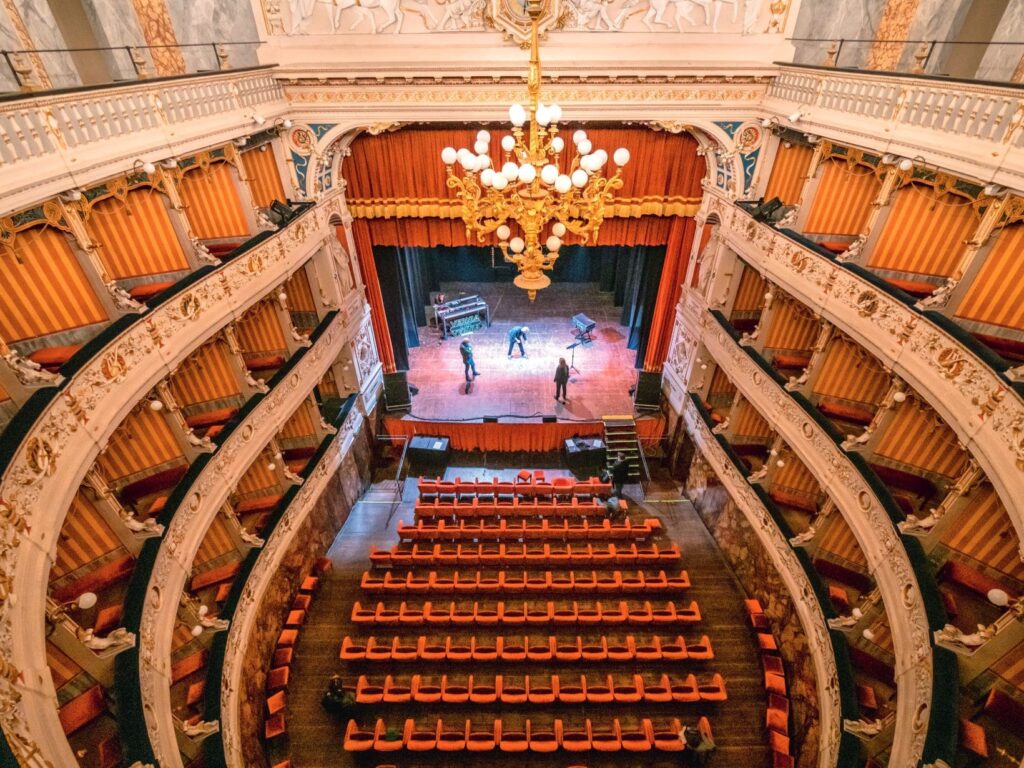
If one’s gaze continues on to the marvellous curtain – the very emblem of the theatre – one will be left speechless whilst admiring the scene, also painted by Venanzi, which depicts a crowd of armed men, pages and high-ranking dignitaries gathered around the pavilion of Frederick Barbarossa, who laid siege to Cagli in 1162. Such splendour is brought to life by one of the region’s most vibrant theatre programmes, running all year round and serving as a cultural hub for the town.
Crafts from Cagli
Artistic ceramics: a blend of innovation and tradition
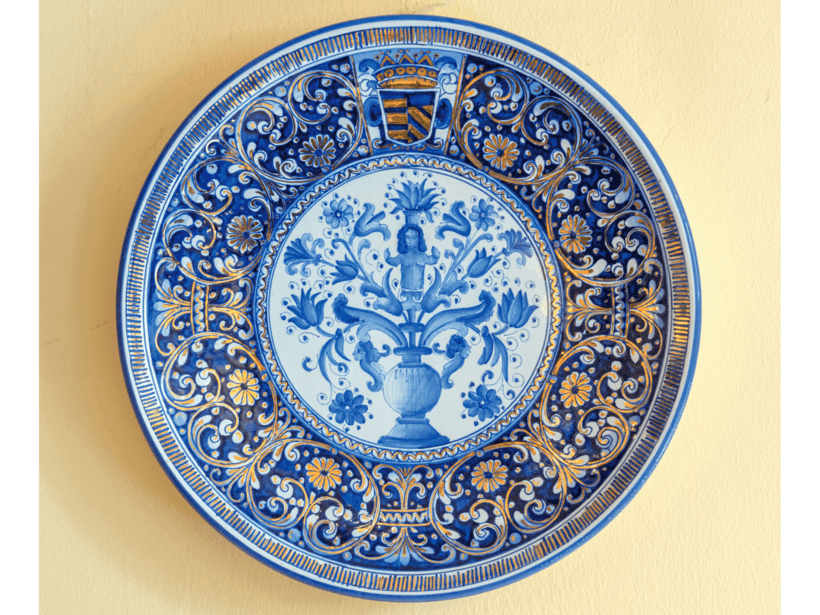
As you stroll through Cagli, your attention is easily drawn to the artisans’ workshops displaying their wares in their shop windows – a testament to tradition and identity.
Linda Zepponi’s Maiolica is a perfect example of this.
Her creations blend the heritage of the 16th-century decorative styles typical of the Montefeltro region with more modern and original designs. This is immediately apparent from the base glazes of her majolica pieces, which are not only classically white but also Berrettino blue – in the tradition of the Faenza school – and even an extremely elegant black, which has been very fashionable in recent years.
The style of Linda’s decorations is astonishing, characterised by a fine, precise line—her defining stylistic feature—combined with a wide range of techniques, from the ‘bianchetto’ typical of the area, which creates a ‘truffle effect’, mushrooms and wines, and ‘Majolica lace’ in the designs, to the skilful use of mezzatinta, right through to mixed-media works that combine majolica with bitumen, wax and gold lustre, in homage to her much-loved Klimt.
The room housing the exhibition opens onto the very heart of the workshop, which is visible to the public, allowing them to understand and appreciate the long and painstaking process that gives rise to the ceramics.
Linda skilfully wields brushes with bristles as fine as a scalpel’s blade, which she dips in water and then uses to draw out the natural clays that form the basis of the colours she uses.
This is one of the most surprising aspects of her work: the colour in its raw, earthy state does not match the result obtained after firing in the large kiln, nor will the same colour always produce the same result – it is capricious and sensitive to the slightest variation in the water.
But Linda proceeds with confidence, tracing her chromatic embroidery with surgical precision, taking particular care not to waste anything. The colour that settles at the bottom of the water is stirred up and reused, giving rise to new shades.
Over the years, Linda has also specialised in other techniques, driven by a desire to try different things and to amaze, sharing this passion through numerous workshops, which constantly breathe new life into her art.

Traditional flavours and tastes
Authentic recipes at Ristorante le Fontane

Leaving the historic centre of Cagli, just as nature begins to reclaim its place over the built-up area, you arrive at the restaurant Le Fontane after a few kilometres.
You are welcomed by chef Valerio Ferri and his wife Flavia, who run the restaurant with their daughter.
Even before their warm welcome, you are greeted by the heady scents wafting from the kitchen – evocative aromas that seem to have captured the surrounding landscape in their fragrance. Le Fontane offers strictly regional cuisine, made with locally sourced produce.
The extensive menu features an authentic showcase of specialities from the Montefeltro area, a culinary and wine journey to be enjoyed whilst comfortably seated in the elegant dining room. Generous platters of classic cold cuts or more unusual specialities, such as ‘lonzino di cotenna’, are served on focaccia baked exclusively in a wood-fired oven. For a first course, you simply must try a plate of passatelli, which originate right here in this area, whilst ‘cresc’tajat’ are a perfect example of the humble pasta of the Marche region, served to ensure the recipe is not lost, cooked with a sauce made from borlotti beans or chickpeas – organic, of course.
Meat is certainly one of the restaurant’s strong points: here too, the focus is on local produce, so make way for the ‘marchigiana’ ribeye steaks or the ‘tagliata’ of ‘cinturello’ pork, a local speciality.
Le Fontane is a business with a strong local identity, not only because of its produce but also because of its commitment to the local community.
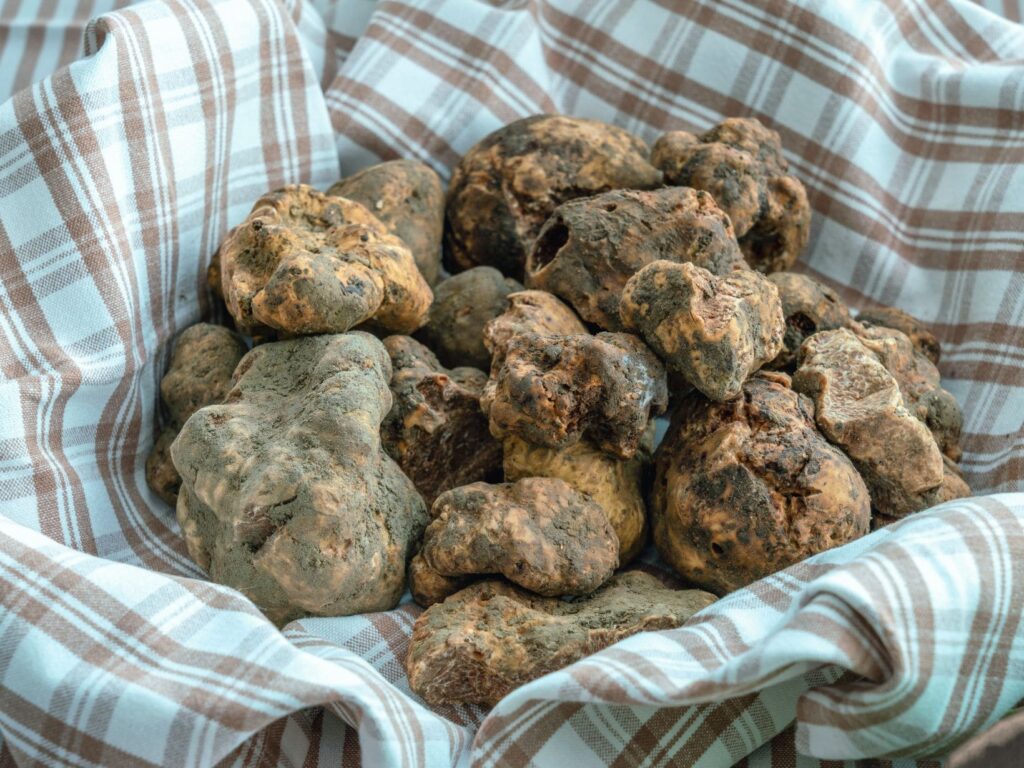
Valerio leads an association of restaurateurs to join forces and tackle any difficulties, but above all to organise festive events with the local community, such as the large barbecues in the square or the new ‘Inno al tartufo’ (Ode to the Truffle), an event celebrating the area’s most prized produce.
Here, in fact, white and black truffles, as well as many other top-quality mushrooms including porcini and spignoli, grow all year round in the mountains surrounding Cagli – veritable cornucopias of delicacies.

Discover the beauty of Cagli
The Beauty Trail comes to life
Exploring the beating heart of the Marche region has never been easier. Criluma Viaggi is proud to bring to life the ‘Itinerario della Bellezza’ project by Confcommercio Marche Nord, transforming a guide to excellence into real-life itineraries, ready for you to experience.
Romantic weekends, days spent immersing yourself in nature or cultural tours: we’ve created itineraries to suit all tastes and time constraints. The Criluma experience is the added value that guarantees you first-class treatment, comprising continuous support, personalised attention and immediate responses.