

6 reasons to visit
Apecchio
Mixed with the sound of the flowing water, the sound of our footsteps almost fades away as we cross the medieval bridge that takes us closer to the centre of Apecchio.
It returns to accompany us, now ringing out clearly and distinctly, as we walk along the cobbled path flanked by flowerbeds, heading towards the grand entrance tower – imposing and austere, an unmissable watchtower during the war-torn medieval centuries.
Built to serve the Ubaldini della Carda family, the historic lords of Apecchio, the tower still bears their coat of arms: a stag’s head – one of the most noble and regal of animals – surmounted by a star.
Now that its defensive purpose has come to an end, what has become the Clock Tower – affectionately known as ‘el Campanon’ by the locals who still pass through it – stands ready to welcome us to Apecchio.
A unique place, at the crossroads of the Marche, Umbria and Tuscany – diverse regions that come together here in a marvellous blend, all clearly visible from the summit of the city’s other great sentinel, Monte Nerone, where the view stretches as far as the sea.
Like all border towns, Apecchio has been a melting pot of diverse traditions and cultures, which have been welcomed and integrated in harmony; wonderful artistic and cultural examples of this – some of which are record-breaking – await us.

Discover the charms of Apecchio
The Beauty Trail comes to life
Exploring the beating heart of the Marche region has never been easier with Criluma Viaggi!
Romantic weekends, days spent immersed in nature or cultural tours: we’ve put together itineraries to suit all tastes and time constraints.
A record-breaking museum and theatre
The rooms of the Palace continue to come to life through the promotion of culture
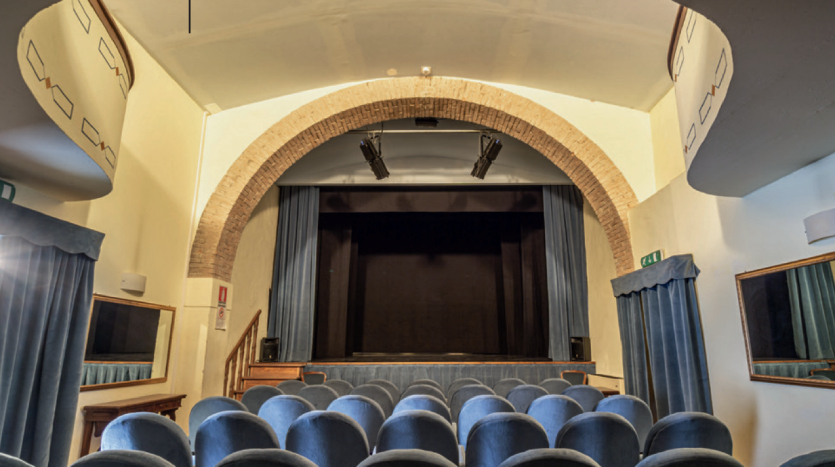
When we enter Palazzo Ubaldini, we might think we are in a symbol of local history which, however splendid, now belongs to the past. Nothing could be further from the truth. The Palazzo is alive and vibrant. On the ground floor lies a unique gem: the G. Perugini Theatre. Listed amongst the Historic Theatres of the Marche region, it was founded in 1876 to coincide with the establishment of the Filodrammatica theatre company, which is still active today and promotes performances in the local dialect that keep local traditions alive.
The theatre holds a very special record: with its 42 seats, it is the smallest theatre in the Marche region.
Descending into the ancient cellars, beneath the sweeping barrel vaults, the Monte Nerone Fossil and Mineral Museum has been set up. As soon as you enter, the shells of ammonites – prehistoric marine molluscs – captivate the eye with their spiral shape. How is it possible that these animals were found amongst the rocks of Monte Nerone? We are used to thinking of the mountain as an unchanging landmark, yet on the scale of geological eras, a mountain is just one of many formations shaped by the extremely slow processes that reshape the earth.
Where there are now high peaks, millions of years ago there was a tropical sea, in which ammonites and countless other creatures swam freely. The museum continues with exhibits that guide us through the environmental evolution of the Nerone area, featuring bones and skulls of predators such as the cave bear, alongside finds from all over the world and the curious septarian stones – rocks that glow under UV light. Also of great interest is the collection of bells recovered from the parish churches of Apecchio.
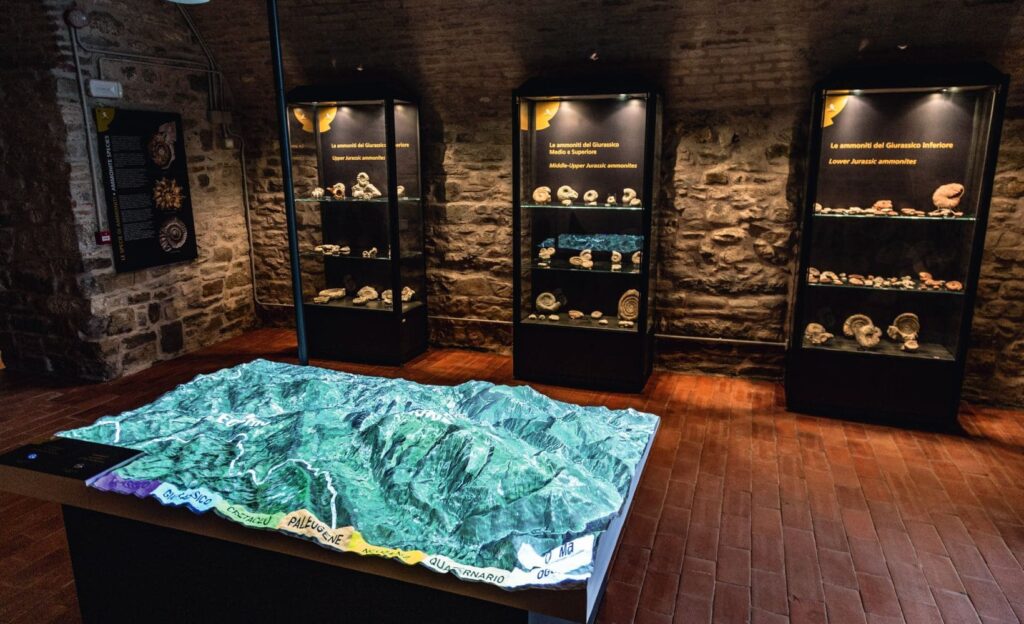
The oldest dates back to 1300, whilst on the Ubaldini bell, dating from the 17th century, we can see the symbol of Apecchio: a woodpecker on the back of a cow. Legend has it that the Ubaldini counts had their gold melted down to cast it, thereby achieving a sound of unrivalled sweetness.
The museum tour is made clear and engaging by the large number of explanatory panels, in Italian and English, and by various multimedia and interactive displays that help visitors immerse themselves in times long past, listening to the sound of the sea where now the wind blows through the mountain peaks.
A village built to the highest standards
A journey through the wonders of the historic centre
Apecchio is a treasure trove. As we explore it, we realise that there is no end to the fascinating sights we can admire.
On arrival, how can one not savour the pleasure of crossing the River Biscubio via the ‘humpback’ bridge, a typical medieval structure which finds one of its most picturesque examples here?
The serene image evoked by this corner of the landscape seems to have inspired Raphael to paint the *Madonna del Cardellino*, a masterpiece against the backdrop of which appears a bridge whose silhouette matches that of Apecchio. Right in the centre, houses, streets and palaces unfold like a book, telling us the story of the village.
We discover the history of the Jewish community, which lived here from the late 15th century, tracing the synagogue, the bakery and the courtyard where Sukkot, the Feast of Tabernacles, was celebrated.
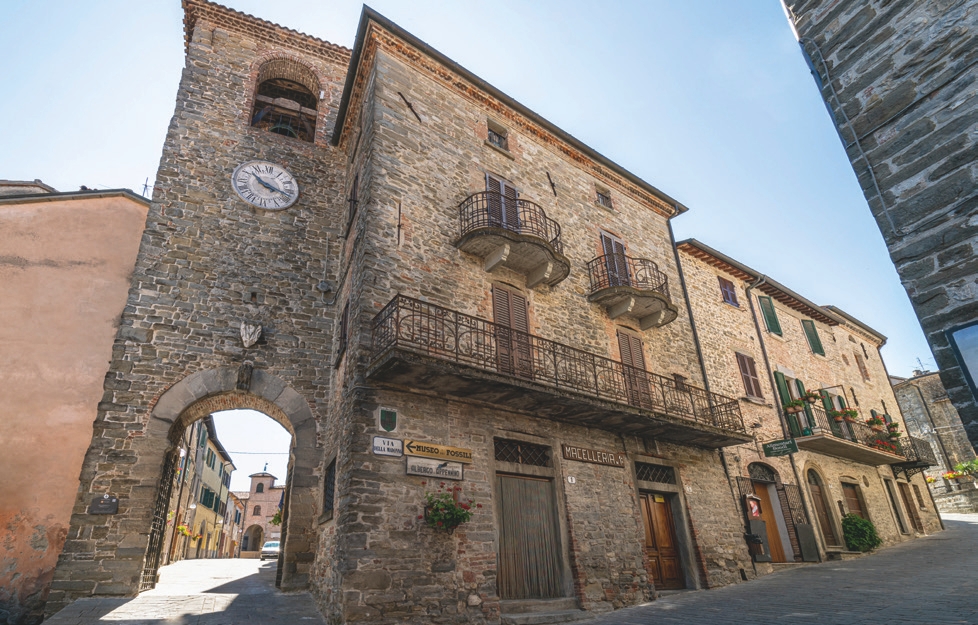
The Vicoletto, no more than 42 centimetres wide – making it one of the narrowest in Italy – bears witness to the clever ploy devised to avoid paying a heavy tax imposed by the Church on those Jews who wished to build their homes adjoining those of Christians.

Another great asset is the collection of churches dotted throughout the heart of Apecchio. Standing out, adjacent to Palazzo Ubaldini, is the Sanctuary of the Most Holy Crucifix, formerly known as the Parish Church of San Martino, which, according to some theories, was built on the remains of a temple dedicated to the god Mars.
Inside, there is a work to which the people of Apeccia are particularly attached: the wooden crucifix which, according to tradition, protected the townspeople from the disastrous earthquake of 1781.
Nor should we forget the precious works of art housed in the Church of the Madonna della Vita, the mysterious Templar symbols that emerge amongst the fragments of the frescoes in the Church of Santa Lucia, and the charming little church of St Catherine of Alexandria, sheltered in the shade of a long tree-lined avenue.
Outside the town limits, an enormous stone millstone stands proudly on display; it was used to grind woad, the plant from which indigo was extracted – a precious dye used to colour fabrics and create paintings, and for centuries a source of wealth for Apecchio.
Harmony and adventure amidst nature
Amidst rock, water and vegetation, a setting just waiting to be explored
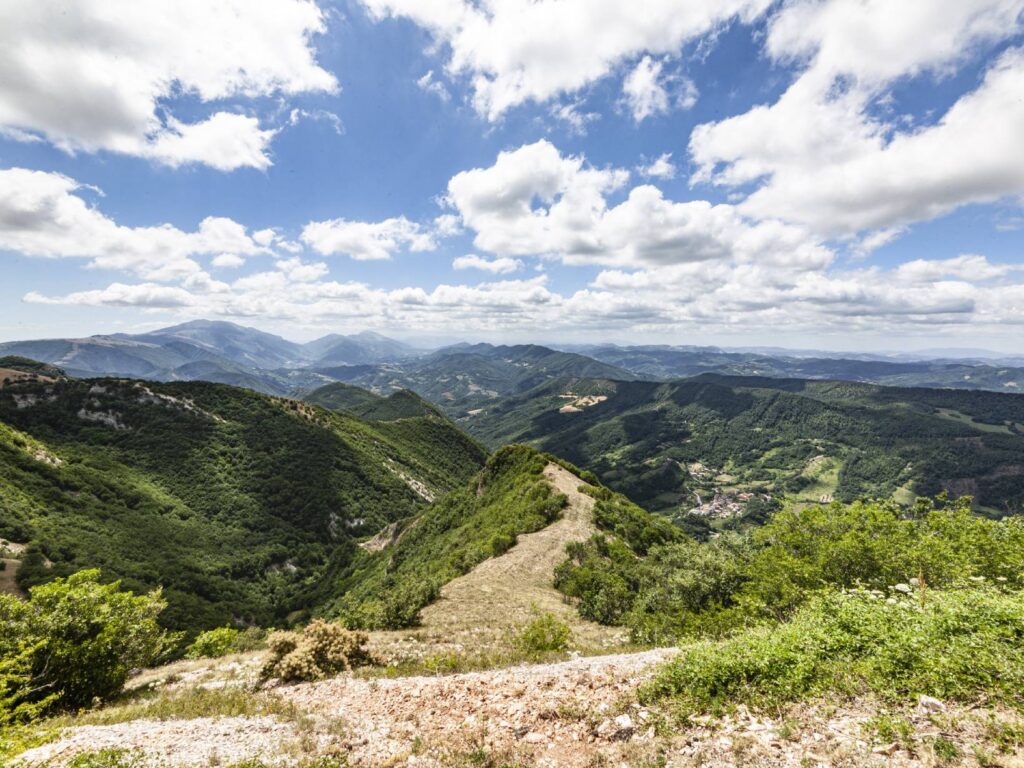
Apecchio is cradled in the embrace of nature. What is striking is the perfect harmony that has been created between human and natural elements.
From Apecchio, built on a river terrace formed by the confluence of the Biscubio and the Menatoio, long tree-lined avenues stretch out like branches from a trunk. The Viale di Velluto stands out, a wide road shaded by the foliage of beech and hornbeam trees. Only the breeze, rustling coolly through the leaves, disturbs the silence as we walk along it. If the sun’s rays pierce through the branches and warm us, no problem: just a few steps away we can cool off at a precious sulphurous spring. But of course, the true star of the Apecchio landscape is none other than Monte Nerone. Majestic and untamed, this mountain beckons you to adventure and exploration.
There’s something for everyone – from those who want to put their fitness to the test to those who simply wish to enjoy a leisurely stroll. The numerous well-marked trails allow you to proceed at a gentle pace and in safety
We have time to take in the beautiful views that come into view when the woods give way to wide clearings; we are enveloped by the scent of wild orchids growing in the meadows, where it is not unusual to come across grazing animals, peacefully munching beneath the clear sky.
We’ll also have the chance to explore these trails on horseback, to feel even more at one with the environment. For those who love sport, there’s plenty to choose from.

The limestone nature of the rocks in the Nerone area has led to the formation of gorges, ravines and caves, which present thrilling challenges for those wishing to try their hand at climbing or caving.
The steep climbs and sharp bends that follow the contours of the slopes get the adrenaline pumping for those who decide to tackle them on a mountain bike.
And in winter, when a blanket of snow covers the ridges, we can leave our footprints behind on long, invigorating snowshoe walks, or make the most of the ski lifts for fast descents on skis or a snowboard.
The exceptional villages
Wonders and points of interest in the hamlets of Apecchio
Serravalle di Carda is a hamlet not far from the centre of Apecchio, just waiting to be explored. It stands on one of the southern-facing slopes of Monte Nerone.
It is bathed in sunlight, which illuminates the white houses clinging to the rock face, making them gleam in stark contrast to the lush green surroundings. It overlooks the area once known as the Byzantine Corridor, now the border between the Marche and Umbria regions. This location shaped its destiny in the past, with changes of ownership between noble families and control by the Church, interspersed with periods of proud autonomy, but it also determines its thriving present. Serravalle di Carda is chosen, precisely because of its location, as the ideal starting point for tackling all the numerous outdoor activities that Monte Nerone has to offer.
It is also the perfect place to return to, thanks to its wealth of accommodation and dining options, where you can sample the village’s traditional specialities, such as the famous lamb’s offal. Among the ancient traditions that have never been allowed to die out, the most important is undoubtedly the Passio, during which, on Good Friday, a re-enactment of the Passion of Christ is staged.
As we continue to explore the slopes of Monte Nerone, amongst woods and bare rock faces, a large blue sphere stands out amongst a cluster of houses atop a rocky outcrop, irresistibly drawing our attention. What we had already glimpsed from afar is the Colombara Globe of Peace.

Built entirely from wood in the 1980s by Orfeo Bartolucci, a long-standing local surveyor, this enormous globe has rightfully earned a place in the Guinness Book of Records for its size.
With a diameter of 10 metres and a circumference of 31 metres, the globe can accommodate up to 600 people inside, and was constructed to replicate the Earth’s rotation.
A masterpiece of extraordinary technical skill, the Globe serves as both a reminder and a hope for promoting peace and harmony on Earth.
Set against a superb natural backdrop and the result of the finest human ingenuity, it reminds us that beauty has the power to save the world.
Culinary tourism and much more: new words and traditional flavours
The City of Beer, Truffles and Traditional Recipes
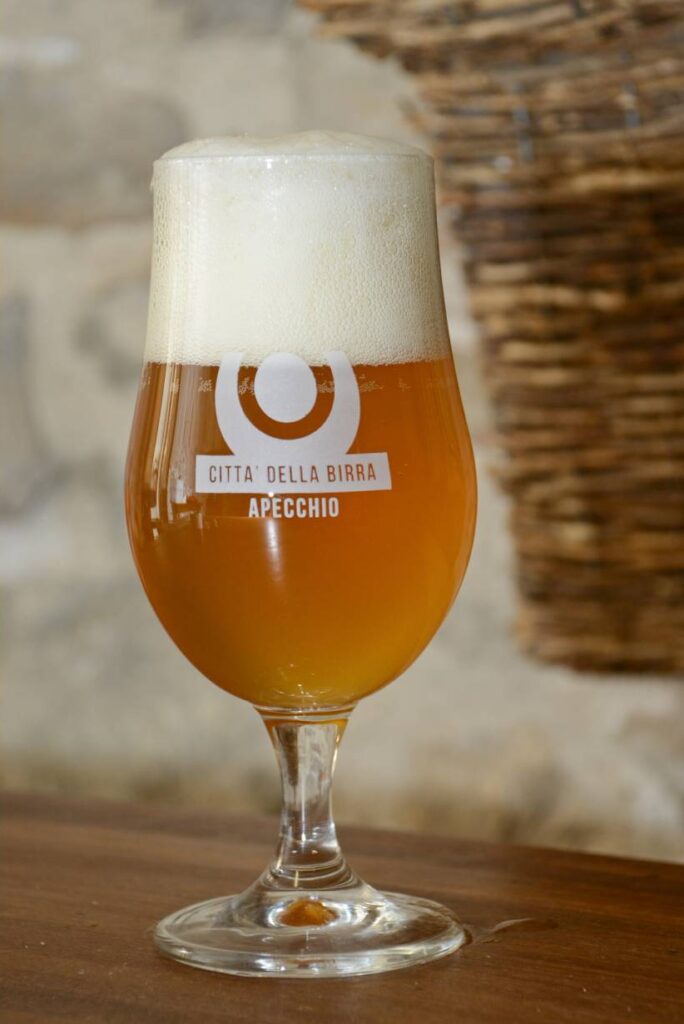
The fact that Apecchio had to coin a new term shows just how important its food and wine culture is, and how many other factors are linked to it.
‘Alogastronomy’ is a neologism that encapsulates the concept of producing, tasting and pairing beer with food, turning this golden alcoholic drink into a genuine connector.
Beer flows in Apecchio like the spring water from Monte Nerone, which is one of its key ingredients, alongside the barley that grows strong and lush in these parts. Such a favourable natural environment has spurred the desire to try one’s hand at producing refined and sophisticated brews.
This has led to the emergence of many breweries that have enjoyed enormous success with their products, notably Tenute Collesi, Amarcord, the Venere brewery and the Mochimash beer firm.
It is no surprise that Apecchio, known as the ‘City of Beer’ and home to the National Association of Beer Cities, has become a benchmark for the whole of Italy in this sector. And there is certainly no shortage of delicacies to accompany the beer mugs.
Apecchio is like a vast treasure chest: as you dig into the soil, truffles emerge – jewels that enrich the table in every season of the year with their many varieties.
To celebrate this abundance, which ensures a year-round supply of beer and truffles, the Truffle Market and Food and Wine Festival is held in the streets of the town centre on the first weekend of October.
No less extensive is the selection of mushrooms, among which the Prugnolo mushroom – known locally as Spignolo – stands out. These are prized, rich and highly sought-after produce. But Apecchio is also a village steeped in tradition, the guardian of ancient and rustic recipes.
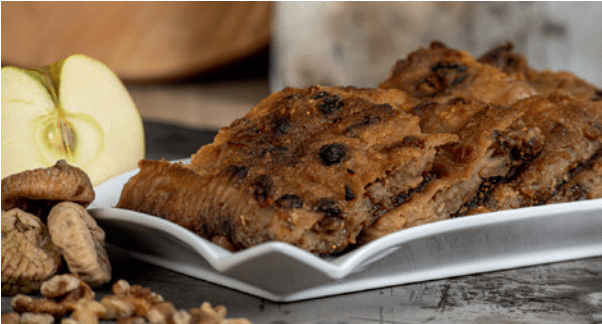
Visitors simply must try the Bostrengo, a dessert whose recipe has remained unchanged for centuries, ever since it was known as the ‘svuotacredenza’ (cupboard-cleaner), as it was made using whatever ingredients were left in the house; today it is produced and sold with the same care and attention as the town’s beer.
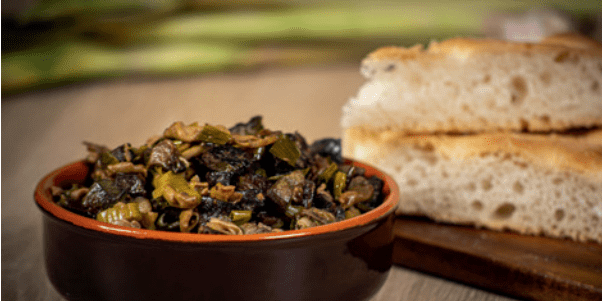
There are many other dishes linked to the town’s identity, such as Salmì del Prete and Coratella d’Agnello.
All are characterised by the excellence of their ingredients and preparation, so much so that here too, Apecchio has been aided by a new designation: the Municipal Designation of Origin ‘DE.C.O.’, which aims to catalogue, enhance and promote local specialities – an invaluable asset to the town.

Discover the charms of Apecchio
The Beauty Trail comes to life
Exploring the beating heart of the Marche region has never been easier. Criluma Viaggi is proud to bring to life Confcommercio Marche Nord’s ‘Itinerario della Bellezza’ project, transforming a guidebook of excellence into real itineraries, ready for you to experience.
Romantic weekends, days spent immersed in nature or cultural tours: we’ve created itineraries to suit all tastes and time constraints. The Criluma experience is the added value that guarantees you first-class treatment, comprising continuous support, personalised attention and immediate responses.