
6 reasons to visit
Urbino
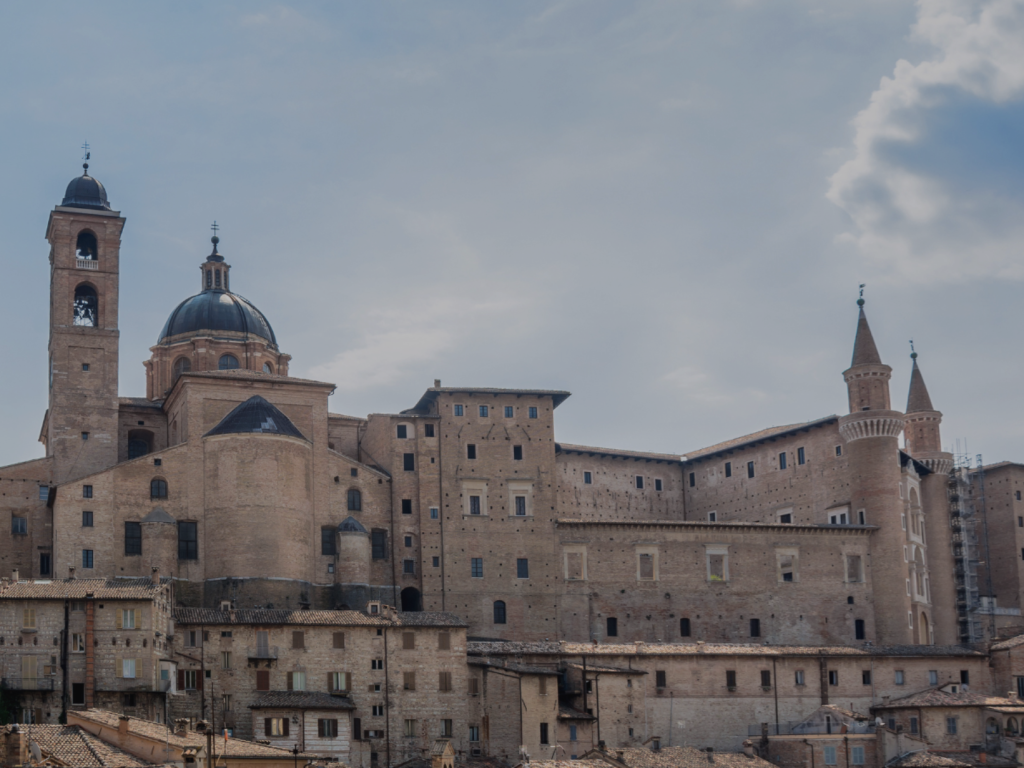
As you stroll through Urbino, it feels as though you can still hear, amongst the walls and the brick and sandstone buildings, the echo of little Raphael’s joyful footsteps. A sound that spreads through the narrow alleyways and over the decorative stones, resonating right into the secret chambers of what was described not as a mere building, but as a veritable ‘city in the form of a palace’.
At number 57 Via Raffaello, the door to the birthplace of the Divine Painter opens. On the ground floor, visitors can explore the rooms of the workshop where his father, Giovanni Santi, used to work, whilst the upper floors reveal the elegance of a bygone era, with coffered wooden ceilings and 16th-century fireplaces made of local stone that once warmed the early years of the genius.
In the room believed to be Raphael’s birthplace, the enchanting fresco of the Madonna and the Sleeping Child takes centre stage. A work characterised by warm colours and bathed in a divine light, it is key to understanding the artistic sensibility that the young Sanzio was developing within these very walls.
The spirit of the Renaissance hovers over the city’s undulating landscape, welcoming visitors with the fresh, pure air of that ‘turquoise sky’ which also enchanted Giovanni Pascoli. The poet dedicated the famous verses of *L’aquilone* to Urbino la Ventosa, celebrating the ethereal charm and light that only this city can offer.
Urbino is not just a city, it is an idea: it is the Renaissance, constantly renewing and evolving. Today, this heritage is transformed into contemporary well-being, offering an unspoilt area where art is immersed in a healthy, intact and unspoilt environment, far from the clamour of modern life.
A place of the soul where balance and authenticity reign, Urbino has become the ‘Home of Poetry’ and of the good life. This commitment to wellbeing is epitomised by Biosalus, the national organic festival, which finds its ideal setting here, celebrating a simple and harmonious way of life amongst the surrounding villages and hamlets.

Discover the charms of Urbino
The Beauty Trail comes to life
Exploring the beating heart of the Marche region has never been easier with Criluma Viaggi!
Romantic weekends, days spent immersed in nature or cultural tours: we’ve put together itineraries to suit all tastes and time constraints.
Urbino: the ideal city in the form of a palace
The cradle of the Renaissance
In Urbino, everything is art, everything is magic; everything comes together in the absolute perfection of the ideal city; every cobblestone, every flight of steps, every portico exudes poetry.
Nestled amongst the hills of the Metauro Valley, the city appears like a sudden vision, with its Palazzo Ducale—‘not a human creation, but a divine one’, as described by the painter Giovanni Santi, Raphael’s father—which stands out against the horizon, fully immersed in the nature that embraces and envelops it. The historic heart of the city, a bustling cosmopolitan centre, has remained intact.
As you stroll, enjoying the sun as it appears and disappears between the closely packed rooftops, gazing out over the surrounding hills, holding firmly to the wrought-iron handrails protruding from the walls of the houses to avoid slipping down the steep steps ill-suited to the human foot, but ideal for the hooves of the horses that passed through here in the Duke’s time, one cannot help but be captivated by the Marche region’s only World Heritage Site.
A marvel of art and harmony, where the soul of the era permeates the air, with its ancient Renaissance charm – the true spirit of Urbino and its people.
Mathematical and geometric beauty blends with the multifaceted elegance one senses upon crossing the threshold of the Ducal Palace, that city in the form of a palace, where Castiglione illustrates the charm of the court of Guidobaldo da Montefeltro and Elisabetta Gonzaga in his famous *The Courtier*; that ideal city where the perspective, harmony and balance of the early Renaissance come together in the perfection of a place that is no longer a fortress, but rather an open, shared space, governed by rational and precise architectural rules, clearly outlined in the painting *The Ideal City*.
Urbino is Federico da Montefeltro; it is the embodiment of the Duke and his enlightened rule, shaped by the principles of trust.
The historic University
A student-friendly city
The history of Urbino, with the Montefeltro family at the heart of the Renaissance, is inextricably linked to the long-standing tradition that characterises the historic University of Urbino “Carlo Bo”, one of the oldest in Italy, with its more than five hundred years of distinguished existence.
It was in 1506 that Guidobaldo, son of Federico, established the College of Doctors of Urbino, and it was in 1507, by a papal bull issued by Pope Julius II, that the newly established academic body in Urbino was authorised to confer degrees in law, poetry and medicine.

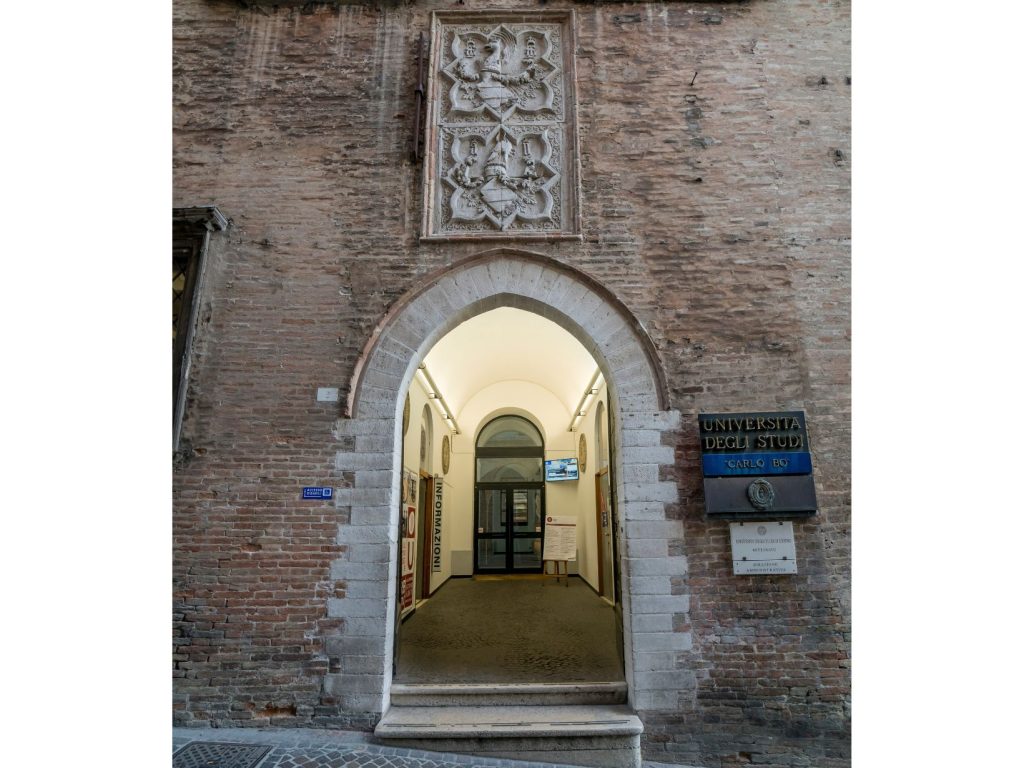
A city of culture, where the layout of the campus buildings blends seamlessly with the surrounding natural landscape, harmonising perfectly with the exquisite urban setting of Renaissance Urbino.
Today, more than five centuries on, the university boasts an international dimension, with over a thousand international students enrolled – around 7 per cent of the total – a figure double the national average, thanks to the excellent hospitality with which Urbino has always welcomed young minds to be educated, nurtured and shaped: a great honour and a source of immense prestige for the city, which, over the past year, has seen its student enrolment rise to over fifteen thousand, thus exceeding the number of its own residents.
The Spirituality of Urbino
Between the majestic cathedral and the treasures housed in the oratories
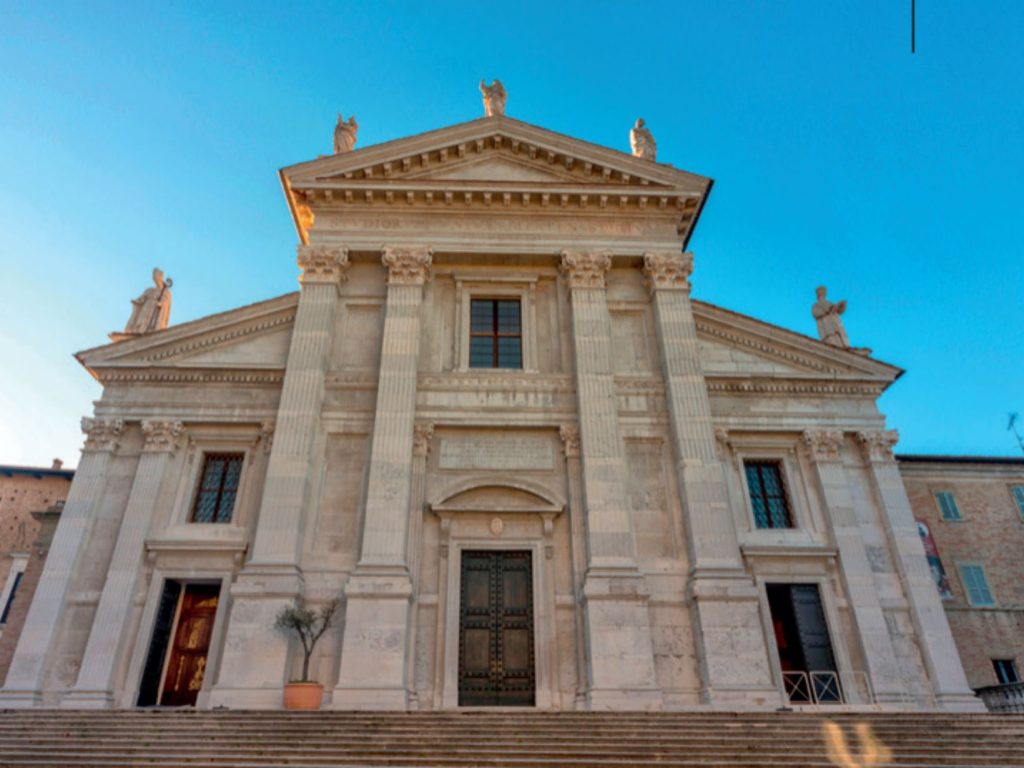
On certain sun-drenched days, with the blue sky just streaked with golden hues of light, standing before the grand staircase leading up to Urbino Cathedral leaves one speechless at the spectacle unfolding before one’s eyes and at the wonder and perfection that man has been able to achieve through his work.
The church, dedicated to Santa Maria Assunta, stands in the historic heart of the city, alongside the Ducal Palace. On the imposing façade, which contrasts with the brick colours of the surrounding buildings, stand seven majestic statues: these are the three theological virtues (Faith, Hope and Charity), Saints John Chrysostom, Augustine, Crescentino, the patron saint, and the co-patron, Blessed Mainardo.
. It is only right to say a few words about two other outstanding examples of Urbino’s cultural landscape, namely the Oratory of San Giovanni and the Oratory of San Giuseppe.
The first, described by the people of Urbino as ‘a little Sistine Chapel’, is home to a pictorial gem painted by the brothers Lorenzo and Jacopo Salimbeni: it is a cycle of frescoes dating from 1416 which, today, after more than six centuries, retains all its splendour and brilliant colours.

The Crucifixion and the Story of St John the Baptist are true masterpieces: even the most inattentive observer cannot help but be struck by the expression of grief, the furrowed brow of the Virgin Mary, and the precision with which the various strokes of colour blend into one another. The Oratory of St Joseph, meanwhile, houses a spectacular stucco Nativity scene dating from 1560, created by Federico Brandani. It is a work unique in its kind, in which the figures of the Nativity take on natural features: the meticulous attention to detail blends with the effects created by the light streaming down from above; at the end of the day, beams of light fall upon the child, causing him to glow with his own energy and fully realising that magic which only a depiction of the Nativity can bring to life.

Postcard from the Doge’s Palace
A journey through the rooms of an enchanted palace
Set at the very centre of the Ducal Palace’s marvellous roof garden is a rare example of a concave sundial, the result of the mathematical teachings of Urbino’s Renaissance scholars, which blends in perfect harmony with the five large raised flowerbeds containing rare botanical species.
This attention to detail is evident in every aspect of the Palace and is meticulously executed, as seen in the innovative plumbing systems of the underground chambers which housed the activities related to the running of the Court, complete with stables, kitchens and even Federico’s private bathroom, situated directly beneath the most private part of the building: the two rooms comprising the Chapel of Forgiveness and the Temple of the Muses, and the Studiolo.
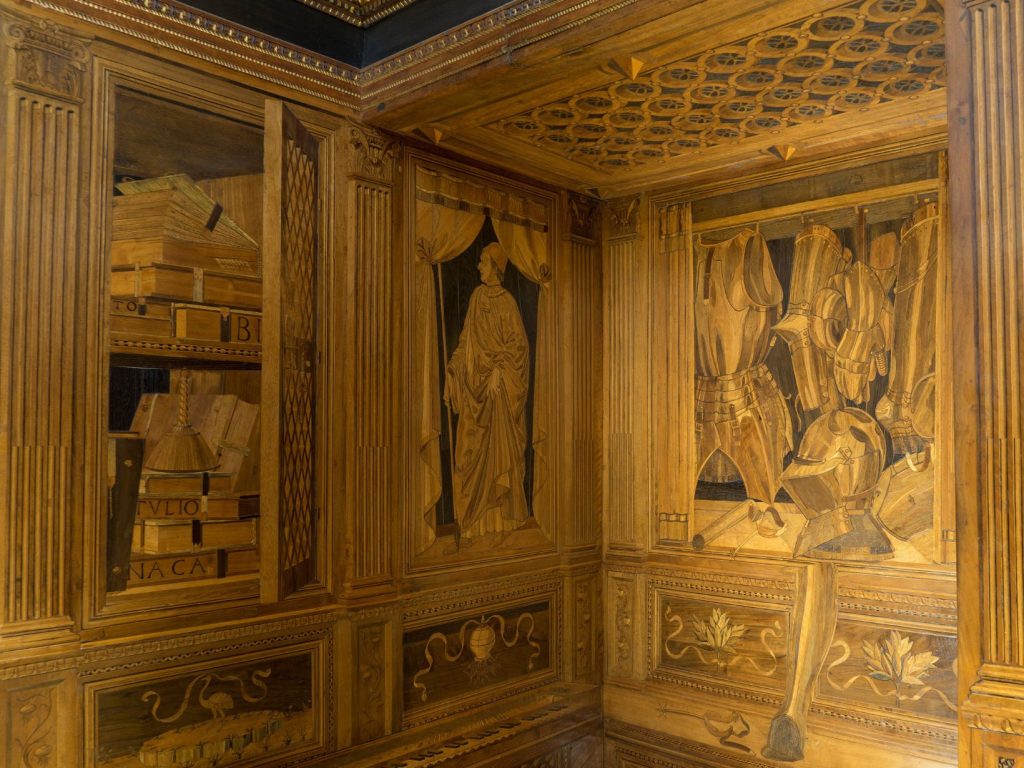
The latter is the most famous room in the entire Palace, a treasure-trove of immeasurable beauty – a beauty that flows across the richly inlaid wooden walls, through the harmonious arrangement of objects depicted in perspective and portraits of learned men who inspired the mind, actions and spirit of the Duke.
Here he gathered all his learning and his thirst for knowledge: in this intimate and private study, he read legal texts, works on geography and mathematics, and Greek and Latin classics.

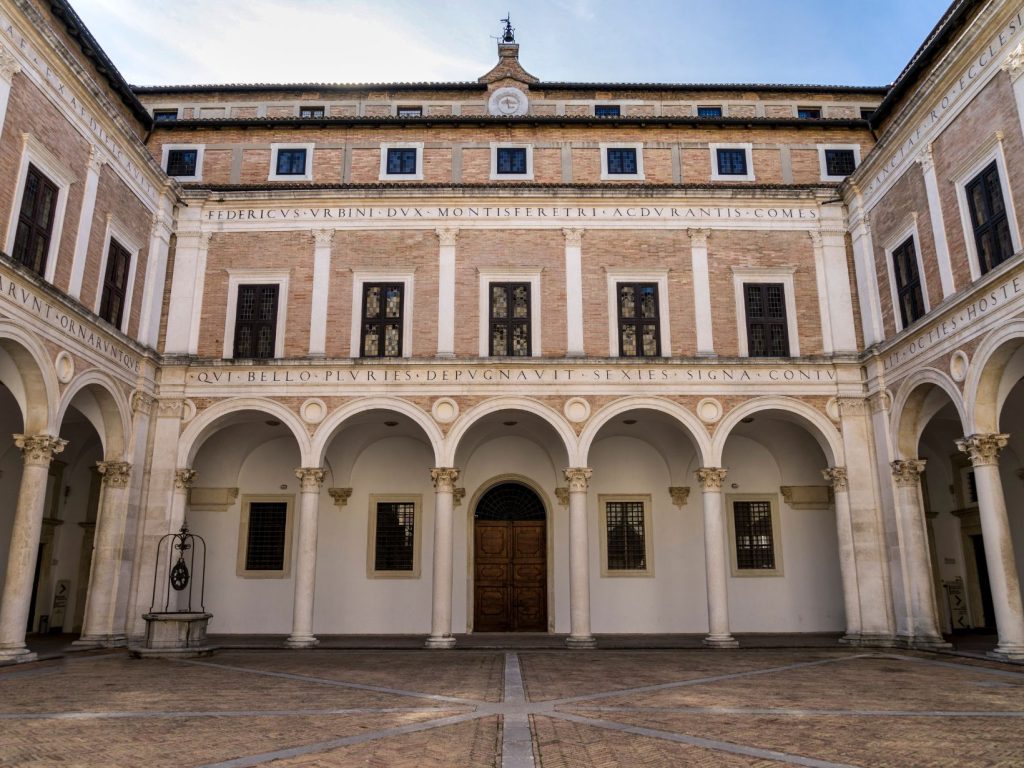
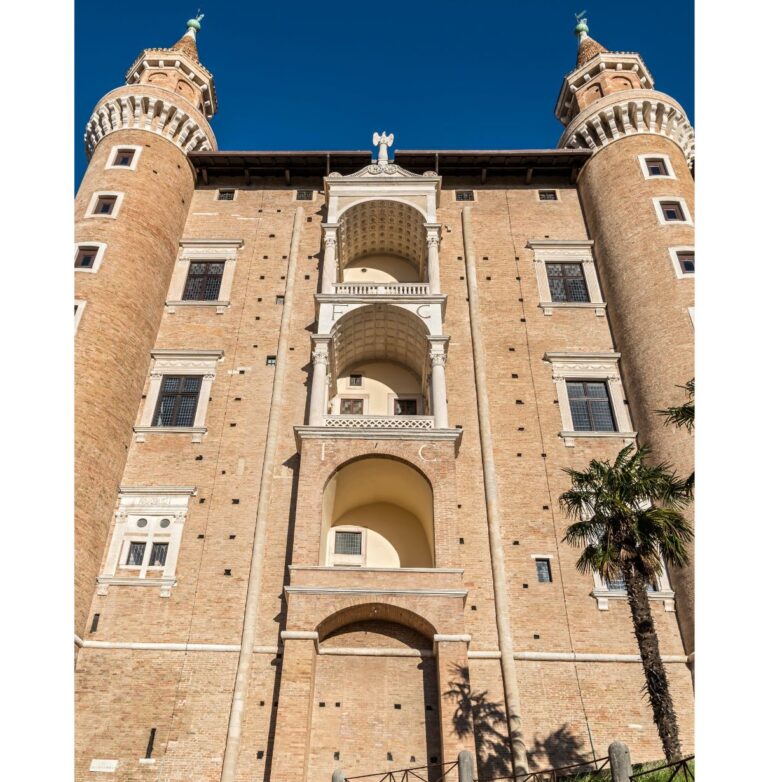
The Ducal Palace, with its unmistakable appearance, embodies the ideals of the Renaissance in its geometric, rational and perspectival structure.
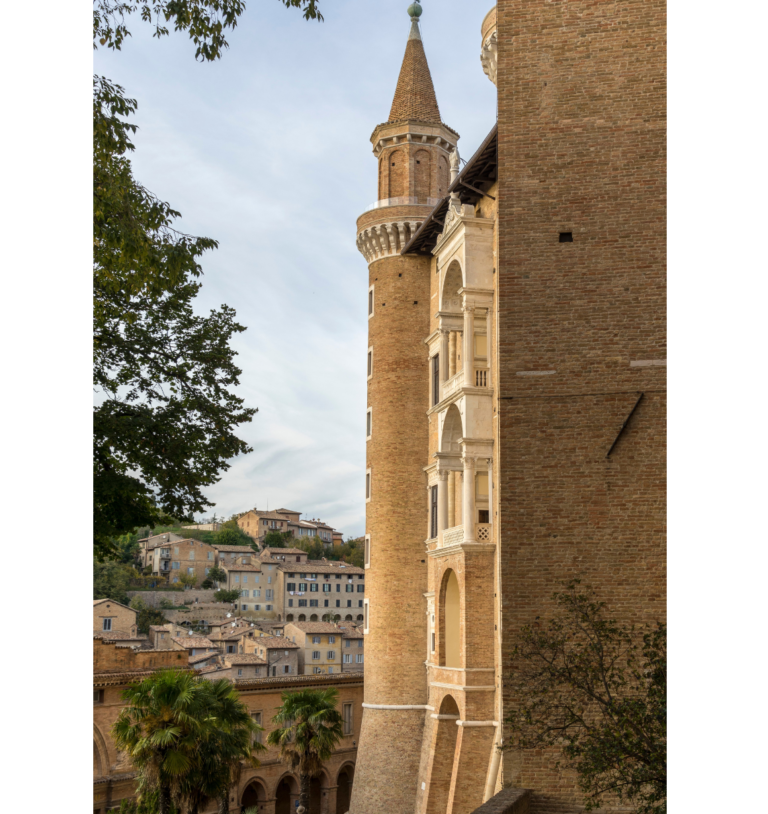
The way it extends in all directions, adapting in each instance to the surrounding landscape; the Torricini façade, a symbol of the city; the courtyard of honour with its arrangement of arches and columns; and the interplay of colour shades ranging from brick red to the lighter ‘Travertine from Monte Nerone”) all make the Ducal Palace, designed by Luciano Laurana and Francesco di Giorgio Martini, a jewel nestled within the city.
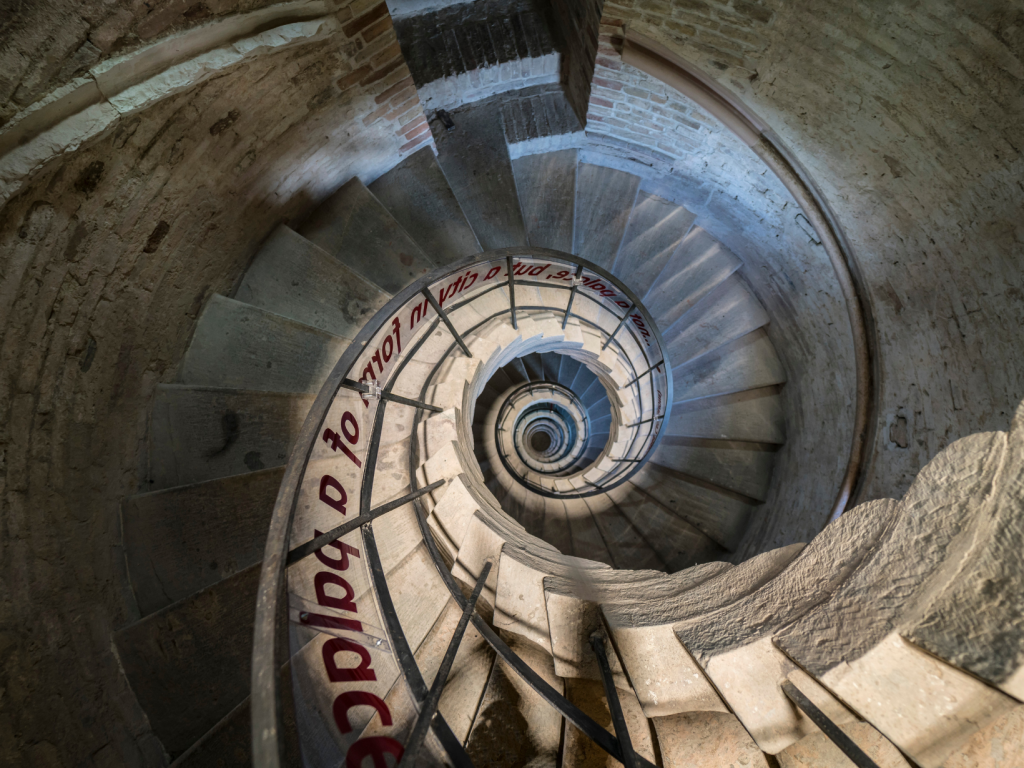
In the palace’s fairytale-like North Tower, which is open to the public, you can climb the spiral staircase to reach the top balcony and enjoy the marvellous, unspoilt surrounding landscape – the very same one depicted in the paintings of the greatest artists of the period.
Today, the Palazzo Ducale houses the National Gallery of the Marche, a veritable treasure trove of priceless works of art. Here are preserved the masterpieces of artists such as Piero della Francesca, Paolo Uccello, Pedro Berruguete, Giusto di Gand, Luca Signorelli, Titian, Federico Barocci and, above all, Raffaello Sanzio, whose splendid *Muta* is on display in the Duchess’s apartment.
Contemporary Art and Renaissance Treasures
Exploring Confcommercio’s permanent exhibition and the charm of the Albani Museum in the Ducal City
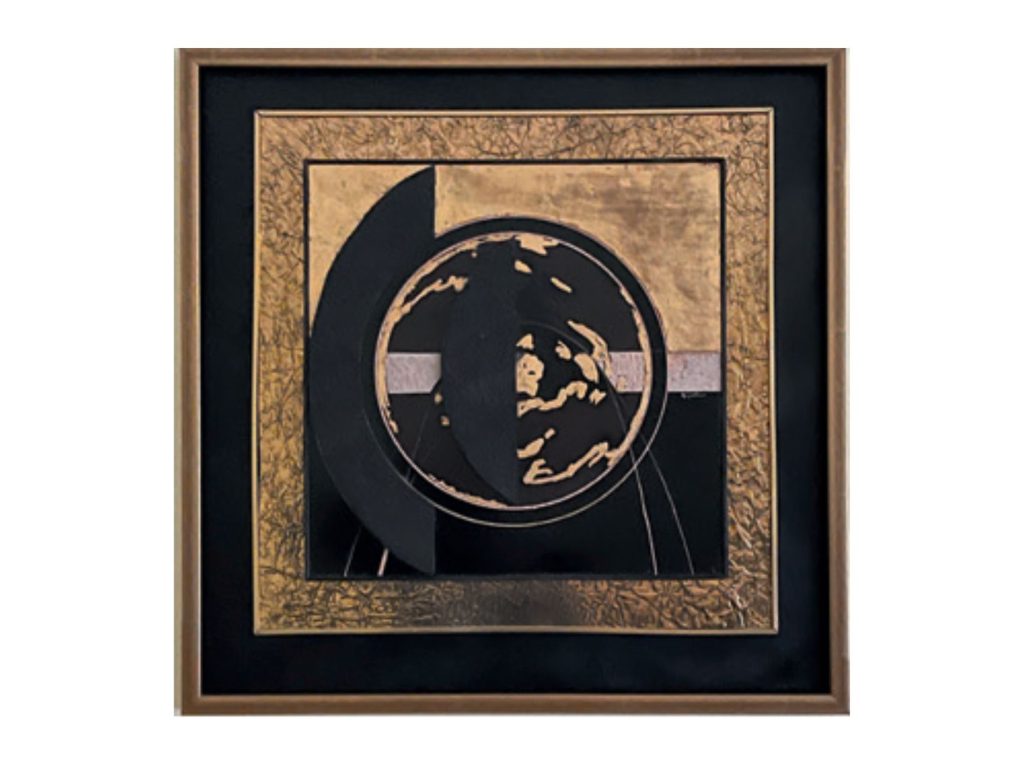
The Confcommercio headquarters in Urbino could not be situated in a more picturesque location: at number 12 Via Vittorio Veneto, in an elegant 19th-century building, just a stone’s throw from Piazza della Repubblica, the nerve centre of city life and the crossroads of Urbino’s main streets.
Inspired by this vibrant atmosphere, a permanent exhibition of contemporary art has been created within the building, curated by the Urbino Arte Association, chaired by Vitaliano Angelini.
The gallery exhibits works by artists who live and work in the ducal city and throughout the Marche region. Paintings, sculptures and engravings are displayed in succession, skilfully combining the lessons of the old masters with new trends and the originality characteristic of each artist.
The Albani Museum offers a fascinating journey through the rich artistic heritage of the Archdiocese of Urbino-Urbania-Sant’Angelo in Vado. Named in honour of the Albani family, who contributed to the ‘treasure of the Cathedral’, the museum has been housed in the Bishop’s Palace since 1964. Its recently refurbished exhibition features ecclesiastical artefacts dating from the 13th to the 19th century, including illuminated manuscripts, chalices, reliquaries, majolica, porcelain, amber, gold, silver, crystal and liturgical vestments woven with precious metals.
Works such as panel paintings, canvases and sculptures recount the history of the Urbino Renaissance up to the city’s cultural heyday between the 17th and 18th centuries. The Oratorio della Grotta, which forms part of the museum, offers a liturgical itinerary that retraces the stages of Christ’s life, much like a pilgrimage to the Holy Land.
The Chapel of Calvary houses a 16th-century sculptural group depicting the Lamentation over the Dead Christ, reflecting the faithful’s personal participation in the ‘experience of the tomb’. In the third chapel, an extraordinary Pietà in marble and stone, commissioned by Francesco Maria II Della Rovere, Duke of Urbino, captures the moment following Christ’s death with great realism.
Amidst green secrets and authentic
flavours
A botanical and gastronomic history
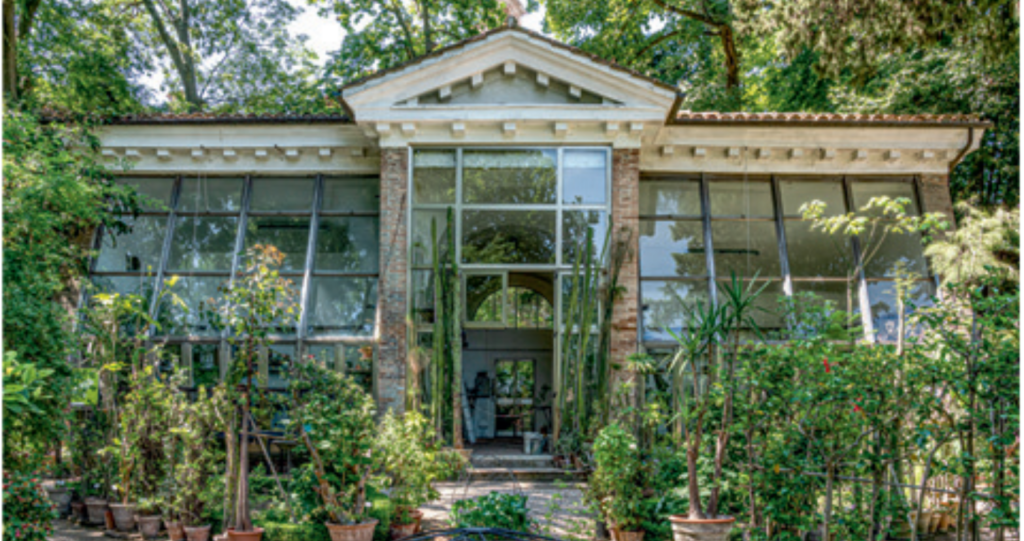
The Carlo Bo Botanical Garden of the University of Urbino is an enchanting green oasis in the heart of a fortified town, recognised as a site of historical, artistic and architectural interest by the Ministry of Culture in 2023.
Founded in 1809 on a site that was once the main garden of a Franciscan monastery, the Botanical Garden bears witness to the region’s tumultuous history during the Napoleonic period. Its founder, Giovanni de Brignoli da Brunhoff, a passionate botanist, made a significant contribution to the creation of the garden for medical and agricultural purposes. The greenhouse, built in 1813, now houses potted plants during the winter and serves as an exhibition space during the spring and summer.
Over the years, the garden passed from religious ownership to the local council and finally, in 1844, to the University. The current façade, in the Neoclassical style, dates from 1848 and is the work of the architect Ercole Salmi, also known for designing the theatres in Urbania and Gubbio. The entrance features a vaulted ceiling with frescoes attributed to Quinto Possenti (1861–62) and a polychrome stained-glass window that welcomes visitors.
As well as housing a variety of plant species from all over the world and native to the area, the botanical garden is also a cultural venue hosting exhibitions of painting and sculpture, as well as theatrical performances, thereby contributing to the enrichment of Urbino’s artistic and natural heritage.
The Urbino area is an unspoilt place, where over half of the agricultural land is farmed organically, and where the local cuisine is of the highest quality, increasingly linked to organic produce and local specialities.
Among the many delicacies you can enjoy, we’d like to highlight two specialities that are absolutely not to be missed: the ‘crescia sfogliata’ and the ‘Casciotta’. Urbino’s ‘crescia sfogliata’ is a refined, rich dish that originated during the Renaissance, between the 15th and 16th centuries.
Flour, eggs and lard of the very highest quality, thoroughly blended, kneaded and baked by hand, make the ‘crescia sfogliata’ one of the most beloved local specialities. And what about Casciotta d’Urbino PDO? That cheese whose very name evokes authenticity, originality and uniqueness, with that ‘c’ kissed by the ‘s’.
Its alluring flavour, its indescribable delicacy, and the taste and aroma of the blend of cow’s and sheep’s milk evoke the pastures of the Urbino countryside.
A food that is a source of inspiration, energy and creativity. It is said that Michelangelo Buonarroti was particularly fond of this cheese.


Discover the beauty of Urbino
The Beauty Trail comes to life
Exploring the beating heart of the Marche region has never been easier. Criluma Viaggi is proud to bring to life Confcommercio Marche Nord’s ‘Itinerario della Bellezza’ project, transforming a guide to excellence into real-life itineraries, ready for you to experience.
Romantic weekends, days spent immersed in nature or cultural tours: we’ve created itineraries to suit all tastes and time constraints. The Criluma experience is the added value that guarantees you first-class treatment, comprising continuous support, personalised attention and immediate responses.