Descrizione
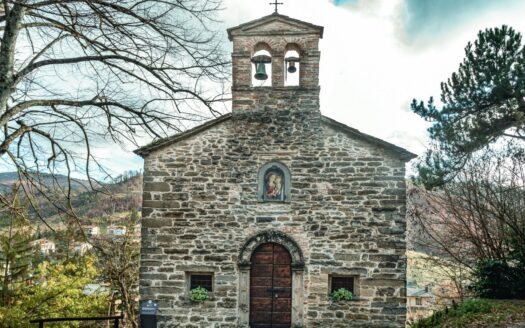
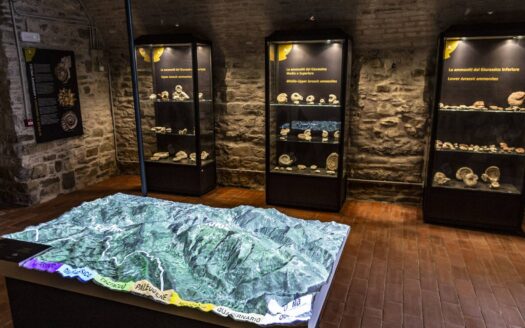
Although it is not implausible to think that a medieval structure may have stood on the site, work on Palazzo Ubaldini began under Ottaviano Ubaldini (Gubbio 1422 – Cagli 1498) in 1477. Following his death in 1498, there were no further records of the palace until the end of the following century, when Gentile II Ubaldini (Apecchio, d. 1543), Count of Apecchio, decided to renovate it as it had fallen into a state of disrepair. The Counts of Apecchio, in fact, frequently resided in their palace in Gubbio because they did not own a habitable residence within their own territory. The site on which the building now stands originally comprised the two Ubaldini residences, belonging respectively to the Montevicino and Montefiore branches of the family. Documents from the period allow us to trace their original locations, as we know that the palace of the Counts of Montevicino was situated on the left-hand side, next to the parish church, whilst that of the Montefiore family was on the right-hand side, next to the Porta del Castello (probably the current emergency exit of the Fossil Museum). Count Gentile decided to unite the two residences into a single palace and completed the work in 1588. Evidence of this alteration can still be seen in the underground rooms that now house the Fossil Museum, which were then used as service quarters where the servants carried out their daily tasks.

At the time of the papal occupation of Apecchio (1752), the palace was confiscated by the Reverend Apostolic Chamber and renamed the Apostolic Palace. During this period, the rooms were occupied by soldiers of the papal garrison and the podestà. On 3 June 1781, the entire region was shaken by a powerful earthquake, estimated to have been of magnitude 9–10 on the Mercalli scale, with its epicentre at Monte Nerone. Among the numerous casualties and extensive damage, the earthquake also caused the palace to collapse. However, restoration work began immediately the following year, as the collapse had not affected the load-bearing walls. We know that between 1818 and 1821, a severe epidemic of typhus spread across the entire peninsula, affecting Apecchio as well, and making it necessary to use the undamaged rooms of the palace as a hospital to admit and isolate the sick. A few years later, in 1833, the building was registered in the land registry and described as comprising five rooms on the ground floor and seven on the first floor; it was noted, however, that it was not being used for any purpose. Consequently, as restoration work by the Reverend Apostolic Chamber was deemed unfeasible, Pope Gregory XVI granted the building to the Municipality of Apecchio on 10 December 1841 for the purpose of using it as the town hall. This use has remained largely unchanged to the present day. Since 1977, the building’s underground chambers have housed the collections of the Monte Nerone Fossil Museum. Over the last two decades, it has undergone a complete restoration of both the courtyard and the rooms on the upper and lower floors.