Descrizione
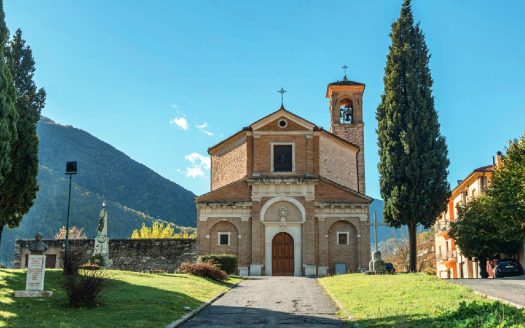
Located on a hill south-east of Piobbico, on the slopes of the suggestive Monte Nerone and on the edge of the wild gorge of Infermaccio, the Sanctuary of Santa Maria in Val d’Abisso has ancient roots linked to popular devotion to an image of the Madonna, according to tradition brought down to the valley by shepherd children. Its history dates back to at least the eleventh century, with the first documentary mention in 1063 as “Santa Maria in Mavi”. Over the centuries, the sanctuary has been subject to expansions, renovations and restorations, also following the earthquake of 1789.
The architecture of the sanctuary, in Romanesque-Gothic style, has a sandstone façade and a single-nave interior, with a polygonal apse. Among its most significant works of art are the “Madonna and Child” of the Umbrian school of the fifteenth century, the “Crucifix” by Giovanni Santi of the same period and the “Annunciation” by Perugino of the sixteenth century. The sanctuary was also chosen as a burial place by members of the Brancaleoni family.
In addition, other artistic treasures are preserved inside, including a majolica crucifix by Valerio Valeri of Civita Castellana and a sixteenth-century fresco depicting the Madonna. This sacred place represents not only a spiritual point of reference, but also an important testimony of the art and history of the region