Descrizione
The collections of the National Gallery of the Marche are displayed in a setting that is unique in the world: the splendid Ducal Palace in Urbino, commissioned by Federico da Montefeltro to honour his family and, at the same time, as an expression of his personality as a Renaissance man, who combined culture with military prowess and political skill.
Federico came to power in the State of the Montefeltro in 1444. As the legitimised son of Count Guidantonio, he succeeded the legitimate heir, his half-brother Oddantonio, who had been killed in a revolt. His political acumen and moderation immediately made him a prince well-regarded by his subjects and the Italian courts: under his rule, Urbino became, within a few decades, one of the beacons of the Italian Renaissance.
It is to him that the city of Urbino owes its distinctive character during this period. Thanks to his refined choice of decorators – mainly from Florence and Lombardy – and of avant-garde artists and architects such as Piero della Francesca and Leon Battista Alberti, Federico brought about a definitive transformation of the cultural and urban landscape.
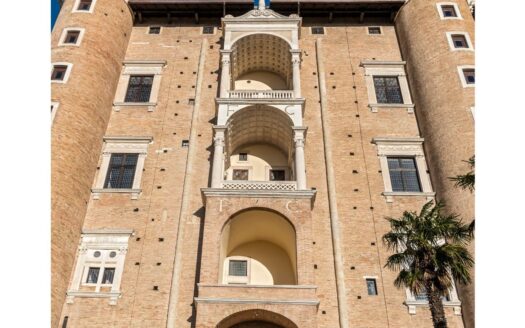
The Ducal Palace underwent several phases of development, to which the Dalmatian architect Luciano Laurana made a key contribution; it is to him that we owe the fairy-tale turrets. By 1459, Federico had already begun the extension and redecoration of the modest existing residence of the Counts of Montefeltro.
He began with the wing facing what is now Piazza Rinascimento, characterised by its long façade adorned with mullioned windows, which corresponds internally to the Appartamento della Jole, so named for the imposing fireplace in the first room, adorned with figures of Hercules and Jole. The decoration of the rooms in this part of the palace, of extraordinary quality, is the work of Tuscan craftsmen, such as Michele di Giovanni da Fiesole, known as ‘il Greco’. This wing houses the palace’s only frescoed room; otherwise, the walls were ‘covered with simple whitewashed plaster in accordance with modern practice’ (Bernardino Baldi, 1587); these were not decorated but covered with fabric wall hangings or, more often, with embossed and gilded leather, or with tapestries.
The palace has a functional layout, designed by the Duke’s engineer and military architect, the Sienese Francesco di Giorgio Martini. The ‘technical’ aspects of the construction and the modernity of the residence can be particularly appreciated by visiting the cellars, the kitchens, the icehouse and the service areas, which reveal the organisation of a structure capable of accommodating an army of servants and an extremely wealthy court.
Adjacent to his private chambers, in the central core of the palace between the two small towers, the Duke had commissioned the splendid inlaid study, a testament to his cultural refinement.
Also directly accessible from his rooms were the Chapel of Forgiveness, previously attributed to Bramante, and a small temple dedicated to the Muses, painted by the court painter Giovanni Santi, Raphael’s father.
This section – a compact and refined synthesis of the qualities and interests of the Renaissance man (scholarship, arms) – stands in contrast to the magnificent refinement of the apartments and the immense Salone delle feste, later known as the Throne Room during the era of the papal legates.
The palace’s extraordinary Renaissance balance is most perfectly expressed in the stunning Courtyard of Honour, where the colour combinations of light stone and brick punctuate the carefully calculated harmony in the arrangement of the building’s compositional elements. The inscription running along the frieze above the arches commemorates Federico’s glory as a condottiere and prince.
One of the palace’s greatest treasures was its rich library of illuminated manuscripts, the most splendid of its time, to which Federico devoted a substantial portion of his income as a condottiero. At the time of Federico’s death, the library housed no fewer than 900 codices; the collection was purchased by Pope Alexander VII in 1657 for the Vatican Library.
In 1474, Federico received the coveted title of duke from Sixtus IV della Rovere, and the proud inscription ‘FE-DUX’ has featured prominently on many parts of the palace ever since.
On the Duke’s death in 1482, the culture and refinement of the court of Urbino passed to his son Guidubaldo and his wife Elisabetta Gonzaga. With them, the Montefeltro dynasty came to an end, passing through the female line to the Della Rovere branch.
The second floor of the palace, which was renovated and raised in the mid-sixteenth century at the behest of Guidubaldo II Della Rovere, currently houses the collections of seventeenth-century paintings, prints and ceramics.
One of the earliest 16th-century additions is the Hall of the King of England: the gilded stucco ceiling, the work of Federico Brandani, features all the emblems, coats of arms and honours of Duke Federico and his family.
The duchy prospered until 1631, when it passed under the control of the Church. Vittoria della Rovere, the last of the dynasty, took the entire ducal ‘Guardaroba’ with her to Florence, where she married her cousin Ferdinando de’ Medici.
The magnificent collections from the palace in Urbino are now largely housed in the Uffizi Gallery. The ‘Illustrious Men’ from the studiolo, however, ended up in the Barberini Collection (part of which is now in the Louvre).
The presence of a significant collection of archaeological artefacts, assembled by Cardinal Francesco Stoppani in 1756, has led to the establishment of a Lapidary Museum within the Gallery, situated on the ground floor.
For further information, please refer to the official guide to the Galleria Nazionale delle Marche, available for purchase at the bookshop on the ground floor.